.png)
Six Week Clinician Plan for Rosacea: Red Light Therapy in Australia

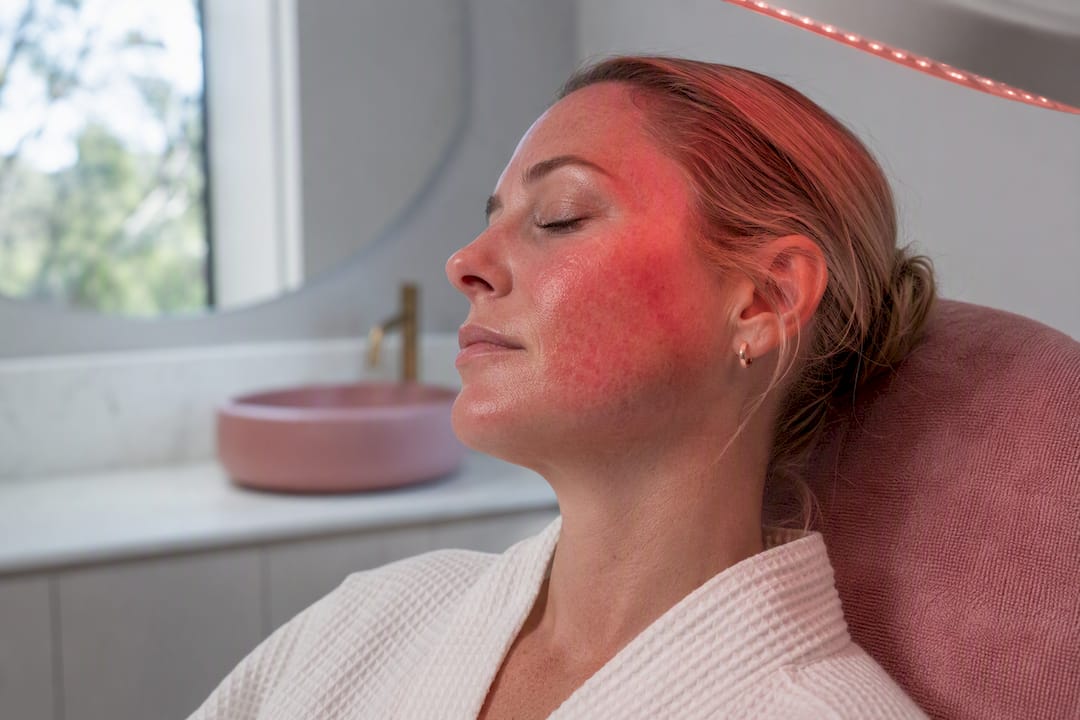
Red light therapy can genuinely help rosacea, but it works as an adjunct, not a cure. Used alongside your existing skin plan, it can calm inflammation and ease transient flushing, though it won’t erase the visible broken capillaries known as telangiectasia. Clinics typically work with yellow light near 590 nm, red light between 630 and 660 nm, and near-infrared between 810 and 850 nm, and clinical-grade devices deliver a stronger, more consistent dose than most at-home tools. Talk to a dermal clinician before starting, and expect to wait six weeks or more before you see meaningful change.
TL;DR:
Red light therapy can reduce inflammation and flushing in rosacea patients when used as an adjunct to existing treatments, especially for papulopustular and erythematous subtypes.
Clinical evidence shows about a 66.7% success rate when combined with medication, but most studies are small, varied, and involve treatment protocols that differ widely.
Wavelengths matter: yellow, red, and near-infrared lights target different skin layers and functions, but LED mainly calms inflammation rather than collapsing visible blood vessels.
Typical supervised courses last six weeks with two to three sessions per week, using clinical-grade devices that deliver consistent, regulated doses.
LED therapy is safest when combined with professional assessment and appropriate treatment planning, avoiding overuse and devices that run too hot or lack proper eye protection.
Table of Contents
Does Red Light Therapy Help Rosacea? What the Clinical Evidence Shows
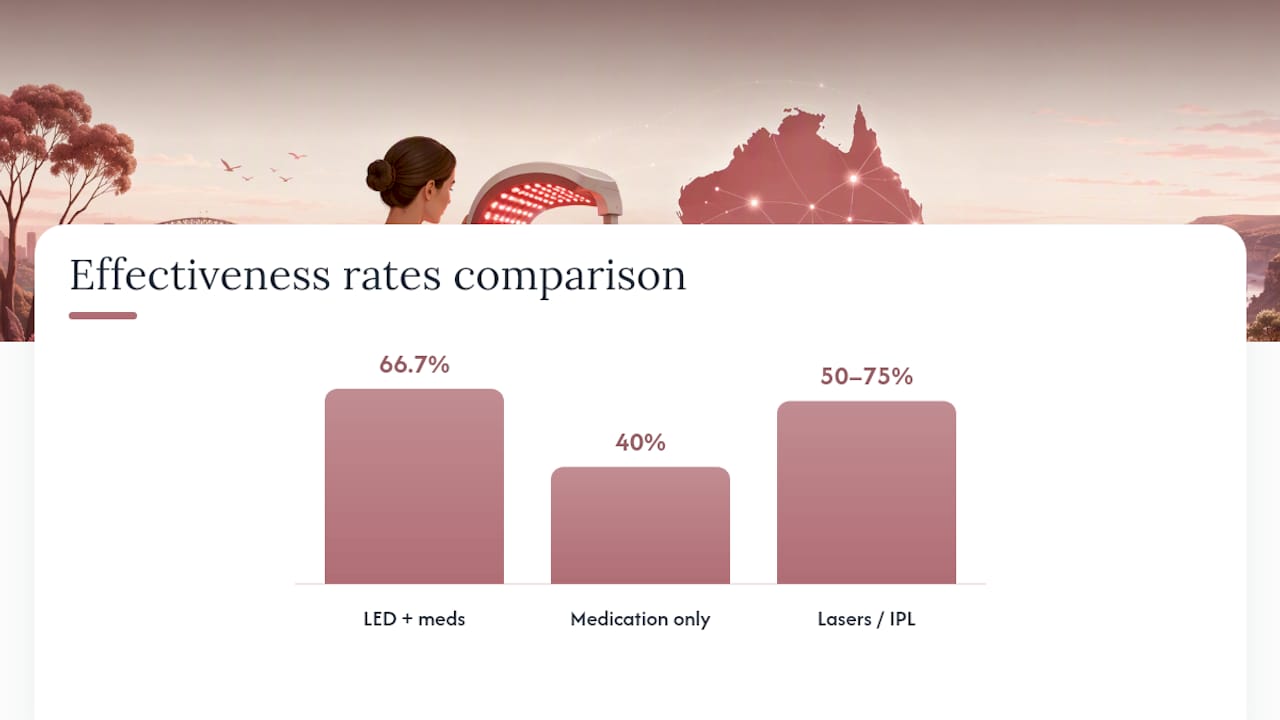
The strongest data point comes from a 2025 retrospective clinical observation that tracked rosacea patients using LED therapy alongside hydroxychloroquine and topical treatment. The combination reached a 66.7% effective rate, compared with 40% for medication alone. That’s not a marginal bump. It suggests LED is doing real work when layered onto an existing medical plan, not just adding a placebo glow.
Case-level evidence tells a similar story on a smaller scale. Two published case reports used coupled blue (480 nm) and red (650 nm) LED, twice weekly for ten sessions, and both patients showed clinical improvement in papulopustular rosacea, the subtype marked by inflamed bumps and pustules rather than just redness. Separately, small postmarket studies of biophotonic light platforms have reported reduced facial erythema and better patient-reported satisfaction in similarly modest cohorts.
Here’s the honest caveat: this evidence base is still young.
Most published studies involve small patient groups, often a handful to a few dozen.
Protocols vary widely between studies. Wavelengths, session counts, and treatment intervals aren’t standardized.
The majority of trials test LED as an add-on to medication, not as a solo treatment, which makes it hard to isolate LED’s standalone effect.
Reviews of the photobiomodulation literature through 2026 echo this, describing the data as preliminary and heterogeneous, and positioning LED as adjunctive rather than a standalone, evidence-backed cure.
The comparison that matters most: vascular lasers and IPL remain the more established tools for visible blood vessels, with 50 to 75% reductions after one to three treatments, according to the American Academy of Dermatology. LED’s strength lies elsewhere, in dialing down inflammation and background redness, not collapsing dilated vessels.
How Red Light Therapy Works on Rosacea-Prone Skin
Photobiomodulation is the clinical term for what happens when specific light wavelengths hit skin cells. Red and near-infrared light get absorbed by cytochrome c oxidase, an enzyme inside mitochondria, which boosts ATP production and triggers a cascade that increases nitric oxide availability and shifts inflammatory signaling. For rosacea skin, that translates into calmer, less reactive tissue and better conditions for the skin barrier to repair itself.
Different wavelengths play different roles, and understanding this matters more than most patients realize:
Yellow light (around 590 nm) sits closer to the skin’s surface and is often favored early on for calming vascular reactivity without overstimulating already-sensitive skin.
Red light (630 to 660 nm) penetrates deeper into the dermis, supporting collagen activity and dialing back inflammatory mediators.
Near-infrared light (810 to 850 nm) reaches deeper still, working on inflammation at a tissue level that surface treatments can’t touch.
This is also where patient expectations need a reality check. LED does not generate the thermal energy that vascular lasers use to seal off and collapse dilated capillaries. It works through a biochemical, cellular pathway instead of a mechanical one. That distinction explains why LED reduces flushing and inflammatory bumps but leaves visible thread veins largely unchanged. If your main complaint is visible vessels rather than inflamed, reactive skin, LED alone won’t get you the result you’re picturing.
Realistic Red Light Therapy Protocols and Timelines
Clinical studies give us a decent template for what actually works. The case reports on papulopustular rosacea used twice-weekly sessions for a total of ten treatments, roughly five weeks of consistent exposure before assessing results. Other clinical LED protocols for skin conditions commonly run in that same range, several sessions per week over multiple weeks, rather than a single dramatic treatment.
Here’s roughly how a supervised course tends to unfold:
Initial assessment. A clinician evaluates your rosacea subtype, triggers, and skin barrier status before recommending wavelengths or frequency.
Induction phase (weeks one through six). Sessions typically run two or three times weekly, focused on calming inflammation and building tolerance.
Reassessment. Around the six-week mark, most published protocols report measurable change in redness or lesion count.
Maintenance phase. Ongoing, less frequent sessions to hold the gains, since rosacea is a chronic, trigger-driven condition rather than one you cure and forget.
Where you get treated matters as much as how often. Clinical-grade LED systems deliver validated, controlled irradiance and fluence, the dose and uniformity that published protocols were actually built on. Many consumer at-home devices operate at a fraction of that output, with far less independent testing behind them. That gap is a big part of why an at-home mask that promises salon results rarely delivers the same change a supervised course does.
Pro Tip: Track your redness with the same lighting and angle every two weeks using your phone camera. Rosacea flares are so tied to triggers, heat, alcohol, sun, that it’s easy to lose the plot on whether LED is actually helping unless you have a consistent visual record.
Which Rosacea Subtypes Respond Best to LED Therapy
Not every rosacea presentation benefits equally, and knowing where you fall changes what you should expect from a course of treatment.
Papulopustular rosacea (inflamed bumps, pustules) tends to respond well, matching the profile in the published case reports.
Background erythema and reactive, barrier-compromised skin often improve with LED’s anti-inflammatory action, especially when paired with barrier-supportive skin care.
Predominant telangiectasia, meaning visible, mapped-out blood vessels, is the subtype LED helps least. Vascular lasers and IPL are the better-established route here because they target the vessels directly rather than the surrounding inflammation.
A few groups should hold off on LED until they’ve spoken with a clinician: anyone on photosensitizing medication, anyone who’s recently had an ablative procedure like deep resurfacing, and pregnant patients, where caution is standard practice for most device-based treatments. None of these are permanent disqualifiers. They’re reasons to get assessed first rather than book a course on your own. If you’re unsure which category you fall into, a proper rosacea facial assessment that starts with your skin barrier, not just your redness, is the more sensible first move.
Is Red Light Therapy Safe? Side Effects and When to Stop
LED therapy has one of the gentler safety profiles among rosacea treatments, which is part of why it’s such a common adjunct. Most people experience nothing more than mild, transient warmth or a light flush during and immediately after a session. Severe adverse events are rare across the published studies.
That doesn’t mean every device or every session is automatically safe.
Watch for excessive heat coming off a device. Rosacea skin is thermally reactive, and heat itself can trigger flare-ups, so a device that feels hot rather than mild is a problem.
Protective eyewear matters. Where a clinic or device manufacturer recommends goggles, use them. This is standard for higher-output clinical systems.
Stop treatment and contact your clinician if you notice sustained worsening of redness beyond the normal post-session flush, blistering, or any sign of skin infection.
The trade-off worth remembering: LED’s excellent safety record is precisely why it’s positioned as an adjunct rather than a replacement for vascular-targeted treatments. Gentle enough to layer onto a medical routine, but not powerful enough on its own to reach the 50 to 75% vessel reduction that laser and IPL treatments can achieve for visible vessels.
Combining Red Light Therapy With Other Rosacea Treatments
LED rarely works best alone, and the evidence backs that up directly. The retrospective study showing a 66.7% effective rate paired LED with hydroxychloroquine and topical treatment, not LED by itself. That’s the model worth copying: light therapy layered onto, not instead of, an existing medical plan.
A sensible sequencing approach looks like this:
Get background erythema and active inflammation under control first, typically with topicals or oral agents your clinician prescribes.
Use LED sessions to support that phase, reducing inflammatory lesions and calming reactive skin between other treatments.
If visible vessels remain the main concern once inflammation settles, that’s when vascular lasers or IPL enter the plan.
Keep LED running as a lower-frequency maintenance tool once your active phase winds down.
Whatever combination you land on, loop your clinician in before adding LED sessions to an existing prescription regimen. Some topical agents and oral medications increase photosensitivity, and your clinician needs the full picture to sequence treatments safely rather than reactively.
Choosing a Clinic or Device: What to Ask Before You Start
A good consultation should feel like a real assessment, not a sales pitch. Bring a short list of questions and expect clear answers.
What wavelengths does the device use, and why those specific ranges for my rosacea subtype?
What’s the irradiance and fluence, and is this a clinical-grade system or a consumer device?
Who operates the device, and what’s their training?
What course length and session frequency should I realistically expect before reassessment?
How does LED fit into my broader treatment plan, including any topicals or oral medication I’m already using?
Be wary of anyone promising a single-session transformation. Genuine photobiomodulation works cumulatively. Other red flags include devices that run noticeably hot, no eye protection offered when the system calls for it, and any clinic reluctant to coordinate with your dermatologist or GP. Fundamental Skin builds its LED protocols around a barrier-first assessment, tailoring wavelength and frequency to your specific rosacea presentation rather than running a one-size-fits-all course.
A Dermal Clinician’s Take on Using LED for Rosacea Safely
Rosacea clients come in wanting a quick fix, and LED simply isn’t that. What it is, when used correctly, is one of the most reliable ways to take the edge off inflammation without adding trauma to skin that’s already reactive. The approach that works is conservative: assess the barrier first, calm the inflammatory picture, then decide whether visible vessels need a separate, vascular-targeted conversation.
A typical in-clinic plan starts with a barrier-focused facial, moves into a course of red or near-infrared LED sessions, and often incorporates a biomimetic peel once the skin is stable enough to tolerate light exfoliation. Clients rarely see change in the first week. By week five or six, most notice calmer texture and fewer flare episodes, provided triggers are also managed outside the treatment room. LED earns its place in a rosacea plan by being patient and precise, not by promising something it was never built to deliver.
— chevonne
Book a Clinician-Led LED Session for Rosacea Care
Skip the guesswork of an at-home device with unknown output. Fundamental Skin’s Biomimetic Peel + LED Therapy pairs clinical-grade light with a barrier-first peel, so you get a calibrated dose instead of a consumer gadget’s best guess.

Every appointment starts with a proper skin assessment, not a generic protocol. Chevonne reviews your rosacea subtype, current triggers, and any topicals or medication you’re using, then builds session frequency and wavelength choice around that picture rather than a fixed package. Sensitive, reactive skin gets patch-tested first, and your plan gets adjusted as your skin responds over the induction weeks. If visible vessels turn out to be your main concern rather than inflammation, that gets flagged honestly rather than treated with more LED than it can fix. Ready to see where your skin actually stands? Book a Larimedical assessment and get a plan built around your specific rosacea presentation instead of a generic course.
Sources
This article is general information, not a substitute for advice from a qualified doctor. Consult a qualified healthcare professional about your own circumstances before acting on anything here.
Recommended
Comments