.png)
Overloaded Skincare Routine Red Flags: 10 Signs + Fix
- chevonne stewart
- a few seconds ago
- 10 min read
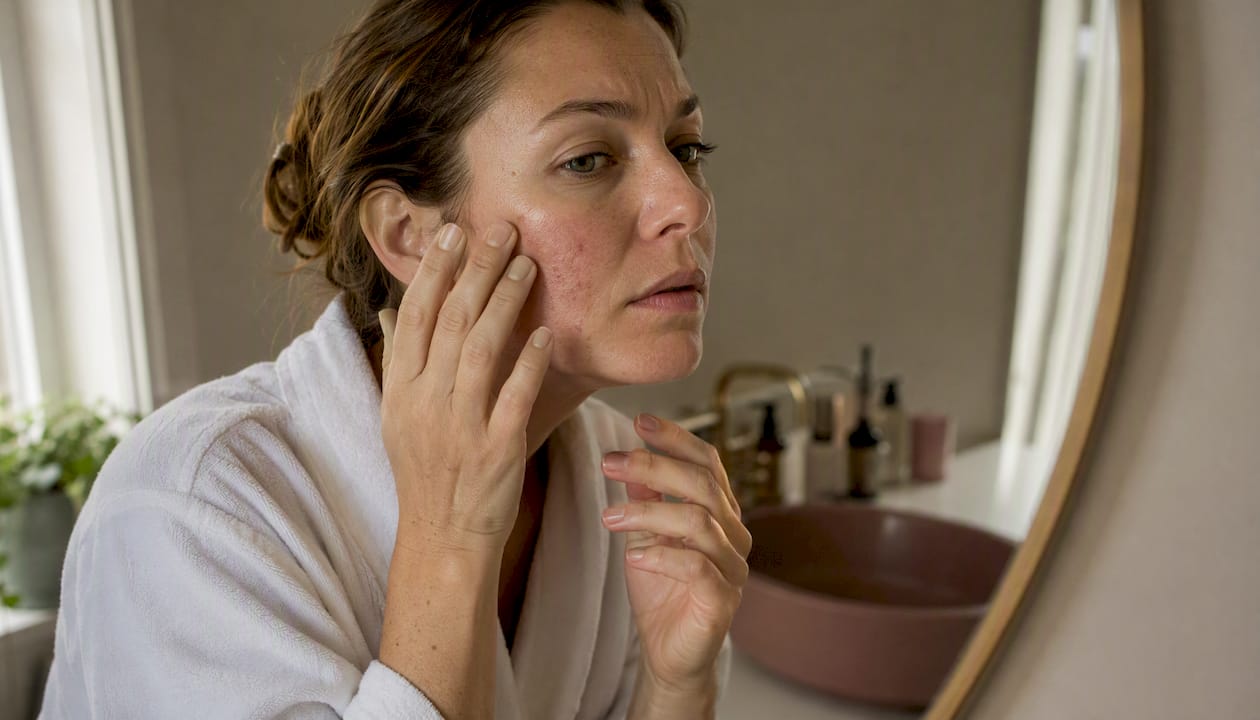
If your skin is burning, flaking, or breaking out more than usual, your routine is likely overloaded. Stop all actives now, strip back to three steps, and give your barrier at least one week—preferably up to two weeks if symptoms persist—to stabilize before adding anything back.
Here’s what to do in the next 24–72 hours:
Stop all active ingredients immediately. Retinoids, AHAs, BHAs, vitamin C serums, and exfoliating peel pads all go on pause. Continuing them on compromised skin prolongs the damage.
Return to a three-step routine. A gentle cleanser, moisturizer, and SPF are all your skin needs right now. Everything else is noise until the barrier heals.
Apply sunscreen every morning without exception. Actives increase photosensitivity, and even after stopping them, your skin remains vulnerable. SPF 30 or higher is the minimum.
Patch-test before reintroducing anything. Once symptoms settle, test each returning product on a small area for 48–72 hours before applying it to your full face.
Key Takeaways
An overloaded skincare routine is best addressed by stopping all actives immediately, returning to a three-step minimal routine, and reintroducing products one at a time with a 2–4 week gap between each addition.
Point | Details |
Stop actives first | Pause all retinoids, acids, and exfoliants the moment you notice burning, flaking, or spreading redness. |
Use only three steps | A gentle cleanser, ceramide moisturizer, and SPF 30+ are sufficient for barrier recovery. |
Reintroduce one at a time | Wait 2–4 weeks between each new product to isolate reactions and avoid repeating damage. |
See a clinician if symptoms persist | Redness or stinging lasting beyond 2–3 weeks on a minimal routine warrants professional assessment. |
Consistency beats complexity | Fewer products applied consistently outperform a long routine that overwhelms the barrier. |
Ready to get your skin assessed by a qualified Dermal Clinician? Book a personalized consultation with Fundamentalskin and get a plan built around your skin, not a trend.

Table of Contents
What are the red flags of an overloaded skincare routine?
Recognizing the signs of an overloaded skincare routine early prevents weeks of unnecessary recovery. The symptoms below are your skin’s way of communicating that its barrier is under stress.
The “angry skin trio” — the most diagnostic cluster
Burning or stinging, persistent tightness and flaking, and lingering redness appearing together are the clearest signal that your barrier is compromised. Clinicians refer to this cluster as the “angry skin trio.” If you experience all three at once, treat it as a firm stop signal, not a reason to add a calming serum on top of everything else.
Full symptom checklist
Symptom | What it signals | Immediate action |
Burning or stinging on application | Barrier disruption; pH imbalance | Stop all actives; switch to fragrance-free products |
Persistent redness that doesn’t fade | Chronic inflammation from overuse | Pause exfoliants; apply a barrier-repair moisturizer |
Tight, flaky, or peeling skin | Moisture loss; over-exfoliation | Add a ceramide or hyaluronic acid moisturizer |
New breakouts in unusual areas | Disrupted microbiome or clogged pores from heavy products | Simplify; avoid occlusive products on acne-prone zones |
Increased sensitivity to water or products | Severely compromised barrier | Use lukewarm water only; avoid all actives |
Skin that looks dull despite effort | Barrier stress suppressing natural radiance | Rest the skin; prioritize hydration over treatment |
Beyond the trio, watch for these additional warning signs:
Sensitivity to products that never bothered you before. When your toner or moisturizer suddenly stings, your barrier has thinned.
Skin that feels tight immediately after cleansing. A healthy barrier retains moisture; tightness means it’s failing to do so.
Persistent dullness despite using brightening actives. More product rarely fixes this. Overuse of actives can trigger chronic inflammation that suppresses your skin’s natural glow rather than enhancing it.
New breakouts in areas where you don’t normally break out. This often points to a disrupted skin microbiome or pore congestion from layering too many products.
Why do routines get overloaded in the first place?
Most overloaded routines don’t happen overnight. They build gradually, one well-intentioned product at a time. Understanding the common causes helps you avoid repeating the same skincare routine mistakes.
Over-exfoliation is the most frequent culprit. Using a chemical exfoliant daily, layering a physical scrub on top of a peel pad, or rotating multiple acid products across the week strips the skin faster than it can regenerate. The barrier needs time to rebuild between exfoliation sessions, and most people don’t give it that.
Mixing strong actives without spacing them out compounds the problem significantly. Retinoids combined with AHAs or BHAs on the same night, vitamin C layered directly over an acid toner, or benzoyl peroxide used alongside a retinoid are combinations that dermatologists consistently flag as high-irritation pairings. Each of these actives is effective on its own; together, they can overwhelm even resilient skin.
The “new product every week” habit is another major driver. Viral skincare trends move fast, and the temptation to try each one is real. But chasing instant-gratification trends leads many people to overuse exfoliants and actives, increasing the risk of barrier compromise before any single product has had time to show real results.
Fragrance and alcohol-based toners are common irritants hiding in plain sight. Many people assume these are harmless because they’ve used them for years, but they can silently erode barrier integrity over time.
Multiple serums with overlapping functions (two brightening serums, two hydrating serums) don’t double the benefit. They double the ingredient load your skin has to process.
Applying actives too frequently, such as using a retinoid every night from the start, is a textbook skincare routine mistake that accelerates sensitization rather than results.
Adding more products often reaches diminishing returns and increases the chance of irritation and barrier compromise. More is rarely better, and the skin’s tolerance has a ceiling.
How can you tell for sure if your routine is overloaded?
Distinguishing between a temporary reaction, purging, and true barrier damage requires a short, structured self-assessment. These at-home diagnostics are reliable and take less than a minute each.
Run the sting test. Apply your usual moisturizer to clean skin. If it stings, burns, or causes immediate redness, your barrier is compromised. A healthy barrier tolerates a well-formulated moisturizer without discomfort.
Do a 48-hour stop-all-actives reset. Remove every active ingredient from your routine for 48 hours and use only a gentle cleanser and a fragrance-free moisturizer. If symptoms improve noticeably, overuse is the likely cause.
Start a product diary for 2–4 weeks. Tracking products in a short diary helps identify triggers and avoids repeated reactions. Note what you applied, in what order, and any symptoms within 30 minutes and again the next morning.
Patch-test every product you plan to reintroduce. Apply a small amount to the inner arm or behind the ear for 48–72 hours before using it on your face. No reaction means it’s likely safe to proceed.
Irritation vs. purging: how to tell the difference
Purging looks like small whiteheads or pimples in areas where you already break out, and it typically resolves within four to six weeks of starting a new active. Irritation, by contrast, spreads beyond your usual breakout zones, burns or stings, and often worsens with continued use. The rule is simple: if it hurts or spreads, it’s irritation, not purging. Stop the product.
What to expect on a reset timeline: Visible stabilization often appears within 4–14 days of stopping actives and following a minimal routine. Clearer, calmer skin typically follows over 3–8 weeks, depending on how compromised the barrier was.
How to simplify your routine and start repairing the skin barrier
Barrier repair doesn’t require a new set of products. It requires fewer products, applied consistently. Here’s the sequence that works.
Cleanse gently, twice daily. Choose a fragrance-free, low-pH cleanser that doesn’t strip the skin. Avoid foaming cleansers with sulfates during recovery; they remove the natural oils your barrier needs to rebuild.
Moisturize immediately after cleansing. Apply a ceramide-rich or hyaluronic acid moisturizer while skin is still slightly damp. Ceramides are the lipids that hold your barrier together; replenishing them is the single most direct path to recovery.
Apply SPF 30 or higher every morning. Sunscreen is a non-negotiable protective step, especially when the barrier is compromised. UV exposure worsens inflammation and slows healing.
Pause all exfoliants, strong actives, and fragranced products. This means retinoids, AHAs, BHAs, vitamin C, niacinamide at high concentrations, and any product with alcohol or synthetic fragrance listed in the first half of the ingredient list. Pause for at least one week; extend to two weeks if symptoms are still present after the first week.
Add an occlusive at night for dry or flaky patches. A thin layer of petrolatum or a dedicated barrier balm over your moisturizer seals in hydration and accelerates repair on the most damaged areas.
Pro Tip: Apply your moisturizer within 60 seconds of patting your face dry. That brief window, while the skin surface is still slightly moist, dramatically improves how much hydration the moisturizer locks in.
For a structured approach to building back from scratch, the minimal effective skincare routine framework is a practical starting point.
How do you reintroduce products safely after an overloaded routine?
Reintroduction is where most people undo their progress. Moving too fast, adding two products at once, or returning to a strong active at full frequency are the most common mistakes. A conservative, one-product-at-a-time approach protects the work you’ve done in recovery.
Wait until your skin is fully stable. No redness, no stinging, no flaking. This usually takes at least one week on the minimal routine, but two weeks may be needed if symptoms persist.
Introduce one product at a time, with a 2–4 week gap between each new addition. This is the window dermatologists recommend to isolate reactions. If something causes a response, you’ll know exactly what it was.
Start actives at the lowest possible frequency. A retinoid, for example, should begin at every third night, not nightly. Increase to every other night only after two weeks of tolerance, then to nightly after another two weeks if skin remains calm.
Patch-test every returning product on your inner arm or jawline for 48–72 hours before full-face application.
Keep your product diary running. Note the date, product, frequency, and any skin response. This record becomes your reference if symptoms return.
Combinations to avoid when reintroducing
Retinoid + AHA or BHA on the same night. Both increase cell turnover and thin the barrier when used together. Alternate nights instead.
Benzoyl peroxide + retinoid. Benzoyl peroxide can deactivate retinoids and cause significant irritation when layered. Use them on separate nights or separate AM/PM.
Vitamin C + acids. Layering an ascorbic acid serum over a low-pH acid toner can cause stinging and instability. Apply vitamin C in the morning and acids at night.
Understanding how skin responds to new products helps you read early signals before they escalate. A clinician can also set up intentional combinations once your barrier is fully restored, but during recovery, keep each active isolated.
When does your skin need medical attention?
Some symptoms go beyond what a simplified routine can address at home. Knowing when to seek professional care is part of responsible skin health.
Seek urgent medical attention if you notice:
A spreading rash, hives, or swelling, particularly around the eyes or lips
Open wounds, weeping skin, or signs of infection (warmth, pus, crusting)
Intense pain or burning that doesn’t subside after rinsing the product off
Difficulty breathing or throat tightness after applying a product (this is a medical emergency)
Book a clinic appointment within one to two weeks if:
Redness, stinging, or flaking persists after two to three weeks on a minimal routine
New breakouts continue spreading despite stopping all actives
Your skin feels worse, not better, after the reset period
A board-certified dermatologist or dermal clinician can offer prescription topical steroids to calm severe inflammation, a tailored reintroduction plan based on your specific skin type and concerns, and in-clinic barrier repair treatments that accelerate recovery beyond what home care can achieve. Professional guidance removes the guesswork and shortens the recovery timeline considerably.
A clinician-backed 4-week recovery plan
This week-by-week framework gives you clear checkpoints and safe product choices at each phase of recovery.
Week | Focus | What to do | What to watch for |
Week 1 | Stop and stabilize | Gentle cleanser twice daily, ceramide moisturizer, SPF 30+ every morning; petrolatum or barrier balm on dry patches at night | Reduced stinging and redness within 4–14 days, but continue for up to 2 weeks if symptoms persist |
Week 2 | Assess and support | Continue the minimal routine; if skin is calm and stable, introduce one gentle, unfragranced serum (e.g., hyaluronic acid) | No new redness or stinging; improved texture |
Week 3 | First active reintroduction | Introduce one low-strength active at lowest frequency (e.g., retinoid every third night); keep diary entries daily | Mild dryness is normal; burning or spreading redness means pause |
Week 4 | Progress or hold | If Week 3 active is tolerated, increase frequency slightly; if not, hold at current frequency for another week before reassessing | Skin should feel noticeably calmer and more resilient |
Week 1 priority: Rest is the treatment. Resist the urge to add anything new, even products marketed as “soothing” or “repairing.” Your barrier needs consistency, not novelty.
Week 2 checkpoint: If skin still stings or flakes after seven days, extend Week 1 by another week before moving forward.
Week 3 rule: One active only. Not two “gentle” ones. One. The reintroduction schedule works because it isolates variables.
Week 4 decision: Skin that feels resilient and calm is ready for a maintenance routine. Skin that still reacts needs another week at the current phase, not a push forward.
Pro Tip: During Week 1, apply your barrier balm or occlusive only to the driest or most reactive patches, not your whole face. This prevents congestion in areas that are already recovering well.
Why less often wins: a clinician’s perspective
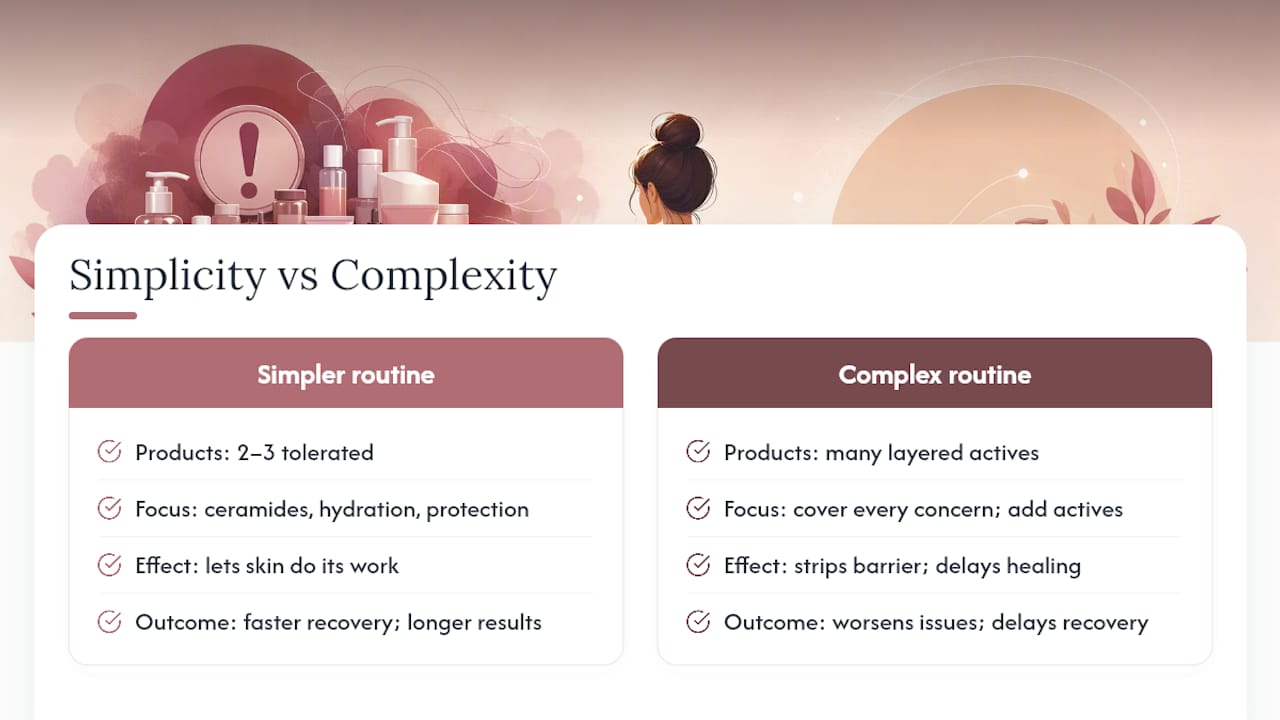
The most consistent pattern in overloaded skin cases is this: the people who recover fastest are the ones who do the least.
There’s a cultural pressure in skincare to be proactive, to treat every concern, to layer every beneficial ingredient. But the skin barrier is not a problem to be solved with more inputs. It’s a living system that responds to consistency and rest. When you strip it back and give it what it actually needs, ceramides, hydration, and protection, it heals. When you keep piling on actives to speed that process, you delay it.
Simplified routines often give better, longer-lasting results precisely because they let the skin do its own work. Clinician commentary consistently supports this: overcomplicating a routine frequently worsens the issues it was meant to address. The goal isn’t a ten-step routine that covers every concern. It’s two or three products that your skin genuinely tolerates, applied with enough consistency to see real change.
If you’re overwhelmed by skincare and unsure where your specific skin sits, that’s exactly when a personalized consultation adds the most value. A clinician can assess your barrier, identify which actives are worth reintroducing for your skin type, and build a plan that’s grounded in your actual skin, not a trend.
Sources
These sources informed the guidance in this article and are worth bookmarking for deeper reading:
This article is general information, not a substitute for advice from a qualified doctor. Consult a qualified healthcare professional about your own circumstances before acting on anything here.
Recommended