.png)
Best Mineral Sunscreens in Australia: Dermatologist-Backed Picks
- chevonne stewart
- Aug 20
- 7 min read


If you want a quick answer: look for a lightweight zinc-oxide face formula for daily wear, a higher water-resistance zinc lotion for the body, a tinted mineral option if pigmentation or melasma is a concern, and a mineral stick for touch-ups on the go. Each category earns its spot for a different reason. A well-formulated zinc-oxide face sunscreen gives you photostable, broad-spectrum coverage without the sting that chemical filters can cause on reactive skin. Tinted versions reduce the chalky white cast that once made mineral formulas hard to wear under makeup, while helping camouflage pigmentation. Water-resistant body lotions matter for the beach and outdoor work where sweat and swimming break down protection fast. Sticks are the easiest way to actually reapply, which is where most people fail.
Face (zinc-rich, low white cast): best for daily wear and pigmentation-prone skin, since zinc oxide is more photostable than most chemical filters.
Body (zinc-based lotion, water-resistant): suited to beach days and sport, where reapplication after swimming is non-negotiable.
Tinted mineral SPF: best for melasma or post-procedure skin needing camouflage plus protection.
Mineral stick: best for reapplication over makeup without disturbing your look.
Sensitive-skin mineral formula: best for reactive or eczema-prone skin, thanks to shorter ingredient lists.
Whatever you choose, look for SPF50+ and a broad-spectrum claim, and check that the brand is TGA-registered. Independent lab testing has raised real questions about whether labeled SPF always matches performance, so a batch-testing claim on the label is worth seeking out.
Key Takeaways
Zinc-oxide mineral sunscreens with SPF50+ and a clear or tinted finish offer the most reliable daily protection for Australian conditions, especially for pigmentation-prone or reactive skin.
Point | Details |
Prioritize SPF50+ | Choose a broad-spectrum SPF50+ mineral formula as the baseline for daily Australian sun exposure. |
Check active percentages | Look for disclosed zinc oxide percentages, often in the low-20% range for cosmetic-friendly facial formulas. |
Match category to use case | Pick tinted zinc for pigmentation, clear zinc for daily face wear, and water-resistant lotion for the beach. |
Verify with independent testing | Favor brands claiming batch testing, since Choice found 16 of 20 tested sunscreens missed their labeled SPF. |
Get a tailored recommendation | Fundamentalskin offers personalized consults to match mineral SPF choices to pigmentation-prone or sensitive skin. |
Table of Contents
Best Mineral Sunscreens Australia Shoppers Compare by Feature
Not every mineral sunscreen behaves the same on skin, and the differences usually come down to five things: the active mineral filter, the percentage disclosed (if any), the finish, water resistance, and how transparent the brand is about what’s actually in the bottle. Rather than naming brands here, it helps to think in categories, because the same category shows up across price points and retailers.
Editorial roundups such as Harper’s Bazaar Australia point out that facial formulas in the low-20% zinc oxide range tend to strike the best balance between UV protection and cosmetic wearability, which is worth checking against the percentage printed on your own tube if the brand discloses it.
Ingredient transparency is the flag that matters most here:
Does the label state the active mineral percentage, not just “contains zinc oxide”?
Is there any claim of independent batch testing after manufacture?
Is it labeled fragrance-free and alcohol-free for sensitive skin?
Does it carry a reef-safe or non-nano claim, and is that backed by anything beyond marketing copy?
Brand and retailer pages frequently advertise non-nano zinc oxide with estimates around 25%, along with reef-safe and vegan claims, but those specific figures and certifications vary a lot between products and should be read as brand statements rather than independently verified facts.
How to Choose a Mineral Sunscreen in Australia
Standing in a pharmacy aisle staring at ten near-identical white tubes is nobody’s idea of fun. A simple checklist cuts through it fast:
Confirm SPF50+ and a broad-spectrum claim on the front label.
Check whether zinc oxide or titanium dioxide is listed first, and whether a percentage is disclosed.
Decide your finish preference: clear, sheer-tinted, or fully tinted for pigmentation coverage.
Match water resistance to your activity: 40 minutes for daily wear, 80 minutes for swimming or sport.
Scan for fragrance-free and alcohol-free wording if you have reactive or eczema-prone skin.
If pigmentation or melasma is a concern, prioritize a tinted formula. Our guide on choosing sunscreen for pigmented skin breaks this down further.
A useful ordering rule: for your face, go lightweight and tinted or clear zinc first, since that’s what you’ll actually wear every day. For your body, prioritize water resistance over finish, since nobody’s checking for white cast at the beach.
Pro Tip: Before buying online, do the jawline test in a physical store if you can: apply a pea-sized amount to your jawline, rub it in fully, and check the color match in natural daylight, not fluorescent store lighting. A 50ml tube used daily on the face at roughly a quarter-teaspoon per application typically lasts several weeks; a 200ml body lotion at a full-body dose disappears much faster during summer.
What TGA Rules and Recent Testing Mean for ‘Mineral’ Claims
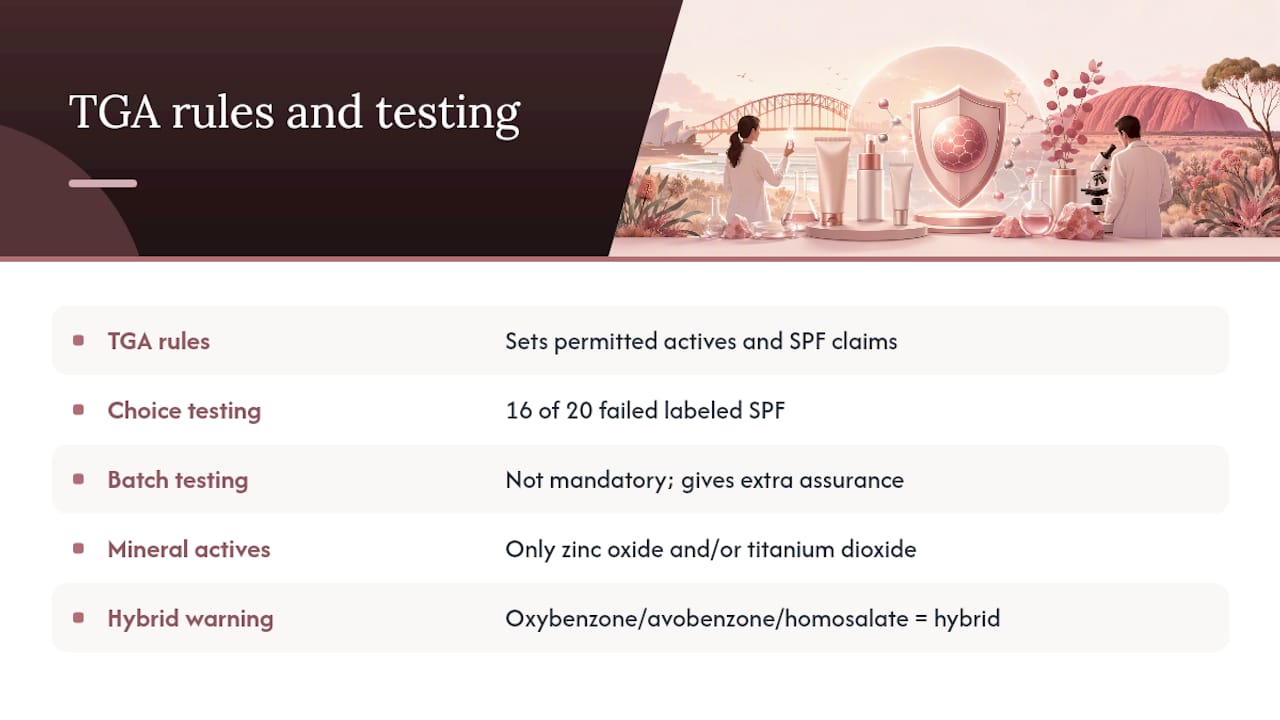
The Therapeutic Goods Administration regulates what sunscreens sold in Australia can claim on their labels, including which active ingredients are permitted and how SPF and broad-spectrum protection must be represented. That’s the baseline you’re relying on every time you buy off a shelf.
Independent lab testing has found real gaps between label and performance. Choice tested 20 sunscreens and found 16 fell short of their labeled SPF in laboratory conditions. That’s a meaningful reason to favor brands that publicly claim post-manufacture batch testing, since batch testing isn’t mandatory in Australia and gives you an extra layer of assurance beyond the TGA registration itself.
Separately, investigative reporting found some products marketed as ‘mineral’ in Australia contained additives or synthetic filters that muddy the line between “mineral” and “chemical” formulations.
Pro Tip: Read the actives list, not just the front-of-pack marketing. A genuinely mineral formula lists zinc oxide and/or titanium dioxide as the only active ingredients. If you see oxybenzone, avobenzone, or homosalate buried in the list alongside “mineral” branding on the front, it’s a hybrid, not a true mineral formula. For general reapplication and sun-safety guidance, HealthDirect recommends pairing sunscreen with shade and protective clothing rather than relying on it alone.
Why Dermatologists Lean Toward Mineral Formulas
Dermatologists often steer patients with reactive skin, pigmentation concerns, or recent in-clinic procedures toward zinc-oxide mineral sunscreens, mainly because zinc oxide is photostable and tends to be better tolerated in Australia’s high-UV conditions than many chemical filters.
Pigmentation and melasma prevention: consistent, photostable UV coverage helps prevent existing pigmentation from darkening further.
Post-procedure skin (peels, laser): mineral filters are gentler on compromised skin barriers during healing.
Sensitive or irritated skin: shorter ingredient lists lower the risk of an irritant reaction.
Reef-conscious users: mineral formulas are the more common choice for those seeking reef-safe options, though certifications still vary by brand.
When a client has dry or textured skin, a matte mineral SPF can actually make texture more visible. Layering a hydrating serum or moisturizer underneath first helps the sunscreen glide on evenly and cuts down on that chalky, cakey look.
That layering advice pairs well with a broader routine; see how to build a natural skincare routine for sensitive skin for more on sequencing products correctly.
Our Verdict on Choosing Mineral SPF in Australia
Across finishes, price points, and claims, the shortlist holds up: favor zinc-oxide mineral formulas with clear or tinted finishes and SPF50+ for daily Australian sun exposure, and size your water resistance to match your actual activity level.
If your skin has pigmentation, recent treatment history, or a pattern of reacting to new products, a personalized consult adds real value. An in-clinic assessment at Fundamentalskin can match a mineral formula to your specific pigmentation pattern, patch test for sensitivity, and advise on layering sunscreen with any ongoing treatment plan.
Before a consult, jot down:
Your current skincare products and any known reactions.
Where pigmentation or redness tends to show up.
Any sunscreens that have caused stinging, breakouts, or white cast issues in the past.
A clinician’s real-world take on wearing mineral SPF daily
Finding a mineral sunscreen you’ll actually wear every day usually matters more than chasing the theoretically “best” formula on paper. My practical tip: keep a tinted mineral stick in your bag matched to your foundation shade, so reapplying midday doesn’t mean redoing your whole face.
Get Personalized Sunscreen and Pigmentation Guidance
Reading labels only gets you so far when your skin has its own history of reactions, pigmentation, or recent treatments. Fundamentalskin gives you what a pharmacy aisle can’t: a personalized consult where Chevonne, a Dermal Clinician with 15 years of experience, patch tests and matches a mineral sunscreen to your actual skin, not a generic skin type category.

This matters most for pigmentation-prone skin, where the wrong formula or a missed reapplication window can undo months of progress. An in-clinic consult also lets you coordinate sunscreen choice with treatments like the Biomimetic Peel + LED Therapy, since post-procedure skin needs particular care in sun protection. If you’re already managing pigmentation concerns, book a consult and bring your current sunscreen along so we can check whether it’s actually working for your skin.
Resources Worth Bookmarking
TGA sunscreen guidance for official labeling and active-ingredient rules.
HealthDirect for public sun-safety and reapplication advice.
Choice’s independent SPF testing for lab-verified performance data.
Guardian investigation on ‘mineral’ labeling claims.
Harper’s Bazaar Australia for editorial, dermatologist-informed picks.
Use the regulatory sources to understand the rules, the independent lab testing to check real-world performance, and the editorial roundup for practical, wearable picks.
This article is general information, not a substitute for advice from a qualified doctor. Consult a qualified healthcare professional about your own circumstances before acting on anything here.
Sources
Recommended
Comments