.png)
Fine Lines vs Wrinkles: What's the Real Difference?
- chevonne stewart
- 8 hours ago
- 8 min read

Fine lines are defined as shallow creases that sit at or near the skin’s surface, while wrinkles are deeper, more permanent folds that signal significant collagen and elastin loss in the dermis. Knowing what are fine lines vs wrinkles is not just a matter of semantics. The distinction determines which treatments actually work and which ones waste your time and money. Fine lines typically begin appearing in your mid to late 20s as subtle creases visible mostly during facial expressions, while wrinkles are visible even when your face is completely relaxed. Getting this right is the first step toward healthier, more confident skin.
What are fine lines vs wrinkles, and how do they differ?
Fine lines affect mostly the epidermis and upper dermis. Wrinkles extend deeper into the dermis, where structural fiber breakdown is more advanced. That depth difference is what separates a manageable surface crease from a permanent fold.
Fine lines are the early warning sign. They appear as faint, shallow marks, often less than 1mm deep, and tend to show up around the eyes, mouth, and forehead first. At this stage, the skin’s collagen network is still largely intact. The crease is a surface event, not a structural one.

Wrinkles, by contrast, reflect real tissue change. The dermis has lost enough collagen and elastin that the skin can no longer spring back. These folds stay visible at rest, not just during expression. Treating fine lines and wrinkles as the same condition is a critical mistake because the interventions required are fundamentally different.
What causes fine lines versus wrinkles, and how do they develop?
Both fine lines and wrinkles share a root cause: the gradual breakdown of collagen and elastin. But the triggers and timelines differ in important ways.
Intrinsic aging is genetic and inevitable. Collagen production slows naturally from your mid-20s onward, reducing the skin’s ability to repair surface creases. Extrinsic aging is driven by external factors, primarily UV exposure, smoking, poor sleep, and dehydration. Sun damage is cumulative and largely irreversible once it affects the dermis, which is why visible wrinkles often indicate damage that skincare alone cannot fully correct.
Dynamic lines form from repeated muscle movement. Squinting, smiling, and frowning crease the skin in the same places thousands of times a day. Early on, these creases disappear when the face relaxes. Over time, they become static, meaning they stay visible even without expression. That transition from dynamic to static is the moment a fine line becomes a wrinkle.
Dehydration accelerates this process. When the skin barrier is compromised, moisture escapes faster, making surface creases more visible and more likely to deepen. Skin barrier repair is one of the most underrated tools in slowing this progression.
UV exposure degrades dermal collagen faster than any other external factor
Smoking reduces blood flow to the skin, starving it of oxygen and nutrients
Dehydration makes fine lines appear deeper and more pronounced
Repetitive facial expressions create dynamic lines that eventually become static
Poor sleep limits the skin’s overnight repair cycle, slowing collagen synthesis
Pro Tip: Apply a broad-spectrum SPF 30 or higher every morning, even on cloudy days. UV rays penetrate clouds and glass, and the damage adds up silently over years.
How to visually identify fine lines versus wrinkles on your skin
The clearest way to tell the difference is the mirror test. Relax your face completely and look closely. Fine lines often disappear or become very faint at rest. Wrinkles stay visible regardless of expression.
Location also gives clues. Fine lines appear first in areas where the skin is thinnest: around the eyes (crow’s feet), above the upper lip, and across the forehead. Wrinkles tend to deepen in the same zones but also develop along the nasolabial folds (the lines running from nose to mouth) and the marionette lines below the corners of the mouth.
Feature | Fine lines | Wrinkles |
Depth | Less than 1mm, surface level | Deeper, into the dermis |
Visibility at rest | Often faint or invisible | Clearly visible |
Skin layers affected | Epidermis and upper dermis | Mid to deep dermis |
Primary cause | Dehydration, early collagen loss, expression | Collagen/elastin breakdown, UV damage, muscle use |
Treatment response | Topical skincare, hydration | Clinical procedures, combination therapy |
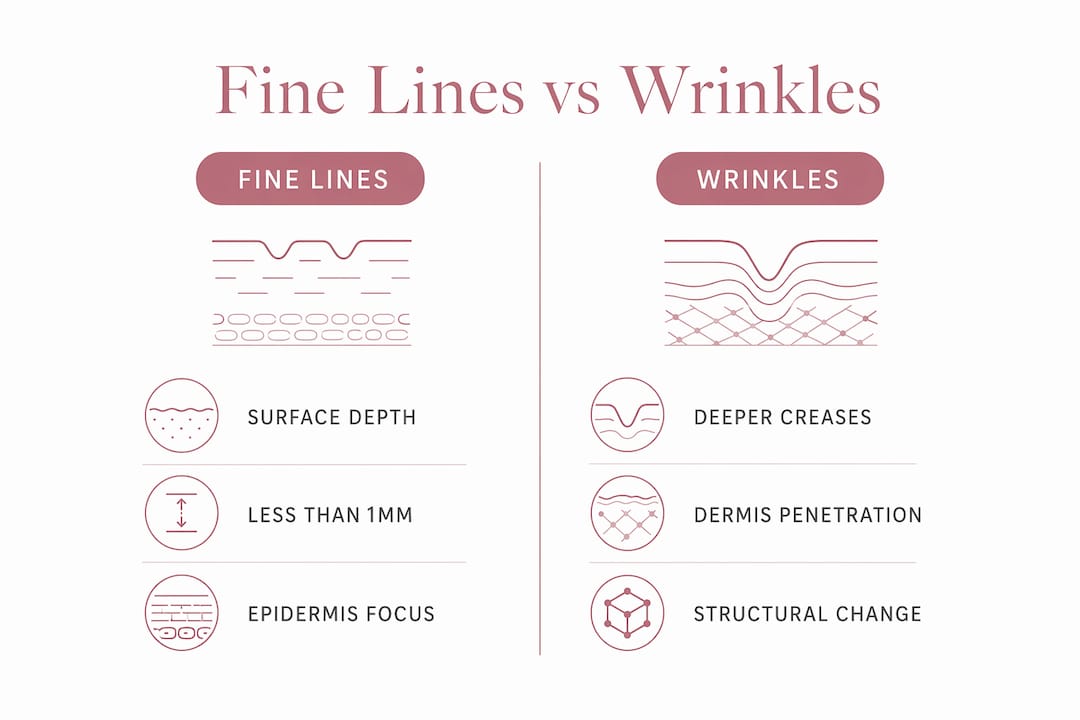
Dynamic fine lines are the ones that appear when you smile or squint and vanish when you stop. Static wrinkles are present all the time. If you press gently on a line and it smooths out, it is likely still in the fine line stage. If it remains visible under gentle pressure, the skin has lost structural support.
What treatment options exist for fine lines versus wrinkles?
Surface fine lines respond well to skincare, while deeper wrinkles require clinical procedures. Matching the treatment to the condition is what produces real results.
Topical treatments for fine lines
Retinoids stimulate collagen synthesis in the deeper layers of the skin. They take consistent use over several months to show structural change, but they are the most evidence-backed topical ingredient for fine line reduction.
Vitamin C (ascorbic acid) protects the skin surface from oxidative damage and supports collagen production. It works best as a morning serum under SPF.
Hydrating actives like hyaluronic acid and ceramides restore the skin barrier and plump surface creases quickly. Hydration reduces dehydration lines fast, but the effect is temporary without consistent barrier support.
Peptides signal the skin to produce more collagen over time. They are gentler than retinoids and well suited to sensitive skin types.
Choosing the right combination of skin-improving ingredients matters as much as the individual actives. Layering incompatible ingredients reduces efficacy and can irritate the skin barrier.
Clinical treatments for wrinkles
Neurotoxin treatments like Botox target dynamic wrinkles by relaxing the muscles that create repetitive creases. Results appear within days and typically last 3–4 months. They do not restore volume loss.
Dermal fillers address volume loss in deeper wrinkles, particularly nasolabial folds and marionette lines. Neurotoxins and fillers serve different purposes and are most effective when used together as part of a planned treatment program.
Resurfacing treatments, including chemical peels and device-based therapies, work on both fine lines and wrinkles by stimulating collagen remodeling. Advanced skin device therapy can reach deeper skin layers than topical products alone.
Pro Tip: Do not expect a single treatment to address both fine lines and wrinkles. Effective care often combines neurotoxins, fillers, skincare, and resurfacing for results that hold up over time.
How to prevent the progression from fine lines to wrinkles
Prevention is the most effective strategy. Addressing sun damage and hydration early delays the transition from fine lines to static wrinkles. Once the dermis loses structural integrity, no topical product can fully restore it.
The habits that protect your skin are straightforward, but consistency is what makes them work.
Daily SPF is non-negotiable. UV exposure is the single largest external driver of premature wrinkle formation.
Consistent hydration keeps the skin barrier intact and prevents fine lines from deepening due to moisture loss.
Quit smoking if you smoke. Smoking accelerates collagen breakdown and reduces skin oxygenation significantly.
Sleep 7–9 hours per night. Skin repairs itself during sleep, and chronic sleep deprivation shows up on the face faster than most people expect.
Regular skin assessments with a qualified clinician catch changes early, when they are still manageable with less invasive approaches.
Layered skincare combining antioxidants, retinoids, and barrier repair actives creates a compounding protective effect over time.
An organic skincare routine built around these principles gives your skin the daily support it needs to resist premature aging. The earlier you start, the more you preserve.
Key Takeaways
Fine lines are surface-level creases treatable with skincare, while wrinkles are deeper structural changes that require clinical intervention to address effectively.
Point | Details |
Depth defines the difference | Fine lines sit at the skin’s surface; wrinkles extend into the dermis with collagen loss. |
Causes overlap but diverge | Both involve collagen breakdown, but wrinkles reflect more advanced UV and intrinsic aging damage. |
Treatments must match the condition | Topical retinoids and hydration work for fine lines; wrinkles need clinical procedures like fillers or peels. |
Prevention outperforms correction | Starting SPF and barrier repair early delays fine lines from becoming permanent wrinkles. |
Combination care delivers best results | Mixing topical actives with professional treatments addresses both surface and structural aging signs. |
What I’ve learned after 15 years of treating aging skin
Most people come in hoping one product or one treatment will fix everything. That expectation is the biggest obstacle to real results.
The fine lines versus wrinkles difference is not just clinical trivia. It changes everything about how you treat your skin. I have seen clients spend years on anti-aging serums that were never going to touch their deeper wrinkles, and I have seen others rush to injectables when their skin was still in the fine line stage and would have responded beautifully to a well-designed topical routine.
What most people miss is the window. Fine lines are the opportunity. They are the skin telling you that change is happening but has not yet become permanent. That window is when consistent SPF, a good retinoid, and barrier repair work best. Once wrinkles are static and deep, you are managing them, not reversing them.
The other thing I see constantly is people treating one sign of aging in isolation. Botox for forehead lines, but no attention to hydration or sun protection. A peel for texture, but no follow-up skincare to maintain the result. Aging skin is a whole-skin issue. The clients who get the best long-term results are the ones who commit to a layered approach, combining what they do at home with what we do in clinic.
Prevention is not glamorous advice. But after 15 years, it is the most honest thing I can tell you.
— chevonne
Personalized fine line and wrinkle treatments at Fundamentalskin
Fundamentalskin offers targeted, non-invasive treatments designed specifically for women managing the early and advanced signs of skin aging.

Chevonne, a Dermal Clinician with 15 years of experience, builds personalized treatment plans that address both surface fine lines and deeper wrinkles. The Larimedical Biomimetic Peel works to resurface and remodel the skin without downtime, making it an ideal starting point for clients at any stage of aging. For those ready to go deeper, the Biomimetic Peel combined with LED Therapy supports collagen remodeling and skin renewal in a single session. Every treatment at Fundamentalskin uses organic, Australia-sourced ingredients and is tailored to your skin’s specific needs. Book a consultation and start seeing real, lasting results.
FAQ
What is the main difference between fine lines and wrinkles?
Fine lines are shallow creases near the skin’s surface, often visible only during facial expressions, while wrinkles are deeper folds that remain visible at rest due to collagen and elastin loss in the dermis.
Can fine lines turn into wrinkles?
Yes. Fine lines that go unmanaged can progress into static wrinkles as collagen continues to break down and the skin loses its ability to recover from repeated movement and UV damage.
What is the best way to treat fine lines at home?
Retinoids, vitamin C serums, and hydrating actives like hyaluronic acid are the most effective topical options. Retinoids stimulate collagen over months, while hydration reduces the appearance of surface creases quickly.
Do wrinkles require professional treatment?
Deeper, static wrinkles typically require clinical procedures such as neurotoxins, dermal fillers, or resurfacing peels. Topical skincare alone cannot restore the structural collagen loss that defines a true wrinkle.
At what age should I start preventing wrinkles?
Starting sun protection and a basic skincare routine in your 20s is the most effective prevention strategy. UV damage is cumulative, and the earlier you protect the dermis, the longer you delay the transition from fine lines to permanent wrinkles.
Recommended