.png)
How Skin Responds to New Products: A Clear Guide
- chevonne stewart
- Jul 6
- 8 min read


How skin responds to new products is determined by the interaction between your skin barrier, product ingredients, and your individual skin sensitivity, producing reactions that range from irritation and purging to full allergic responses. The clinical term for this process is cutaneous reactivity, and understanding it helps you tell a normal adjustment apart from a warning sign. Skin cell turnover takes approximately 28 days, which means most products need at least one full cycle before you see meaningful results, and often 8–12 weeks for visible improvements. Knowing this timeline prevents you from quitting products too early or pushing through reactions that are actually damaging your skin.
How skin responds to new products: causes and reaction types
Skin reactions to new products fall into three distinct categories: irritant contact dermatitis, allergic contact dermatitis, and purging. Each has a different cause, a different timeline, and a different solution.
Irritant contact reactions account for roughly 80% of all adverse cosmetic responses. That figure means the vast majority of redness, stinging, or flaking you experience is not an allergy. It is a direct chemical disruption of your skin barrier caused by strong actives, high concentrations, or overuse.
Here is how each reaction type works:
Irritant contact dermatitis occurs when a product physically disrupts the skin barrier. Common triggers include high-concentration acids, retinoids, and physical scrubs. Symptoms appear quickly, often within hours, and typically clear within 2–5 days after stopping the product.
Allergic contact dermatitis involves your immune system. Your body recognizes a specific ingredient as a threat and mounts a response. This reaction can develop even after years of using the same product without any issue, because allergic reactions can develop after long product use or after a break in use. Symptoms include swelling, hives, and a spreading rash.
Purging is driven by accelerated cell turnover. Certain actives, particularly retinoids and chemical exfoliants, speed up the rate at which skin cells shed. This pushes existing clogged pores to the surface faster than usual, causing a temporary breakout.
Between 60–70% of women and 50–60% of men report having sensitive skin linked to a compromised skin barrier. A weakened barrier lowers your tolerance threshold, making you more likely to experience all three reaction types when you introduce something new.
How can you tell if your skin is purging or reacting negatively?
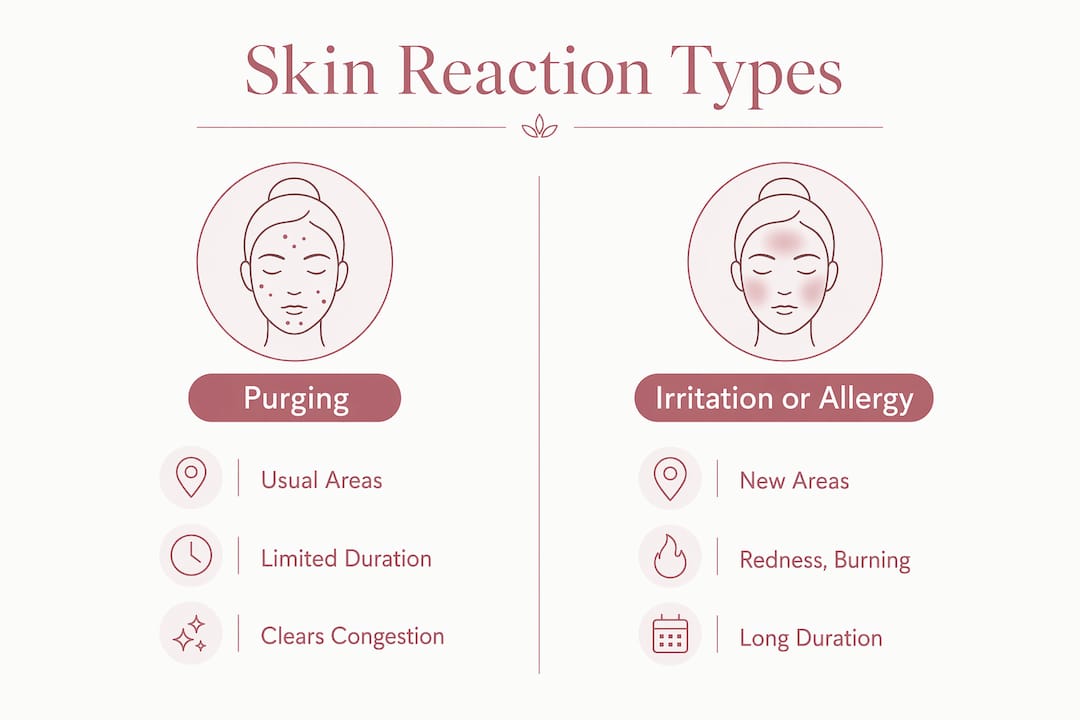
Distinguishing purging from irritation is one of the most practical skills in skincare. Getting it wrong leads to either quitting a product that would have worked or continuing one that is causing real damage.

Feature | Purging | Irritation or allergy |
Location | Your usual breakout areas | New areas, often widespread |
Symptoms | Whiteheads, blackheads, small pimples | Redness, stinging, flaking, swelling |
Timeline | Starts within days, resolves in 4–6 weeks | Worsens with continued use |
Response to stopping | Improves gradually | Clears within days |
Trigger ingredients | Retinoids, AHAs, BHAs | Fragrances, preservatives, high-dose actives |
Purging accelerates cell turnover and pushes existing comedones to the surface, occurring in your usual breakout zones and resolving in about six weeks. Irritation, by contrast, presents as new and widespread symptoms that worsen if you ignore them.
Burning and stinging add another layer of confusion. Stinging under two minutes from potent actives can be normal, but prolonged burning, especially from a moisturizer, indicates barrier damage. A moisturizer should never sting. If it does, your barrier is already compromised.
Pro Tip: Apply a new active to the inner forearm for 48 hours before putting it on your face. If you see redness or feel lasting irritation, your skin is reacting, not purging.
Best practices for introducing new skincare products safely
Safe product introduction follows a clear sequence. Skipping steps is the most common reason people experience reactions that could have been avoided entirely.
Patch test every new product. Apply a small amount to the inner forearm or behind the ear. Wait 48 hours before applying it to your face. This single step catches most allergic reactions before they affect a large area of skin.
Introduce one product at a time. Using multiple new actives at the same time compounds irritation and overwhelms the skin barrier. Adding one product every two to four weeks lets you identify exactly what caused a reaction if one occurs.
Start with low frequency. Begin with two to three applications per week rather than daily use. Gradually increase frequency over four to six weeks as your skin adjusts. This approach applies especially to retinoids, vitamin C, and exfoliating acids.
Use the buffer method for strong actives. Apply a fragrance-free moisturizer before your active ingredient. The buffer method significantly reduces irritation risk without neutralizing the active’s benefits. This technique works particularly well for retinoids and high-concentration acids.
Wait a full 28-day cycle before judging results. Skin cell turnover averages 28 days. Visible improvements in texture, pigmentation, or fine lines typically require 8–12 weeks of consistent use. Quitting before that window closes means you never get a fair read on whether the product works.
Pro Tip: Keep a simple skin log. Note the date you started each product, your frequency, and any symptoms. This record makes it far easier to spot patterns and identify triggers.
For a structured approach to building your routine safely, the skincare routine order guide from Fundamentalskin walks through exactly how to layer and sequence products to protect your barrier. You can also find expert guidance on introducing actives safely for every age group.
How to manage and recover from adverse skin reactions to new products
When a reaction occurs, the recovery process is straightforward if you act quickly and resist the urge to add more products to fix the problem.
Stop the suspected product immediately. Do not wait to see if it improves on its own. Irritant dermatitis resolves within 2–5 days after discontinuation. Continuing use extends the damage and makes recovery slower.
Simplify your routine to three steps. Use a gentle cleanser, a fragrance-free moisturizer, and SPF. Nothing else. Reactive skin recovers fastest when you remove all potential irritants and focus on barrier repair.
Choose moisturizers with minimal ingredients. Look for products containing ceramides, hyaluronic acid, or colloidal oatmeal. These ingredients support barrier repair without adding new sensitization risk. Avoid fragrances, essential oils, and alcohol during recovery.
Consult a professional for severe reactions. Swelling, blistering, or a spreading rash that does not resolve within a week warrants professional assessment. These signs suggest an allergic response rather than simple irritation.
Reintroduce products one at a time after recovery. Patch test again, even for products you used before. Prior tolerance does not guarantee future safety, particularly after a period of barrier compromise.
For more detail on rebuilding a damaged barrier, the Fundamentalskin guide on repairing aging skin barriers covers the most effective clinical and at-home methods. If you are also managing sensitivity alongside natural product choices, this resource on choosing natural products for sensitive skin offers practical selection criteria.
What is the timeline for skin adaptation and visible benefits?
Skin adaptation follows a predictable biological schedule, and knowing it prevents both premature quitting and prolonged damage.
Timeframe | What happens |
Days 1–7 | Initial adjustment; mild tingling or dryness is common with actives |
Weeks 2–4 | Barrier begins adapting; purging may peak and start to resolve |
Weeks 4–8 | First subtle improvements in texture and tone become noticeable |
Weeks 8–12 | Visible changes in fine lines, pigmentation, or hydration appear |
Week 12+ | Full product efficacy assessment is possible |
The 28-day cell turnover cycle is the biological reason why skincare results take time. Each new layer of skin cells takes roughly four weeks to migrate from the base of the epidermis to the surface. Products that influence cell behavior, such as retinoids or vitamin C, need multiple cycles to produce visible change. Patience is not passive. It is the active choice to give your skin the time it needs to respond.
Monitoring comfort throughout this timeline matters as much as monitoring results. A product that keeps your skin calm and comfortable is working with your barrier. One that keeps producing stinging, redness, or breakouts in new areas is working against it.
Key Takeaways
Skin reacts to new products through three distinct pathways: irritant contact dermatitis, allergic response, and purging, each requiring a different response and timeline.
Point | Details |
Most reactions are irritant-based | Roughly 80% of adverse cosmetic responses are irritant, not allergic, and resolve within days of stopping the product. |
Purging has a defined location and timeline | Purging occurs in your usual breakout zones and resolves within 4–6 weeks; new or widespread symptoms indicate irritation. |
Introduce one product at a time | Adding one new product every 2–4 weeks prevents compounded barrier stress and makes triggers easy to identify. |
The buffer method protects the barrier | Applying moisturizer before a strong active reduces irritation risk without reducing the active’s effectiveness. |
Allow 8–12 weeks before judging results | Visible skin improvements require multiple full cell turnover cycles; quitting before week eight gives no reliable data. |
What 15 years of reactive skin cases taught me
Most people who come to me convinced they have “sensitive skin” actually have a temporarily sensitized barrier. Those are very different things. Sensitive skin is a fixed trait. A sensitized barrier is a state, and it is reversible.
The pattern I see most often is this: someone adds three new actives in one week because they read about a trending routine, their skin flares, and they conclude that their skin “can’t handle” good ingredients. What actually happened is that they overwhelmed a barrier that needed more time. The skin was not rejecting the products. It was asking for a slower pace.
The most underrated tool in skincare is a stripped-back routine. Two weeks of a gentle cleanser, a ceramide moisturizer, and SPF will do more for reactive skin than any serum stack. Once the barrier is calm, you can reintroduce actives one at a time and actually see what each one does.
The other thing I want you to know: stinging does not mean working. That misconception leads people to push through damaging reactions, worsening barrier health over time. If something burns, stop it. Your skin is not being dramatic. It is communicating clearly, and listening to it is the most effective skincare strategy there is.
— chevonne
When professional treatment supports your skin through the change
If your skin keeps reacting despite careful product introduction, a professional treatment can reset your barrier and give your routine a stronger foundation.

At Fundamentalskin, the Biomimetic Peel + LED Therapy is designed specifically to support barrier repair and calm reactive skin. The biomimetic peel works with your skin’s natural processes rather than against them, making it an effective option for women managing pigmentation, redness, or sensitivity during routine transitions. LED therapy adds an anti-inflammatory layer that accelerates recovery. Chevonne builds every treatment plan around your skin’s current state, not a generic protocol, so you leave with a clear picture of what your skin needs and what it can handle next.
FAQ
What is the difference between purging and a bad reaction?
Purging occurs in your usual breakout areas and resolves within 4–6 weeks as the active clears congestion. A bad reaction produces new symptoms in new areas and worsens with continued use.
How long should I wait before trying a new skincare product?
Introduce one new product every 2–4 weeks. This spacing lets your skin adjust and makes it easy to identify the cause if a reaction occurs.
Can skin suddenly react to a product it has used for years?
Yes. Allergic reactions can develop after years of use or after a break in use, because immune sensitization can occur at any point. Patch testing remains important even for familiar products.
How do I repair my skin barrier after a reaction?
Simplify your routine to a gentle cleanser, a fragrance-free ceramide moisturizer, and SPF. Avoid all actives until redness and stinging resolve, which typically takes one to two weeks.
Does stinging mean a product is working?
Brief tingling under two minutes from a potent active can be normal. Prolonged burning or stinging, especially from a moisturizer, signals barrier damage and means you should stop the product.
Recommended
Comments