.png)
How to Evaluate Skincare Clinic Credentials Confidently
- chevonne stewart
- Jul 10
- 8 min read


Evaluating skincare clinic credentials means verifying practitioner licenses, clinic registration, specialist training, and treatment protocols before you book any appointment. This process protects you from unsafe care and ensures the results you’re promised are actually achievable. Knowing how to check clinic credentials is not optional. It is the single most important step between choosing a skincare clinic that delivers real results and one that causes harm. Regulatory standards vary by region, but every reputable clinic operates under a medical or cosmetology board, maintains documented qualifications, and names the clinicians responsible for your care.
How to evaluate skincare clinic credentials: the key qualifications to look for
The first thing to understand is that “skincare professional” is not a protected title. Anyone can print it on a business card. The credentials that actually matter are specific, verifiable, and tied to formal training programs or medical licensing boards.
Practitioner types and what their titles mean
Skincare practitioners fall into distinct categories, and each carries a different scope of practice.
Dermatologists hold a medical degree plus a specialty residency. They diagnose and treat skin conditions medically and can prescribe medications.
Dermal Clinicians complete advanced post-graduate training in clinical skin treatments. This is the qualification held by Chevonne at Fundamentalskin, with 15 years of hands-on clinical experience.
Registered Nurses and Nurse Practitioners hold nursing degrees and may complete additional aesthetic training for injectables and laser procedures.
Licensed Estheticians complete state-regulated training programs ranging from 300 to 1,500 hours depending on the state, followed by a board exam. This range is wide, and 300 hours is a very short foundation for complex skin treatments.
Cosmetologists focus primarily on hair and general beauty services. Their skin training is limited compared to estheticians or dermal clinicians.
Understanding licensed beauty professional categories helps you match the right practitioner to the treatment you need. A licensed esthetician is appropriate for facials and basic peels. Laser resurfacing or medical-grade chemical peels require a clinician with advanced, procedure-specific training.
Clinic licensing and business registration

Beyond individual credentials, the clinic itself must hold valid business and health registrations. A legitimate clinic displays its registration number, names its responsible clinician, and operates from a premises that meets local health and safety standards. Clinic transparency about who owns the business and who is medically accountable is a primary trust indicator.
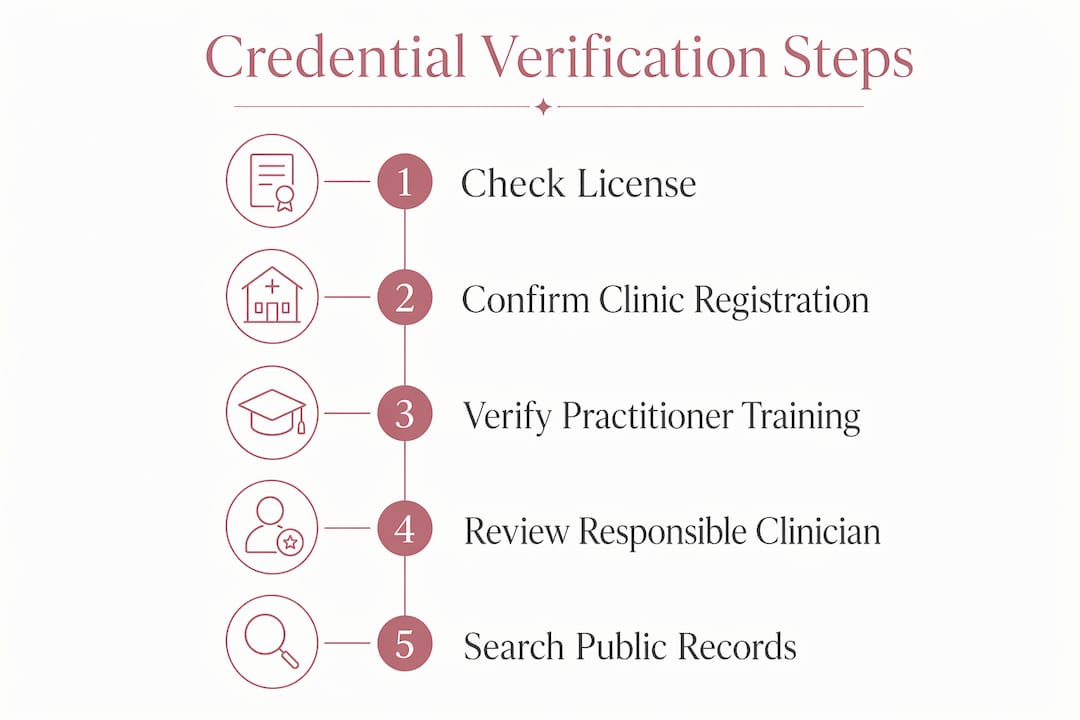
Pro Tip: Ask the clinic directly: “Who is the named responsible clinician for this treatment?” If they cannot answer clearly, that is a red flag.
How can you independently verify a practitioner’s qualifications?
Verification is more effective when you treat it like an audit rather than passive acceptance of marketing claims. Here is a practical sequence to follow.
Search the state or national board database. Medical boards, cosmetology boards, and nursing boards all maintain publicly searchable registers. You can verify licenses online in minutes by entering the practitioner’s name or registration number.
Check for disciplinary history. Most board databases show whether a practitioner has received complaints, sanctions, or license suspensions. A clean record matters as much as the credential itself.
Do not rely on screenshots. Screenshots of qualifications can be falsified. Always search the practitioner’s name and registration number directly on the official regulatory site.
Cross-check across multiple sources. Search the practitioner’s name on the clinic website, LinkedIn, and the regulatory database. Inconsistencies in training dates, qualifications, or clinic affiliations are worth questioning.
Confirm procedure-specific credentials. A practitioner may hold a general esthetician license but lack specific training for lasers or injectables. Ask for evidence of training in the exact procedure you want, including experience managing complications.
“Patients can verify licenses in minutes by searching national or state medical and cosmetology boards online. The absence of a searchable record is itself a finding worth taking seriously.”
Pro Tip: Search the clinic name alongside terms like “complaint,” “review,” or “regulatory action” to surface any public concerns that do not appear on official databases.
What are the red flags when assessing a clinic’s credentials?
Red flags in skincare clinics fall into two categories: credential gaps and behavioral warning signs. Both matter equally.
Credential gaps to watch for
Vague titles like “skin specialist” or “beauty therapist” with no underlying qualification listed
No named clinician on the website or in consultation materials
Certificates from short online courses presented as equivalent to regulated training
Credentials presented in marketing terms that lack legal precision, such as “certified” without specifying the certifying body
No clinic registration number or health authority approval displayed
Behavioral warning signs
Pressure to book quickly or accept a limited-time offer before you have asked any questions
Vague or dismissive answers when you ask about treatment protocols
Unrealistic promises such as guaranteed results or permanent fixes from a single session
No written consent process, no medical history intake, and no aftercare documentation offered
Treatments performed in non-clinical premises without proper hygiene or emergency protocols
Pro Tip: A clinic that discourages questions is telling you something important. Confident, qualified practitioners welcome scrutiny.
How to use a scorecard to compare clinics objectively
A scorecard removes emotion from the decision. When you are comparing two or three clinics, it is easy to be swayed by a beautiful website or a persuasive consultation. Objective criteria like provider credentials and consultation depth protect you from impulse booking.
Rate each clinic from 1 to 5 on the following categories:
Evaluation category | What “5 out of 5” looks like |
Practitioner credentials | Named clinician with verified, procedure-specific training and board registration |
Clinic licensing | Displayed registration number, named responsible clinician, compliant premises |
Consultation quality | Full medical history intake, contraindication screening, realistic outcome discussion |
Treatment transparency | Written protocol, named products or devices, clear explanation of risks |
Aftercare and follow-up | Documented aftercare instructions, follow-up appointment offered, complication protocol explained |
Reviews consistency | Verified reviews across multiple platforms with specific, detailed outcomes described |
Add the scores. A clinic scoring below 20 out of 30 warrants serious caution. A clinic scoring 25 or above across all six categories demonstrates the kind of professional standard that protects your skin and your investment.
The scorecard also helps you ask better questions. When you know you need to rate “consultation quality,” you arrive prepared to assess whether the consultation is thorough or superficial. A thorough consultation that includes medical history and contraindication screening reduces complications and improves outcomes.
What practical steps should you take before booking?
Credential verification is the foundation. These steps convert that research into a confident, informed booking decision.
Contact the clinic before booking. Ask for the name of the practitioner who will perform your treatment. A clinic that cannot or will not tell you this is not ready for your trust.
Request a consultation first. A personalized skin consultation should precede any treatment. Use it to assess how thoroughly the clinician reviews your skin history, current concerns, and treatment goals.
Verify the named practitioner independently. Once you have a name, run it through the relevant regulatory database before your appointment.
Ask about complication management. Every treatment carries some risk. Ask what happens if you experience an adverse reaction and who you contact. A qualified clinic has a clear, documented answer.
Review the consent form carefully. A proper consent form names the treatment, the practitioner, the risks, and the aftercare requirements. Signing a blank or vague form is a risk you do not need to take.
Check before-and-after evidence. Real clinical results are documented with consistent photography, realistic timelines, and honest descriptions of what the treatment achieved. Vague “transformation” language without specifics is a warning sign.
Key Takeaways
Evaluating skincare clinic credentials requires verifying practitioner licenses, clinic registration, procedure-specific training, and consultation quality before you commit to any treatment.
Point | Details |
Verify credentials independently | Search practitioner names on official regulatory databases, not just clinic-provided documents. |
Match qualifications to the treatment | A general esthetician license does not qualify a practitioner for lasers or medical-grade peels. |
Use a scorecard | Rate clinics on credentials, consultation depth, transparency, and aftercare to remove emotional bias. |
Watch for behavioral red flags | Pressure to book quickly and vague answers about protocols signal risk, not just credential gaps. |
Consultation quality is a credential | A thorough intake that covers medical history and contraindications is evidence of clinical competence. |
What I’ve learned after 15 years of seeing clients walk in with the wrong expectations
Clients come to me after visiting clinics that looked professional on the surface. The website was polished. The before-and-after photos were compelling. The price felt reasonable. And then something went wrong, or simply nothing happened at all.
The pattern I see most often is this: clients trusted a clinic’s brand rather than the individual practitioner’s training. A clinic can have a beautiful fit-out and a strong social media presence while employing practitioners who are not trained for the specific procedure being offered. The brand is not the credential. The person treating your skin is.
What I tell every new client is to focus on one question above all others: “Is this specific practitioner trained and experienced in this exact treatment, and can they show me evidence of that?” That question cuts through marketing faster than anything else.
Transparency is also non-negotiable for me. At Fundamentalskin, every client knows my name, my qualifications, and exactly what we are doing to their skin and why. If a clinic cannot offer you that level of clarity before you book, you deserve better. Your skin is not a place to take shortcuts.
The clients who get the best results are the ones who ask the most questions. Not because they are difficult, but because they are informed. That is the kind of client I love working with, and it is the kind of consumer every good clinic should welcome.
— chevonne
Fundamentalskin: where credentials meet clinical results
Choosing a clinic is easier when you can see exactly who is treating you and why they are qualified to do so. At Fundamentalskin, Chevonne is a Dermal Clinician with 15 years of experience, and every treatment is grounded in clinical skincare principles with documented, visible results.

The Biomimetic Peel + LED Therapy is one of Fundamentalskin’s most requested treatments, addressing pigmentation, fine lines, and dull texture with no downtime. Every client receives a personalized consultation before any treatment begins, with full transparency on protocols, ingredients, and aftercare. Apply the scorecard from this article to Fundamentalskin and see how it holds up. BOOK NOW at fundamentalskin.online.
FAQ
What credentials should a skincare clinic practitioner hold?
A qualified skincare practitioner holds a state or nationally recognized license, such as a dermal clinician certification, registered nurse qualification, or esthetician license with board exam completion. For advanced treatments like lasers or medical peels, procedure-specific training is required in addition to a general license.
How do I check if a skincare clinic is legitimate?
Search the practitioner’s name and registration number on your state or national medical or cosmetology board database. Regulatory bodies maintain searchable registers that confirm licensure status and any disciplinary history within minutes.
What are the biggest red flags at a skincare clinic?
Pressure to book immediately, vague credentials with no named certifying body, and the absence of a written consent or aftercare process are the clearest warning signs. A clinic that cannot name the practitioner performing your treatment is not operating to a professional standard.
How many training hours should a licensed esthetician have?
State-regulated esthetician programs require between 300 and 1,500 hours depending on the state, followed by a board licensing exam. More hours generally indicate broader foundational training, though procedure-specific experience matters equally for advanced treatments.
Why is a consultation important before a skincare treatment?
A thorough consultation that covers medical history and contraindication screening reduces the risk of complications and ensures the treatment is appropriate for your skin. It is also your clearest signal of a practitioner’s clinical competence and communication standards.
Recommended
Comments