.png)
See Pigmentation Before and After on Darker Skin: Clinician Timelines

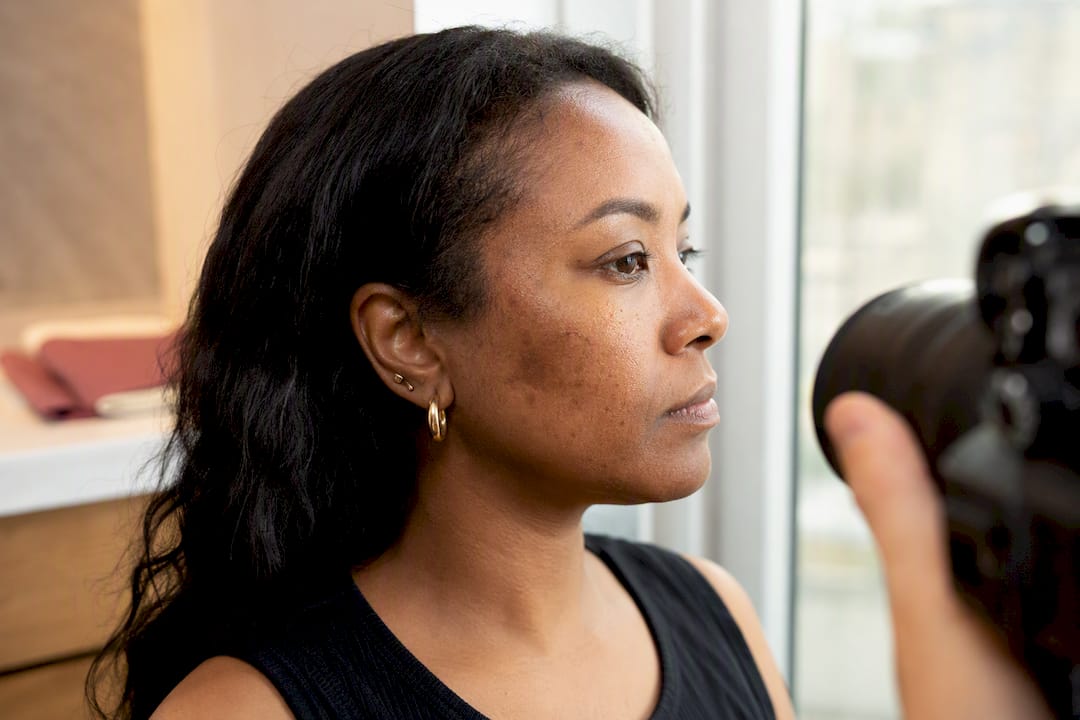
Yes, most pigmentation types visibly improve with the right treatment plan. Early lightening often shows up in 2 to 4 weeks, with more noticeable change by 8 to 12 weeks, depending on the pigment depth and the method used. Melasma tends to move slower and needs stricter sun protection than sunspots or post-inflammatory marks. Results hold only when a clinician oversees the plan and you keep up daily sunscreen.
TL;DR:
Melasma is the slowest pigmentation to fade and typically requires 8 to 12 weeks of a combination of topical inhibitors, sun protection, and gentle peels.
Post-inflammatory hyperpigmentation responds faster, often showing visible fading within 4 to 6 weeks, especially with microneedling or superficial peels.
Sun and age spots tend to improve predictably within 3 to 6 weeks with targeted treatments like peels or light-based devices when combined with ongoing sun protection.
The best results usually come from combination plans that include in-clinic procedures, home regimens, and diligent sunscreen use, rather than single treatments.
Accurate photo evaluation depends on matching conditions, avoiding filters or makeup, and understanding that texture improvement typically accompanies tone fading.
Table of Contents
What Do Pigmentation Before-and-After Photos Actually Show?
Before-and-after photos work best when you group them by pigmentation type, because melasma, post-inflammatory hyperpigmentation, and sunspots respond to treatment on completely different timelines. A gallery that mixes all three without labeling them tells you almost nothing useful.
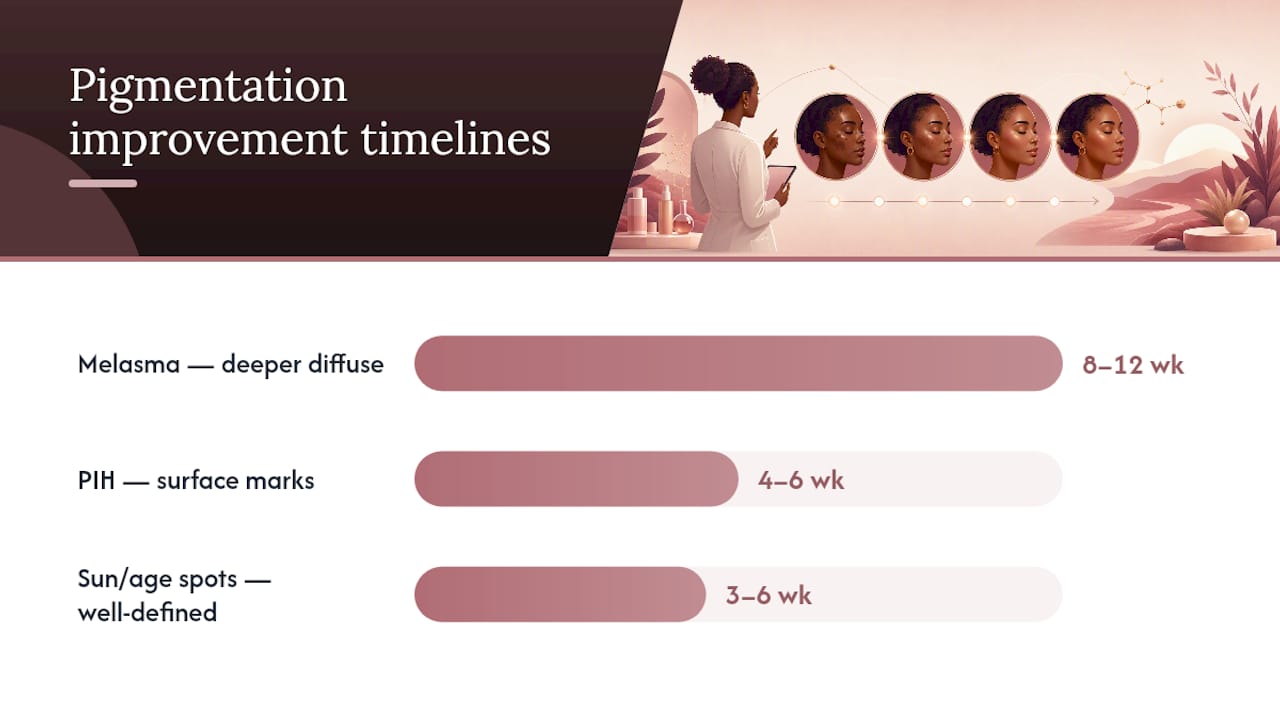
Melasma. This hormonally driven pigmentation sits deeper in the skin and tends to be the slowest to fade. A typical melasma before-and-after set shows softened patches at 8 to 12 weeks using a combination of tyrosinase-inhibiting topicals, tinted sun protection, and gentle peels, with full evenness sometimes taking several months of maintenance.
Post-inflammatory hyperpigmentation (PIH). Marks left behind by acne, waxing, or minor trauma usually respond faster than melasma. Photos in this category often show visible fading by 4 to 6 weeks when microneedling or a superficial peel is paired with a home regimen, since PIH sits closer to the skin’s surface.
Sun and age spots. These respond the most predictably to targeted treatment. Before-and-after sets in this group frequently show sharp contrast reduction within 3 to 6 weeks, particularly with peels or light-based devices, because the pigment is concentrated and well-defined rather than diffuse.
Good captions on any credible gallery answer three questions: what treatment was used, how many sessions it took, and how much time passed between the two photos. A single “after” shot with no session count or timeframe attached is a marketing image, not evidence.
Before trusting a gallery, ask the clinic:
Were the photos taken in the same lighting and at the same angle?
Is this a single case or a representative outcome across multiple clients?
What was the full treatment plan, not just the final procedure shown?
How long after the last session was the “after” photo taken?
Fundamentalskin’s own case examples follow this labeling approach, pairing each image with the treatment and timeframe behind it rather than a bare before-and-after pair.
Which Treatments Show Up Most in Pigmentation Results?
Every modality you see in a before-and-after photo works on pigment through a different mechanism, and that’s exactly why the timelines vary so much from one gallery entry to the next.
Topical regimens. Tyrosinase inhibitors slow new melanin production, retinoids speed cell turnover, and vitamin C brightens tone as a supporting player. Vitamin C rarely clears deep pigment on its own. It works best stacked with an inhibitor and daily sun protection, which is why reducing dark spots naturally usually means combining several actives rather than relying on one.
Chemical peels. A superficial peel exfoliates the top layer and can brighten tone within days, but it doesn’t reach deeper pigment. A biomimetic peel, such as the Larimedical Biomimetic Peel, is formulated to work with the skin’s own repair signals rather than simply stripping the surface, aiming for tone evenness with minimal downtime rather than the redness and peeling associated with older-generation acid peels.
Microneedling. Controlled micro-injuries trigger the skin’s repair response, which regulates melanocyte activity while also improving texture and boosting how well topical actives absorb afterward. It’s featured often in before-and-after galleries because it’s generally well tolerated across a broad range of skin tones when settings are staged correctly.
Lasers and IPL. These target specific pigment depths with concentrated light energy, and the visible change can be faster than topicals or peels alone. That speed comes with a tradeoff: on deeper skin tones, aggressive settings raise the risk of rebound pigmentation, which is why laser and IPL results in credible galleries almost always show a staged approach rather than one aggressive session.
The strongest before-and-after outcomes rarely come from a single treatment. They come from combination plans, where an in-clinic procedure jump starts visible change, a home regimen sustains it, and daily sunscreen locks it in. Hyperpigmentation is largely driven by sun exposure, inflammation, and hormones, so a plan that only addresses the visible spot without controlling those triggers tends to plateau early or relapse.
Pro Tip: Take your own “before” photo in natural daylight, no makeup, same time of day you’d photograph a “week 4” or “week 8” follow up. It gives you an honest comparison instead of relying on memory.
How Long Until You See Real Pigmentation Improvement?
Timelines vary by modality, but there’s a rough pattern worth knowing before you commit to a plan.
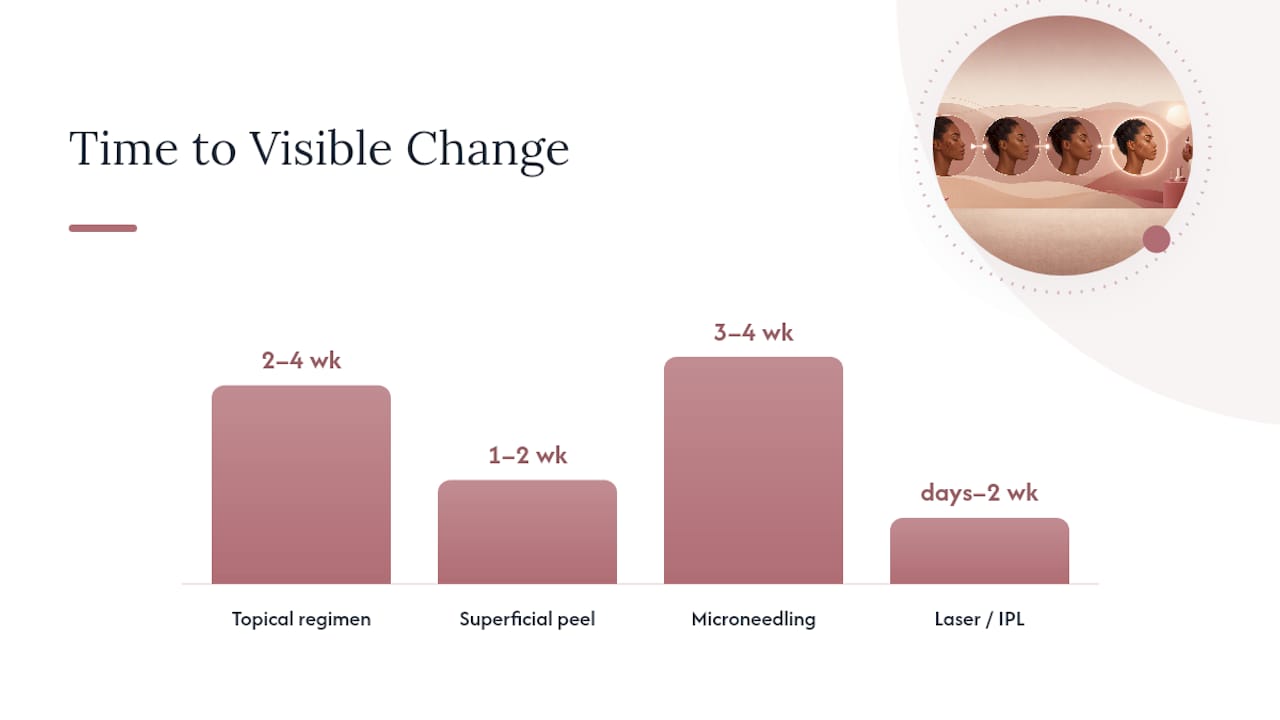
Treatment type | Earliest visible change | Typical sessions |
Topical regimen | 2 to 4 weeks | Ongoing daily use |
Superficial/biomimetic peel | 1 to 2 weeks per session | 4 to 6 sessions, spaced weeks apart |
Microneedling | 3 to 4 weeks | 3 to 6 sessions |
Laser/IPL | Days to 2 weeks | 2 to 4 sessions, staged |
A 12-week open-label trial of a three-product hyperpigmentation regimen found a median MASI improvement of 26% by week 12, and many participants reported lighter brown spots as early as week 2, even before objective scoring caught up with what they were seeing in the mirror.
That gap between how a patient feels their skin looks and what a clinical score confirms is normal, and it’s part of why clinicians track both. Once you hit a plateau, usually after the initial 8 to 12 week window, that’s not a sign the treatment failed. It means you’ve reached maintenance phase, where the goal shifts from visible reduction to holding the gains you’ve already made.
How Do You Spot a Genuine Improvement in a Photo?
Not every dramatic before-and-after photo reflects a real treatment outcome. Some of the difference comes from lighting, angle, or a flattering filter rather than the skin itself.
Look for these signals before you trust what you’re seeing:
Matching conditions. Same lighting, same camera angle, same facial expression in both shots. If the “after” photo is brighter, closer, or shot from a flattering angle, treat it with caution.
No makeup or filter cues. A believable “after” shot shows bare skin, not a foundation-smoothed complexion.
Reduced contrast, not erased pigment. Genuine improvement usually looks like softened edges and lower contrast between the spot and surrounding skin, rather than a spot vanishing completely overnight.
Texture change alongside tone change. Real clinical progress tends to show smoother texture and softer pigment boundaries together, since the treatments that fade color usually also improve surface quality.
When you’re evaluating a clinic rather than a photo, ask directly how many sessions the shown case took, how far apart they were spaced, how long after the final session the photo was taken, and what the client’s maintenance plan looks like now. A clinic that can’t answer those specifics for its own gallery image is one to question.
Is Pigmentation Treatment Safe for Darker Skin Tones?
Darker skin tones, Fitzpatrick types IV through VI, carry a real risk with aggressive treatment: post-inflammatory hyperpigmentation triggered by the treatment itself. This is exactly why experienced clinicians stage their settings rather than starting at full strength.
A responsible “low and slow” protocol usually includes:
A patch test before any device-based treatment, especially laser or IPL.
Preconditioning the skin with topical tyrosinase inhibitors for several weeks before an aggressive procedure.
Starting at conservative settings and increasing gradually across sessions rather than chasing fast results in one visit.
Spacing sessions with enough recovery time between them to watch for reactive darkening.
It’s common for treated areas to darken temporarily before they lighten, particularly with peels and microneedling. That’s usually part of the skin’s normal inflammatory response, not a failure of the treatment. Contact your clinician if darkening persists past the expected window, spreads beyond the treated area, or comes with unusual swelling or pain.
Fundamentalskin’s clinician-led approach to PIH follows this staged model rather than a one-size-fits-all setting on every skin tone.
Pro Tip: If a clinic promises guaranteed clearance in a set number of sessions, or skips a patch test before your first device-based treatment, walk away. Real pigmentation treatment plans always leave room to adjust based on how your skin actually responds.
What Do Fundamentalskin’s Case Results Show?
Some pigmentation programs are led by clinicians with experience treating pigmentation, aging skin, and textural concerns using non-invasive methods.
Some clinics pair treatments like the Larimedical Biomimetic Peel with staged before-and-after imaging, tracking tone evenness and texture across a full course of sessions.
Clients typically move through a staged course of peels rather than a single treatment, with photo check-ins at set intervals.
Home-care regimens often run alongside in-clinic sessions to reinforce results between appointments.
The published 12-week trial data on hyperpigmentation regimens gives a useful external benchmark: a median 26% MASI improvement at 12 weeks is a reasonable reference point for what a well-run combination plan can achieve in that window.
Sun protection is an important part of every plan from day one, not introduced only after visible improvement.
What Actually Counts as a Successful Result?
A photo comparison can tell you a spot got lighter. It can’t tell you whether the skin’s texture improved alongside it, and that combination is what experienced clinicians actually look for. Tone and texture tend to move together when a treatment plan is working, and a result that only changes color while leaving the skin rough or uneven is an incomplete win.
There’s also a wellbeing side to this that rarely makes it into a gallery caption. Clients who set realistic expectations, rather than chasing an overnight fix, tend to stay consistent with maintenance and end up happier with their long-term skin. If there’s one takeaway worth remembering above the rest: sunscreen and scheduled follow-up appointments matter as much as the treatment itself.
— chevonne
Book a Clinician-Led Pigmentation Assessment
Reading about timelines and treatment types only gets you so far. What actually moves the needle on your skin is a plan built around your specific pigmentation type, staged by someone trained to read how your skin responds session to session. Fundamentalskin’s pigmentation program is led by Chevonne, a Dermal Clinician with 15 years of experience, and it centers on the Larimedical Peels that show up throughout the clinic’s own case documentation.

If you want a lower-downtime entry point, the Biomimetic Peel + LED Therapy package at $249 combines the peel with light therapy in a single session. Before your consultation, take a bare-faced photo in natural light and note how long you’ve had the pigmentation and what has been tried already. That single detail helps Chevonne stage your plan correctly from the first visit rather than guessing at a starting point. Book your pigmentation assessment directly through a qualified clinic to get a plan matched to your skin tone and pigment type.
Sources
The timelines and safety guidance in this article draw on published clinical evidence rather than gallery claims alone. The 12-week open-label hyperpigmentation trial supports the MASI improvement figures and early patient-reported change. The review of pigmentation causes and mechanisms explains why treatment choice depends on pigment depth and cause. Research on UV exposure and melanocyte reactivation backs the emphasis on daily sun protection, and a Journal of Cosmetic Dermatology study on topical regimens supports the timeline expectations for darker phototypes.
This article is general information, not a substitute for advice from a qualified doctor. Consult a qualified healthcare professional about your own circumstances before acting on anything here.
Review: Causes and treatments of pigmentation disorders - PMC
FAQ
How long does it take for pigmentation to fade?
Most people notice early lightening within 2 to 4 weeks, with more measurable change by 8 to 12 weeks depending on the treatment and pigment depth. A 12-week trial found a median MASI improvement of 26% at that point, with some subjects noticing lighter spots as early as week 2.
What is the fastest way to get rid of pigmentation?
Laser and IPL treatments tend to produce the fastest visible change, sometimes within days of a session, but they carry a higher risk of rebound pigmentation on darker skin tones without careful staging. A combination plan pairing an in-clinic treatment like the Larimedical Biomimetic Peel with daily sun protection and home care generally produces faster, more stable results than any single method alone.
What does bad hyperpigmentation look like?
Severe hyperpigmentation typically appears as dark, well-defined patches with high contrast against surrounding skin, often accompanied by rough or uneven texture in the affected area. When it’s inflammation-driven, like acne-related PIH, the marks can appear darker and more widespread than the original blemish that caused them.
Can vitamin C remove pigmentation?
Vitamin C helps brighten overall tone but rarely clears deep-seated pigmentation on its own. It works best combined with a tyrosinase inhibitor, gentle exfoliation, and daily sunscreen, which is the layered approach behind most successful before-and-after results.
Recommended
Comments