.png)
Post-Treatment Skin Care Protocol: Your Recovery Guide

A post-treatment skin care protocol is a structured, phased regimen that guides your skin through healing after cosmetic procedures. It defines which products to use, which ingredients to avoid, and when to reintroduce actives based on your skin’s recovery stage. Without this framework, even well-intentioned care can trigger post-inflammatory hyperpigmentation (PIH), barrier breakdown, or prolonged redness. The protocol covers four key phases: pretreatment, treatment day, acute aftercare (Day 1–7), and follow-up (Day 8–28). Getting each phase right protects your results and your skin.
What is a post-treatment skin care protocol and why does it matter?
A post-treatment skin care protocol is the clinical term for a stage-by-stage regimen that adapts to your skin’s changing needs after a cosmetic procedure. The skin barrier does not recover uniformly. It moves through distinct phases of inflammation, repair, and restoration, and each phase demands a different approach.
Post-treatment care should evolve from occlusive barrier support in the first 48 hours to gentle restoration and maintenance thereafter. That shift matters because applying the wrong product at the wrong time, such as a vitamin C serum on day two, can cause more damage than doing nothing at all.
The four-phase framework used by dermal clinicians structures care around predictable healing windows. Pretreatment focuses on barrier preparation. Treatment day centers on immediate protection. The acute aftercare phase (Day 1–7) prioritizes barrier repair and inflammation control. The follow-up phase (Day 8–28) reintroduces support ingredients as the skin stabilizes. Understanding this timeline gives you a clear, confident plan rather than guesswork.
What are the key phases of a post-treatment skin care protocol?
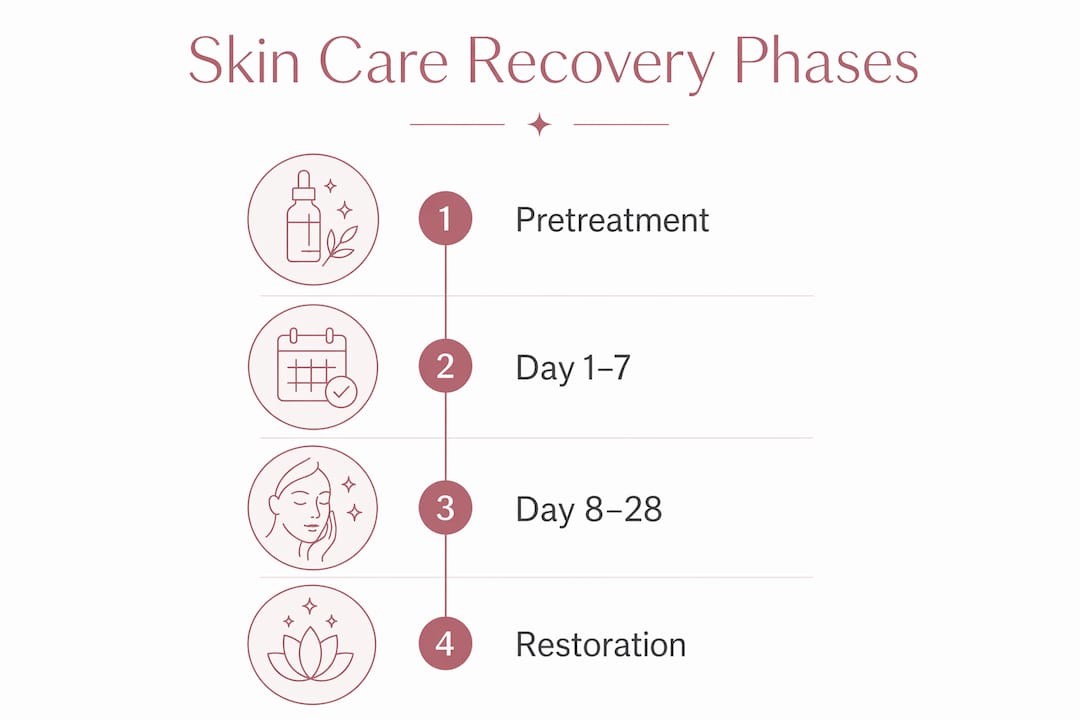
Each phase of the protocol has a specific objective. The table below summarizes the framework used by clinicians.
Phase | Timing | Primary Goal |
Pretreatment | Before procedure | Strengthen barrier, discontinue actives |
Treatment day | Day 0 | Protect, soothe, minimal product use |
Acute aftercare | Day 1–7 | Barrier repair, hydration, sun avoidance |
Follow-up | Day 8–28 | Gradual reintroduction, maintenance |
Pretreatment
Discontinuing retinoids, acids, and exfoliants at least one week before your procedure reduces baseline sensitivity. A stronger barrier before treatment means less disruption during it.
Treatment day and acute aftercare (Day 1–7)
The first 48–72 hours post-procedure are the most critical window. Your skin needs very gentle, non-foaming cleansers, ceramide or hyaluronic acid moisturizers, and strict sun avoidance. During this window, the barrier is physically open and inflammation is at its peak.
Key priorities for Day 1–7:
Use only fragrance-free, non-foaming cleansers with lukewarm water
Apply ceramide-based or hyaluronic acid moisturizers twice daily
Avoid all active ingredients including retinoids, AHAs, BHAs, and vitamin C
Stay out of direct sunlight and wear a physical barrier like a wide-brim hat
Do not use mechanical exfoliation or facial tools
Follow-up (Day 8–28)
Inflammation subsides and re-epithelialization begins. This is when you can cautiously reintroduce support ingredients, always one at a time, with clinician guidance.
Which ingredients are safe and which should you avoid?
Ingredient timing is the most misunderstood part of aftercare for skin treatments. The wrong ingredient at the wrong phase causes setbacks, not improvements.
Universally safe ingredients across all phases
Ceramides, hyaluronic acid, niacinamide, and peptides are safe throughout recovery. They repair the barrier, attract moisture, and calm inflammation without triggering irritation. Growth factor serums are also appropriate during later restoration phases, as they support texture and tone without exfoliating or sensitizing the skin.
Ingredients to avoid in the first seven days
Expert consensus protocols define strict avoidance timelines for retinoids, glycolic acid, lactic acid, and salicylic acid during the first seven days post-treatment. These ingredients exfoliate, thin the barrier, and increase PIH risk on skin that is already compromised. Reintroduction begins only after full re-epithelialization, typically from Day 8 onward.
Ingredients to skip during acute aftercare:
Retinol and prescription retinoids
Glycolic acid, lactic acid, and mandelic acid (AHAs)
Salicylic acid and other BHAs
Vitamin C (ascorbic acid) in high concentrations
Fragrance, alcohol, and essential oils
For clients with darker skin tones, the avoidance window often extends further. Reintroducing retinoids too early risks delayed PIH, particularly in skin of color where melanocytes are more reactive to inflammation. Your clinician should guide timing based on visible healing, not a fixed calendar date.
Pro Tip: Check ingredient labels for “parfum” or “fragrance” as a catch-all term. Even products marketed as gentle can contain sensitizing fragrance compounds. Reviewing harmful skincare chemicals before purchasing post-procedure products protects your recovery.
How do cleansing, hydration, and sun protection fit into the protocol?
These three practices form the non-negotiable foundation of any skin care routine after procedures. Getting them right prevents the most common post-treatment complications.
Cleansing
Gentle cleansing with fragrance-free, non-foaming formulas and lukewarm water minimizes barrier stress during recovery. Avoid surfactants like sodium lauryl sulfate, which strip the skin’s natural lipid layer. Mechanical exfoliation, including washcloths and cleansing brushes, is off-limits until the follow-up phase.
Hydration
Hydration and moisturization are not the same thing, and both are required. A complete hydration regimen combines humectants, which attract water into the skin, with occlusives, which seal it in and prevent transepidermal water loss. Hyaluronic acid is the primary humectant. Petrolatum, shea butter, and squalane serve as occlusives. Using only a humectant without an occlusive leaves water free to evaporate, which worsens dryness.
Sun protection
Broad-spectrum SPF 30 or higher, applied generously and frequently, is the single most important intervention throughout post-treatment and follow-up phases. UV exposure on healing skin triggers melanin overproduction, which causes PIH and undoes the results of your procedure. Reapply every two hours when outdoors, and wear protective clothing as a behavioral backup.
Pro Tip: Mineral sunscreens containing zinc oxide or titanium dioxide are better suited to post-procedure skin than chemical filters. They sit on top of the skin rather than absorbing into it, which reduces irritation risk on a compromised barrier.
Common mistakes to avoid:
Using a foaming or gel cleanser that strips the barrier
Skipping moisturizer because skin feels “oily” or “tight”
Applying SPF only once in the morning and not reapplying
Layering multiple new products at once during recovery
Assuming redness has resolved means the barrier has fully healed
Understanding why redness after treatment occurs helps you interpret your skin’s signals accurately and respond with the right care.
What specific considerations apply when recovering from different procedures?
Not all procedures disrupt the skin barrier equally. Your aftercare for skin treatments must match the depth and type of intervention you received.
Different procedures disrupt the barrier to varying degrees. Ablative laser resurfacing requires more occlusive petrolatum-based care in early healing, while non-ablative treatments and injectables need gentler care with faster reintroduction of actives.
Procedure type | Barrier disruption | Active reintroduction |
Ablative laser | High | Weeks post-treatment |
Non-ablative laser | Moderate | Day 8–14 with guidance |
Microneedling | Moderate | Day 7–10 with guidance |
Chemical peels | Moderate to high | Day 7–14 depending on depth |
Injectables | Low | Day 3–5 for most actives |
Key considerations by procedure type:
Ablative laser: Immediate aftercare involves protecting weeping and crusting skin with minimal products. Active ingredients resume only after surface healing, which can take several weeks.
Chemical peels: Depth determines recovery time. Superficial peels allow faster reintroduction than medium-depth peels. The Larimedical Biomimetic Peel used at Fundamentalskin is designed to deliver clinical results without the extended downtime associated with deeper ablative options.
Microneedling: Channels close within 24 hours, but the barrier remains sensitive for up to a week. Avoid actives and focus on barrier repair ingredients.
Injectables: Barrier disruption is minimal. Most clients can return to a modified routine within days, though avoiding heat, pressure, and actives near injection sites for 48–72 hours is standard.
For clients managing pigmentation, protecting skin post-pigmentation treatment requires an extended sun protection protocol and careful monitoring for PIH signals even after the acute phase ends.
How should you transition back to your normal skincare routine?
Returning to your full routine too quickly is the most common mistake clients make. The skin barrier remains physiologically fragile after visible healing. Rushing actives reintroduction can cause complications including PIH, particularly for darker skin tones.
Follow these steps for a safe transition:
Confirm re-epithelialization. Your clinician should confirm that the surface has fully healed before you reintroduce any active ingredient. Do not rely on the absence of visible redness alone.
Reintroduce one product at a time. Add a single new product every five to seven days. This makes it easy to identify the cause if your skin reacts.
Patch test every new product. Apply a small amount to the inner arm or behind the ear for 24 hours before applying it to your face.
Start with the gentlest actives first. Niacinamide and peptides come before vitamin C. Vitamin C comes before retinoids. Retinoids are always last.
Maintain SPF and barrier support indefinitely. Sun protection and ceramide-based moisturizers are not acute-phase products. They belong in your routine permanently.
Adjusting your skincare for pigmentation-prone skin during the transition phase requires extra caution. Even mild irritation can trigger melanin overproduction in reactive skin types. Clinician guidance during this window is not optional. It is the difference between a result that lasts and one that fades or reverses.
Growth factor serums are a strong choice during the restoration phase. They improve texture and tone without the irritation risk of exfoliating actives, making them a safe bridge between barrier repair and full routine resumption.
Key Takeaways
A post-treatment skin care protocol is a phased, evidence-based regimen that protects the skin barrier, prevents PIH, and optimizes procedure results through ingredient timing and consistent sun protection.
Point | Details |
Four-phase framework | Structure care around pretreatment, treatment day, Day 1–7, and Day 8–28 for best outcomes. |
Avoid actives for seven days | Retinoids, AHAs, and BHAs must be skipped until full re-epithelialization is confirmed. |
Hydration requires two steps | Combine humectants like hyaluronic acid with occlusives to prevent transepidermal water loss. |
SPF is non-negotiable | Broad-spectrum SPF 30 or higher, reapplied every two hours, prevents UV-triggered PIH. |
Reintroduce one product at a time | Adding products gradually lets you identify reactions and protects a still-fragile barrier. |
What I’ve learned from 15 years of post-treatment care
The most consistent mistake I see is clients who feel their skin looks calm and assume it has healed. Visible calm and physiological healing are not the same thing. The barrier can remain fragile for weeks after redness resolves, and that gap is exactly where complications happen.
My honest advice is this: less is genuinely more during the acute phase. I have seen clients with beautiful results at day three undo everything by layering three new serums at day five because they felt impatient. The skin’s natural healing process is sophisticated. Your job in the first week is to support it, not accelerate it.
Sun protection is the one step I will never negotiate on. I have worked with clients across a wide range of skin tones, and UV exposure during recovery is the fastest route to PIH and disappointment. A broad-spectrum mineral SPF applied consistently does more for your results than any active ingredient you could add.
If you are unsure whether your skin has healed enough to reintroduce an ingredient, wait another week and check in with your clinician. Patience in this phase is not passive. It is the most active thing you can do for your skin.
— chevonne
Fundamentalskin’s approach to post-treatment skin recovery
At Fundamentalskin, every treatment comes with a personalized aftercare protocol designed by Chevonne, a Dermal Clinician with 15 years of clinical experience.

The Larimedical Peels and Biomimetic Peel + LED Therapy are formulated to deliver clinical results while minimizing barrier disruption. Each client receives specific post-treatment guidance aligned with the evidence-based phases described in this article, including ingredient timing, hydration support, and sun protection recommendations. Treatments use organic, Australia-sourced ingredients chosen for their compatibility with sensitive, healing skin. Book a consultation with Fundamentalskin to receive a protocol built around your skin, your procedure, and your recovery timeline.
FAQ
What is a post-treatment skin care protocol?
A post-treatment skin care protocol is a structured, phase-based regimen that guides product use and ingredient timing after cosmetic procedures to support healing, protect the skin barrier, and prevent complications like PIH.
How long should I avoid active ingredients after a procedure?
Avoid retinoids, AHAs, and BHAs for at least the first seven days post-treatment. Reintroduce actives only after full re-epithelialization is confirmed, typically between Day 8 and Day 28 depending on procedure depth.
What is the most important step in post-treatment skin care?
Broad-spectrum SPF 30 or higher, applied generously and reapplied every two hours, is the single most critical step throughout recovery. UV exposure on healing skin directly triggers PIH and reverses procedure results.
Can I use the same aftercare routine for all cosmetic procedures?
No. Ablative laser resurfacing requires more occlusive, minimal-product care for several weeks, while injectables allow a faster return to a modified routine within days. Procedure type and barrier disruption level determine the protocol.
When can I return to my normal skincare routine?
Most clients can begin gradually reintroducing their full routine between Day 8 and Day 28, starting with the gentlest actives first and adding one product every five to seven days with clinician guidance.
Recommended
Comments