.png)
How Clinicians Use Red Light Therapy to Cut DOMS in 72–96 Hours

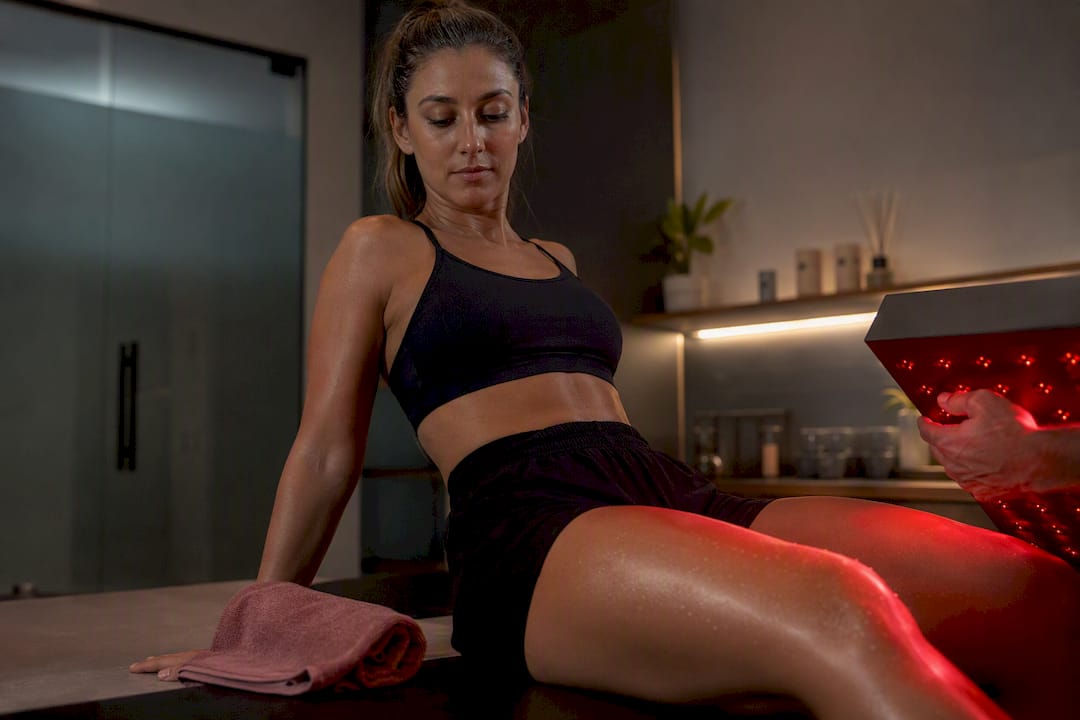
Red light therapy for muscle recovery works, but modestly and inconsistently. Clinical trials show real benefits for delayed-onset muscle soreness and some biomarkers, particularly when used before exercise with clinical-grade devices. It is not a substitute for sleep, protein, or smart training. Treat it as a supporting tool, not a shortcut.
TL;DR:
Red light therapy can modestly reduce muscle soreness around 72 to 96 hours after exercise, especially when used before training with a high-quality device.
Effective treatment depends on proper wavelength (660 nm for superficial, 800-850 nm for deep tissue), sufficient irradiance, and close skin proximity.
Consistent sessions of 10 to 15 minutes, repeated 3 to 5 times weekly for at least four weeks, are necessary to see measurable benefits.
Benefits are more reliable for soreness and biomarkers like creatine kinase, but performance improvements remain inconsistent across different protocols.
Combining red light therapy with other recovery methods requires careful timing, and higher-powered clinical devices tend to deliver more reliable results than at-home units.
Table of Contents
What Happens Inside a Muscle Cell Under Red Light?
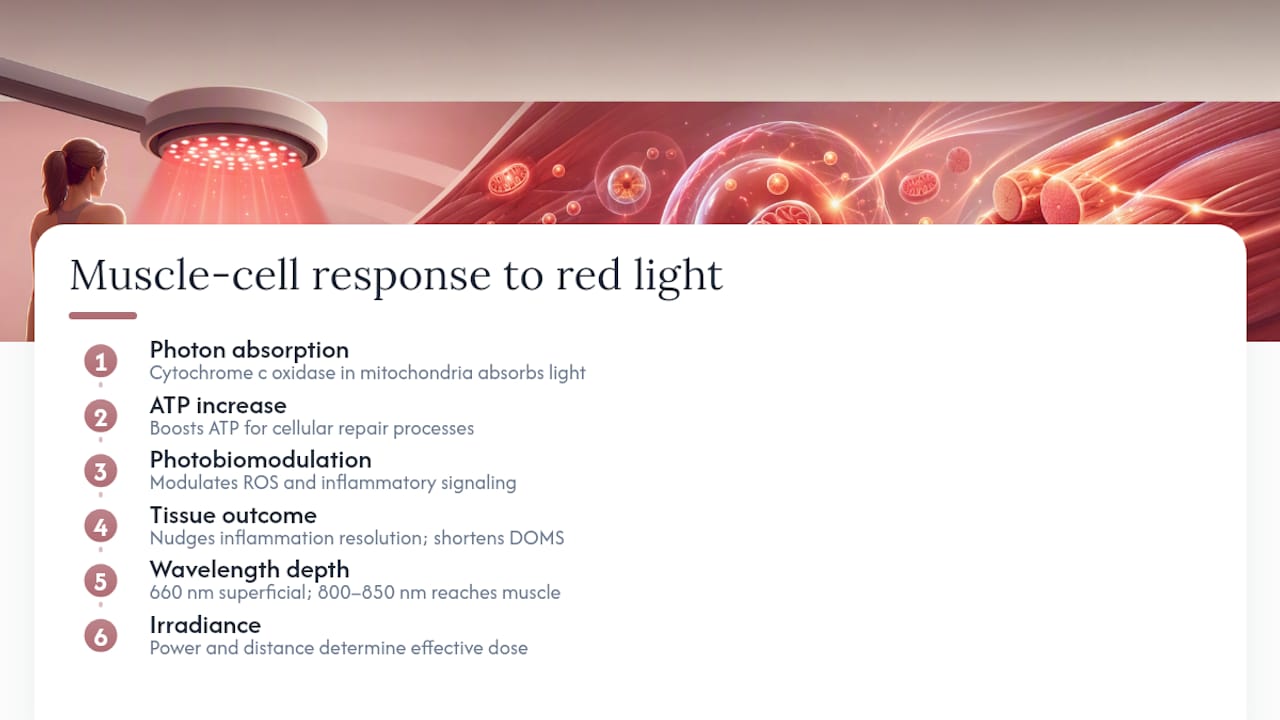
The mechanism behind red light therapy muscle recovery starts inside the mitochondria, the energy factories of every muscle cell. Red and near-infrared light gets absorbed by a mitochondrial chromophore called cytochrome c oxidase, a key enzyme in the electron transport chain. When this molecule absorbs photons, it appears to boost ATP production, giving cells more usable energy to fuel repair processes after exercise damages muscle fibers.
That energy boost sets off a chain reaction. Photobiomodulation, the clinical term for this light-based cellular effect, has been shown to modulate reactive oxygen species and influence inflammatory signaling pathways within muscle tissue, according to a foundational review of photobiomodulation in sports performance. Reactive oxygen species aren’t inherently bad. Some oxidative signaling is necessary for muscle adaptation, but excess buildup after intense training contributes to the soreness and swelling you feel a day or two later. By tempering that oxidative load and nudging inflammatory pathways toward resolution rather than escalation, red light exposure may shorten the window between damage and repair.
Wavelength matters here in ways that surprise a lot of people who assume “red light is red light.” Light around 660 nanometers penetrates only a few millimeters, making it well suited for skin and superficial tissue. Getting light deep enough to influence muscle bellies, particularly in larger muscle groups like the quadriceps or glutes, typically requires near-infrared wavelengths in the 800 to 850 nanometer range. These longer wavelengths pass through skin and fat with less scattering, reaching the muscle fibers where the actual damage and repair are happening.
Irradiance, meaning how much light energy hits the tissue per second, matters just as much as wavelength. A device can advertise the “right” wavelength and still deliver a clinically useless dose if its power output is too low or the treatment distance too far. This is where the gap between a $40 red light mask and a clinic laser becomes physiologically meaningful, not just a marketing distinction. A device without meaningful irradiance is producing a light show, not a treatment.
What Do Meta-Analyses and RCTs Actually Show?
The research on red light after workout use has matured considerably, and the honest summary is this: benefits are real but modest, and they show up more reliably for certain outcomes than others. A 2025 network meta-analysis comparing photobiomodulation against placebo and other recovery interventions found that light therapy outperformed placebo at specific timepoints after exercise, ranking favorably among recovery methods studied. That’s a meaningful data point, but “favorably ranked” is not the same as “dramatically effective.”
Overall evidence certainty across these reviews tends to land in the low-to-moderate range. That phrase, borrowed from how systematic reviewers grade confidence in pooled results, means the direction of effect (light therapy helps) is probably real, but the size of that effect and how consistently it replicates across different populations and devices remains uncertain. This is normal for a field still working out its optimal dosing and timing, not a sign that the whole idea is bunk.
Here’s where the evidence gets genuinely useful for someone deciding whether to try light therapy for sore muscles:
Later-phase soreness reduction is the most reproducible finding. Multiple trials report pain reduction at the 72 to 96 hour mark after exercise, which happens to be exactly when DOMS (delayed-onset muscle soreness) typically peaks.
Creatine kinase, a blood marker of muscle fiber damage, drops in some protocols. Narrative reviews summarizing trial data on PBM and muscle biomarkers report reduced CK levels following light exposure in several studies, suggesting less structural damage or faster clearance.
Performance markers show occasional but inconsistent gains. Some protocols report improvements in maximal voluntary isometric contraction (MVIC) strength and resistance to fatigue, but plenty of other trials find no measurable performance difference at all.
A 2025 meta-analysis pooling 19 randomized controlled trials found that pre-exercise light exposure reduced muscle soreness, though the authors rated this as low-certainty evidence, meaning future research could shift the conclusion in either direction.
Why the inconsistency? Heterogeneity is the honest answer, and it’s worth understanding rather than glossing over. Trials differ wildly in dosing (some deliver a fraction of the energy others use), device type (clinical lasers versus consumer LED panels), participant training status (trained athletes respond differently than sedentary volunteers), and which muscle group gets treated. A 2022 review tracking these patterns found that sex, training background, and dose all moderate outcomes, meaning the same protocol can produce different results in different people.
The device gap deserves its own callout, because it explains a lot of the “why did this study work when that one didn’t” confusion. A 2024 review in the Journal of Functional Morphology and Kinesiology points out that many of the trials with the clearest positive outcomes used clinical laser devices, which deliver coherent, concentrated light at controlled doses. Consumer LED panels, while genuinely capable of photobiomodulation, generally can’t match that consistency of output. That single distinction, laser versus LED, quietly explains why your friend’s at-home panel might not replicate the results from a published clinical trial.
Sports medicine researchers at Stanford Medicine have echoed this caution in their own review of the science behind red light therapy, noting that while the mechanism is plausible and some outcomes look promising, broad claims about athletic performance enhancement outrun what the current evidence actually supports. That’s not a dismissal. It’s a reasonable calibration of expectations.
Should You Use It Before or After Your Workout?
Timing changes everything with red light therapy for sore muscles, and this is one area where the research offers fairly clear, actionable guidance. Pre-exercise application, sometimes called preconditioning, has the most replicated positive results across multiple trials and meta-analyses. Athletes exposed to red or near-infrared light shortly before training tend to show better outcomes on DOMS and biomarker measures than those who skip pretreatment entirely.
Insight from the 2025 network meta-analysis reinforces this pattern: pre-exercise application tends to outperform purely post-exercise use when researchers measure DOMS outcomes days later. The theory is that priming mitochondria before muscle damage occurs gives cells a head start on managing the oxidative stress that follows.
Post-exercise use isn’t useless, though the picture is messier. Applying light after training can still help, particularly with reducing soreness in that 72 to 96 hour window when DOMS is at its worst. But findings across studies are mixed enough that you shouldn’t expect post-workout sessions alone to eliminate soreness.
Practical timing options that show up across published protocols include:
Pre-exercise sessions of 5 to 15 minutes, applied directly to the muscle groups about to be trained.
Some trials extend pre-exercise exposure to 20 to 30 minutes, particularly with lower-powered consumer devices trying to reach an adequate dose.
Post-exercise sessions typically mirror pre-exercise timing, applied within an hour of finishing training for best consistency.
Combining both (a short pre-exercise dose plus a post-exercise session) appears in some study designs, though this “double dosing” approach hasn’t been isolated well enough to call it definitively superior.
Session length varies this much partly because device power varies this much. A clinical laser might need only a few minutes per zone to deliver a therapeutic dose, while a lower-powered LED panel could need triple that time to reach comparable energy delivery. There’s no universal “right number of minutes,” only a right amount of light energy delivered to the tissue.
What Wavelength, Dose, and Distance Actually Matter?
If you’re trying to build an actual protocol rather than just knowing the theory, three variables decide whether a session does anything: wavelength, dose, and distance from the skin.
Wavelength. Most trials showing benefit use a combination approach, roughly 660 nanometers paired with something in the 800 to 850 nanometer near-infrared range. The shorter wavelength handles superficial tissue; the longer one reaches deeper into muscle. A device offering only one narrow wavelength band may be undertreating whichever tissue layer that wavelength doesn’t reach well.
Dose and energy. Researchers measure light dose in joules per square centimeter (J/cm²), sometimes described as “energy per zone” when treating a specific muscle group. Trials reporting benefit span a fairly wide dose range, and honestly, the science hasn’t nailed down one universal optimal number. What matters more practically is understanding that dose equals power output multiplied by time. A weaker device needs longer exposure to reach the same energy delivery as a stronger one; a device held further from skin loses irradiance rapidly, since light intensity drops off sharply with distance.
Session frequency. Study protocols commonly use several sessions per week during active training blocks, though some designs cluster sessions around competition or heavy training days rather than spreading them evenly.
Distance. Closer generally means higher irradiance and a more effective dose in less time. Most clinic protocols position panels or laser heads within inches of the skin, not across a room.
Here’s what to actually check before trusting a device to deliver a real dose:
Stated wavelength(s), ideally covering both the ~660 nm and ~800 to 850 nm ranges for combined superficial and deep tissue effect.
Irradiance output, measured in milliwatts per square centimeter, not just total wattage of the unit.
Treatment area size, since a small panel treating a large muscle group like the hamstrings will underdose most of the tissue.
Manufacturer transparency, meaning the company publishes actual specs rather than vague marketing language like “clinical strength.”
Pro Tip: Clinical-grade lasers and LED arrays used in treatment settings generally deliver higher, more consistent irradiance than home devices. If you’re using a consumer panel, plan on longer sessions held closer to the skin to have any realistic shot at matching the energy doses used in published trials.
What Chevonne Sees in Clinical Practice
Working with clients across a wide range of training backgrounds gives you a pretty clear sense of who actually benefits from LED therapy for recovery. Chevonne, Fundamentalskin’s Dermal Clinician, notes that the clients who report the most noticeable difference tend to be those training frequently enough to accumulate soreness week over week, rather than occasional gym-goers doing light sessions.
Device grade matters just as much in a clinic setting as it does in the research. Higher-powered clinical devices can deliver a therapeutic dose in a shorter, more predictable session, which is part of why in-clinic LED therapy tends to produce more consistent irradiance than most home setups. That consistency is the real advantage of clinic-based treatment, not novelty.
In practice, LED therapy rarely stands alone. It’s frequently paired with other treatments as part of a broader recovery or skin-focused plan, with the sequencing and timing adjusted to the individual rather than applied as a one-size-fits-all routine. A client focused primarily on exercise recovery gets a different approach than one using light therapy alongside a facial treatment plan. If you want to understand the underlying mechanism before booking anything, how LED light therapy works on skin and tissue is worth reading first, since the same photobiomodulation principles apply whether the target is a sore hamstring or dull skin texture.
Is Red Light Therapy Safe? Precautions to Know
Red light therapy carries a strong safety profile overall, but “generally safe” doesn’t mean “no precautions needed.”
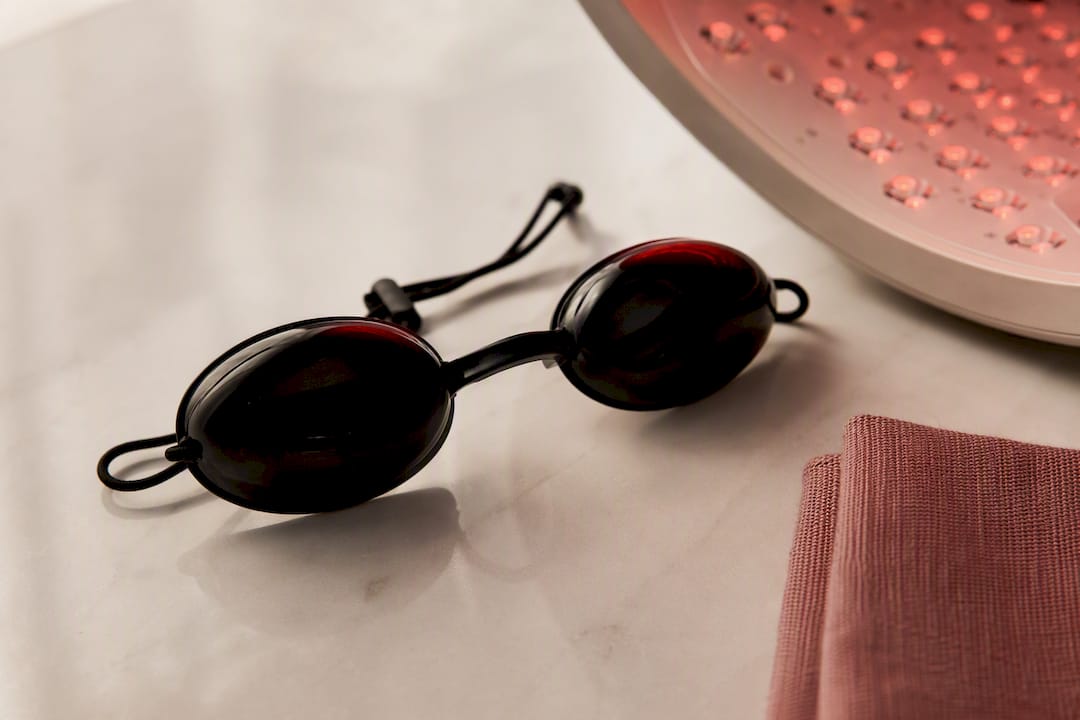
Eye protection comes first. Direct exposure to concentrated red or near-infrared light, particularly from clinical lasers, can be uncomfortable and potentially harmful to the eyes. Use the goggles or shields provided with any device, and never stare directly into an active panel or laser head.
Certain conditions warrant a conversation with a clinician before starting. Photosensitivity, whether from a medication, a skin condition, or a diagnosed sensitivity disorder, can change how skin responds to light exposure. Pregnancy and active malignancy are commonly flagged as situations where a doctor’s input matters before beginning any light-based therapy, since research specific to those populations is limited. Fundamentalskin’s partner resource on red light therapy contraindications covers this ground in more detail if you fall into any of these categories.
Device quality is a safety issue, not just an effectiveness one. According to WebMD’s overview of red light therapy, office-based devices are typically more powerful than consumer units, which cuts both ways: more power can mean faster, more effective sessions, but it also means device specs and manufacturer transparency matter more. Red flags include:
Missing or vague irradiance specifications on the product listing.
No stated wavelength range, or wavelengths outside the 630 to 850 nanometer therapeutic window.
Marketing claims promising dramatic results with no mention of dose, frequency, or realistic timelines.
How Do You Actually Start Using It?
Building a red light treatment for athletes routine doesn’t require guesswork if you follow a structured trial period.
Pick a starting protocol. Try a 10 to 15 minute pre-exercise session on the muscle groups you’re about to train, positioned close to the skin per your device’s instructions.
Add a post-exercise session if soreness has been a recurring issue. Apply within an hour of finishing training, targeting the same muscle groups.
Repeat 3 to 5 times weekly for at least four to six weeks before judging whether it’s working. Photobiomodulation effects build with consistency, not a single session.
Track something measurable. Rate soreness on a simple 1 to 10 scale the day after training, note how quickly you feel ready to train that muscle group again, and if possible, track a functional measure like squat depth or grip strength that tends to dip when you’re sore.
Reassess at the six-week mark. If soreness scores are trending down and recovery feels faster, keep going. If nothing has changed despite consistent use, the dose, device, or timing likely needs adjusting before you write off the whole approach.
Pro Tip: Keep your tracking simple. A soreness rating logged in your phone’s notes app for six weeks tells you more than any single “how do I feel today” impression.
What Results Should You Realistically Expect?
Effect sizes across the research are modest and variable, which is the honest headline after all the mechanism talk and trial data. Red light therapy is best understood as an addition to your existing recovery habits, not a substitute for the practices that do the heavy lifting: sleep, adequate protein, and progressive training load management.
Most disappointing results trace back to a handful of fixable problems. Insufficient dose, from too short a session or a device held too far from skin, is probably the most common culprit. Wrong wavelength selection, particularly relying only on 660 nanometer light for a deep muscle group that needed near-infrared penetration, is another. Inconsistent use undermines results just as badly. A session here and there won’t replicate what a 3 to 5 times weekly protocol produces in trials. And sometimes the real issue isn’t the light therapy at all. It’s poor sleep or under-fueling masking as “the light isn’t working.”
Give any protocol four to six weeks of consistent use before deciding. Track soreness scores and how quickly you’re ready to train the same muscle group again. If those numbers haven’t budged after a genuine trial period, the issue is likely dose or device, not the underlying science.
Does It Work the Same for Every Muscle Group?
Not all muscle groups respond identically to red light therapy for muscle recovery, and exercise type shapes outcomes as much as the muscle itself. Larger muscle groups like the quadriceps, hamstrings, and glutes sit deeper beneath skin and fat, meaning they need near-infrared wavelengths with adequate irradiance to see any real effect. Smaller, more superficial muscles like the biceps or forearm flexors respond more readily to shorter wavelength red light since there’s less tissue to penetrate.
Exercise type matters too. Eccentric-heavy movements, think downhill running or the lowering phase of a heavy squat, cause more microscopic muscle damage than concentric-dominant work, and DOMS tends to be more severe as a result. That’s also where light therapy’s soreness-reduction effect tends to be most noticeable, simply because there’s more soreness to reduce. Endurance athletes dealing with cumulative fatigue across a training block may notice more subtle, harder-to-measure benefits compared to a lifter recovering from one brutal leg day with obvious, trackable soreness.
Trained versus untrained status factors in as well. Research tracking heterogeneity in outcomes notes that participant training background moderates how much benefit shows up, which likely reflects that trained individuals recover through more efficient pathways already, leaving less room for a light-based intervention to show a dramatic difference.
Can You Combine It With Massage or Cold Therapy?
Red light therapy doesn’t operate in isolation from your other recovery habits, and how you sequence it with massage, cryotherapy, or other modalities can change the outcome. Massage and light therapy generally pair well, since manual therapy addresses tissue tension and circulation while photobiomodulation works at the cellular level. Sequencing light therapy before a massage session, when muscles are still primed from the light exposure, is a common approach in clinical settings.
Cryotherapy is a more complicated pairing. Some narrative reviews note that combining photobiomodulation with cold exposure, whether ice baths or cryo chambers, can interact in ways that actually reduce light therapy’s effectiveness. The proposed explanation involves cold’s vasoconstricting effect potentially limiting the circulatory and cellular responses that photobiomodulation relies on. If you’re using both, spacing them apart by several hours rather than stacking them back to back is a reasonable approach until more targeted research clarifies the interaction.
The practical takeaway is that combining modalities isn’t automatically better. Timing and sequence matter, and a clinic-based approach that individualizes when each treatment happens tends to outperform a haphazard “throw everything at recovery” strategy.
Clinician Takeaway: When We Recommend Red Light Therapy
We recommend red light therapy most confidently for clients training frequently enough that DOMS is a recurring issue, not an occasional annoyance. If you’re already sleeping well, eating enough protein, and managing training load sensibly, light therapy can be a genuinely useful add-on.
Clinic-based, higher-power devices make the most sense when consistency and combined treatment planning matter, particularly for clients pairing recovery goals with other treatments. At-home devices can work fine for motivated users willing to hold sessions longer and closer to compensate for lower output.
Sleep, nutrition, and progressive training remain the primary levers. Light therapy supports that foundation. It doesn’t replace it.
— chevonne
Experience Consistent LED Therapy at Fundamentalskin
Getting a consistent, adequately dosed session at home takes discipline that most people don’t maintain for six straight weeks. Fundamentalskin’s Biomimetic Peel + LED Therapy package solves that consistency problem by delivering clinical-grade irradiance in a single, properly timed session, paired with a Larimedical Biomimetic Peel that supports skin health alongside your recovery goals.

In-clinic sessions remove the guesswork around distance, dose, and session length that trips up most home protocols. You get the wavelength combination and power output that published trials actually used, delivered by a Dermal Clinician who adjusts sequencing based on what you’re training for and what your skin needs. If a single LED session is more your starting point, the red light therapy single session option lets you test the waters before committing to a package. Book a session and give your recovery routine the dose consistency the research says actually matters.
Sources
Recommended
Comments