.png)
Evidence From 19 Trials: Azelaic Acid for Rosacea in Australia

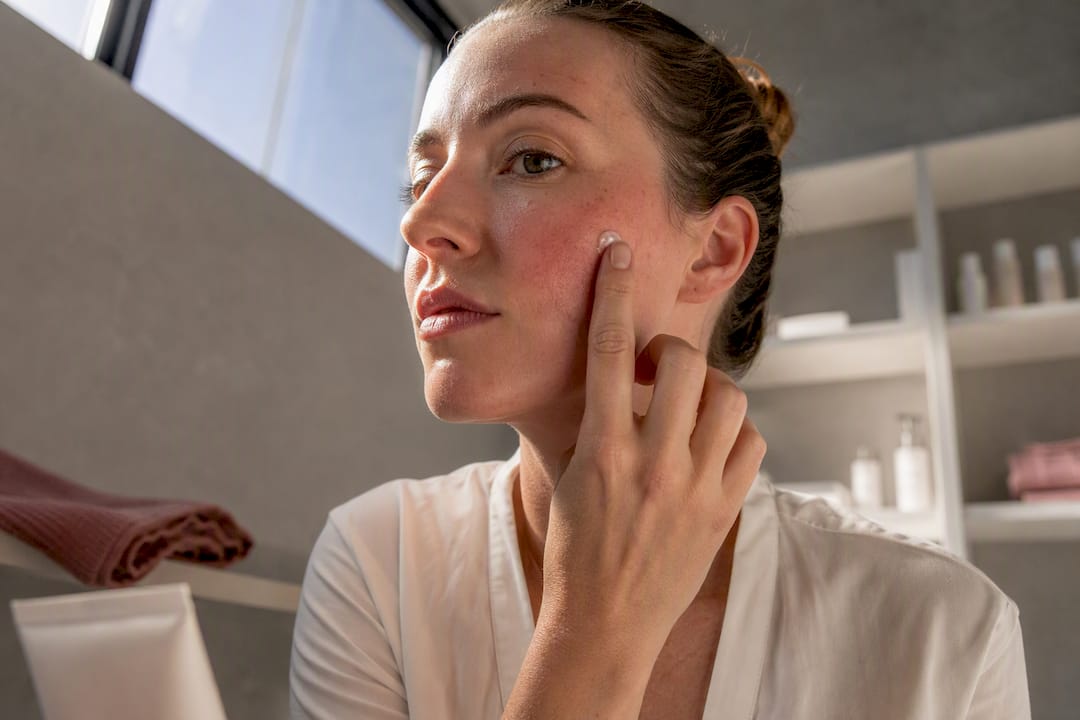
Azelaic acid is one of the best-supported topical treatments for the papules and pustules of rosacea, with clinical trials showing meaningful lesion reduction over several weeks of consistent twice-daily use. It works well on inflammatory breakouts, but it does little for the fixed redness and visible blood vessels of telangiectasia, which usually need procedural care instead. If you stick with it consistently, gradual improvement is the realistic expectation, not an overnight fix.
TL;DR:
Azelaic acid reliably reduces inflammatory papules and pustules in rosacea when used consistently over 12 to 15 weeks, with better results at higher concentrations but increased irritation risk.
It works through anti-inflammatory, antibacterial, anti-keratinizing, and antioxidant effects, but has minimal impact on persistent redness and visible blood vessels, which require laser or light-based procedures.
Proper application includes gentle cleansing, applying a thin layer twice daily, starting slow if sensitive, and consistently using sunscreen to prevent irritation and enhance results.
Common side effects are mild and temporary, such as stinging, dryness, or redness; severe reactions like swelling or blisters should prompt immediate medical consultation.
Combining azelaic acid with other treatments is generally safe but should be carefully spaced to avoid irritation, and long-term use often involves maintenance at reduced frequency under a clinician’s guidance.
Table of Contents
How Azelaic Acid Works for Rosacea Redness and Bumps
Azelaic acid is a naturally occurring dicarboxylic acid, commonly applied topically in formulations such as gels or foams at typical concentrations around 15%, or creams at slightly higher concentrations depending on the country and product. It’s not a single-action ingredient. It works on several fronts at once, which is part of why it holds up so well against other rosacea treatments in head-to-head comparisons.
Mechanistic reviews describe four overlapping effects that make azelaic acid useful for rosacea specifically, rather than for redness in general:
Anti-inflammatory action: it inhibits the production of reactive oxygen species and dampens the cathelicidin and kallikrein pathways that drive rosacea flares, according to a detailed review of azelaic acid’s mechanisms of action.
Antibacterial effect: it reduces the bacterial load associated with follicular inflammation, which contributes to papules and pustules.
Anti-keratinizing effect: it normalizes the shedding of skin cells inside follicles, reducing the buildup that can worsen breakouts.
Antioxidant activity: it helps neutralize oxidative stress in skin that’s already inflamed and reactive.
That combination explains the pattern clinicians see again and again: azelaic acid reliably calms the bumps and pustules of papulopustular rosacea, but it has a much smaller effect on the visible dilated vessels and persistent background redness known as telangiectasia. For that kind of vascular redness, reviews of rosacea treatment point toward laser or light-based procedures rather than topical therapy, a distinction covered in an Australian Prescriber update on rosacea treatment.
Formulation matters too. Gel and foam vehicles tend to feel lighter and absorb faster, which some people with oily or combination rosacea-prone skin prefer. Cream bases sit heavier but can feel more comfortable on skin that’s already dry or barrier-compromised. Neither vehicle changes the active ingredient’s mechanism, but the vehicle does change how well you’ll tolerate it day to day, and tolerability is often what determines whether people actually stick with the routine long enough to see results.
What the Clinical Trials Actually Found
The evidence behind azelaic acid for rosacea isn’t thin or speculative. It rests on randomized controlled trials, a direct comparison against one of the other standard topical treatments, and a 2025 network meta-analysis that pooled data across nearly two decades of research.
The numbers that matter: In a randomized trial comparing azelaic acid gel around 15% against metronidazole gel at 0.75% over about 15 weeks, azelaic acid produced a notably greater mean reduction in inflammatory lesions compared with metronidazole, according to the head-to-head trial published in JAMA Dermatology. Azelaic acid also showed better improvement in erythema over the same period.
That trial matters because metronidazole has long been treated as a default first-line option for rosacea, and azelaic acid outperformed it on the key metric of reducing inflammatory lesions. Improvement built steadily across the study period, aligning with clinical expectations that azelaic acid acts as a slow, cumulative treatment rather than a fast fix.
The more recent picture comes from a network meta-analysis published in JAAD International in 2025, which pooled 19 randomized controlled trials covering 8,208 participants across multiple topical agents used for papulopustular rosacea. Two findings stand out:
Azelaic acid 20% ranked highest for improving Investigator’s Global Assessment (IGA) scores in moderate to severe papulopustular rosacea, with a P-score of 0.97, essentially the strongest relative performance among the agents compared, though wide confidence intervals mean this ranking should be read as a signal rather than a certainty.
Azelaic acid 15% carried a higher adverse-event risk, with an odds ratio of 1.95 for adverse events compared with placebo, a trade-off worth knowing before you commit to a concentration.
That doesn’t mean azelaic acid is right for everyone. It means that if inflammatory lesion count is your main concern, the concentration and formulation trade-offs are real and worth discussing before you pick a product off a shelf.
What does this mean for a typical rosacea patient starting treatment? Based on the trial data, someone using 15% azelaic acid gel consistently for 12 to 15 weeks has a reasonable chance of seeing a meaningful drop in papules and pustules, on the order of what the JAMA Dermatology trial reported. The safety trade-off is that a higher-potency approach, or higher concentration, tends to bring a higher chance of stinging or irritation along with it. That’s the calculation, not a guess: more potency for lesion clearance, more risk of skin reactivity.
How to Use Azelaic Acid the Right Way
Getting results from azelaic acid has less to do with the product itself and more to do with how patiently and consistently you apply it. Rosacea-prone skin is reactive by nature, so rushing the process tends to backfire.
Cleanse gently first. Use a fragrance-free, non-foaming cleanser before application. Harsh cleansers strip the barrier and set up unnecessary stinging later.
Apply a thin layer. Mayo Clinic’s prescribing guidance recommends applying a thin layer to affected areas twice daily, not a thick coat. More product does not mean faster results, it just means more irritation.
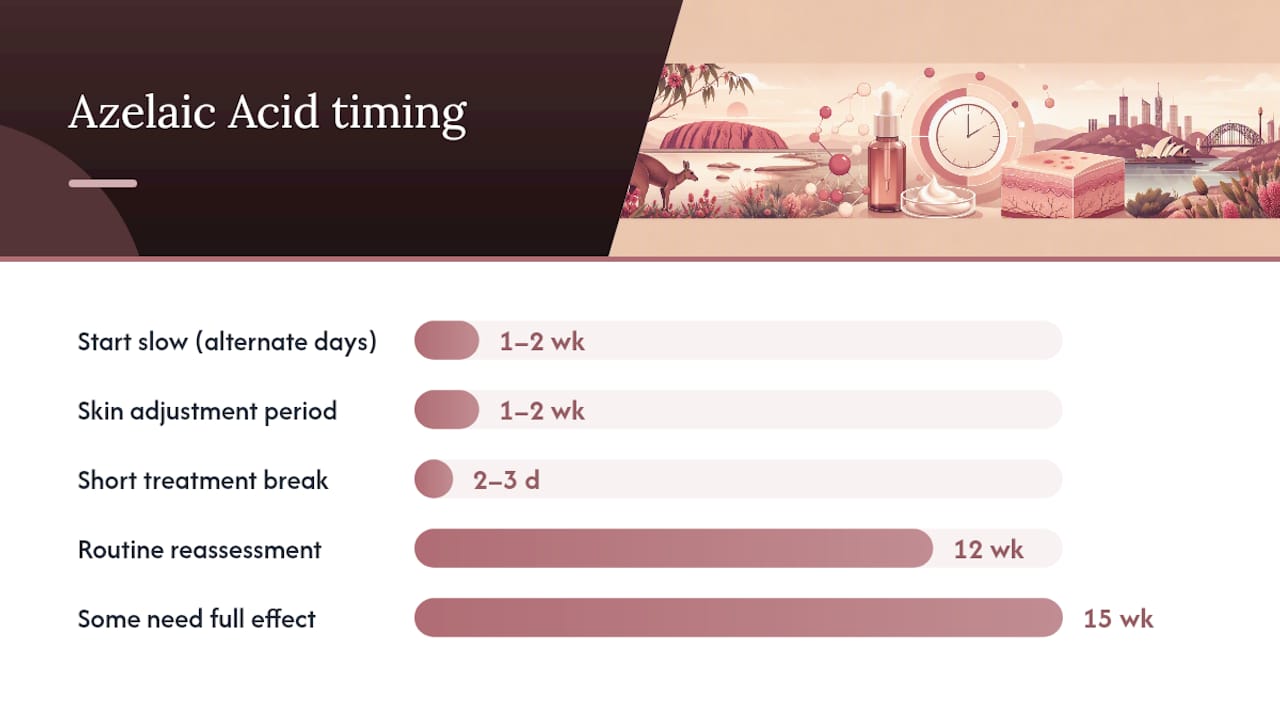
Start slow if your skin is sensitive. Many clinicians suggest beginning with alternate-day application for the first one to two weeks before working up to the standard twice-daily regimen.
Layer sunscreen every morning. Rosacea skin is already photosensitive, and azelaic acid can add mild extra sensitivity during the adjustment period.
Reassess at 12 weeks. If you’re seeing no change in lesion count or redness by that point, that’s the moment to check with a clinician rather than assuming the product has failed outright, since some patients need closer to 15 weeks to see the full effect.
Pro Tip: If your skin stings within the first minute of application but the sensation fades within a few minutes, that’s usually a normal adjustment response, not a sign you need to stop. Persistent burning that lasts an hour or more is a different story and worth flagging to your clinician.
Choosing between gel/foam at 15% and cream at 20% often comes down to your skin’s baseline sensitivity. The lower concentration in a lighter vehicle is the more forgiving starting point for most people with rosacea, particularly those who also deal with dryness or barrier issues.
If irritation shows up and doesn’t settle, don’t abandon the product outright. Reduce application to once daily for a week, add a bland, fragrance-free moisturizer underneath, or take a short two to three day break before resuming. Most people who experience early irritation adjust within one to two weeks once the skin barrier catches up to the new routine.
Side Effects You Should Actually Expect
Local skin reactions are the most common issue with topical azelaic acid, and they’re usually mild and temporary rather than a sign something has gone wrong.
Stinging or burning on application, typically strongest in the first one to two weeks and fading as skin adjusts.
Itching or dryness, often manageable with a simple, fragrance-free moisturizer layered after the active has absorbed.
Mild redness or flushing immediately after application, which is different from rosacea’s baseline redness and tends to settle within the hour.
The 2025 network meta-analysis found that 15% azelaic acid carried an odds ratio of 1.95 for adverse events compared with placebo, meaning people using it were roughly twice as likely to report a side effect than those on an inactive treatment, though most reported events were the local skin reactions listed above rather than anything systemic.
Product labeling, including prescribing information listed on DailyMed, lists application-site burning, stinging, pruritus, and dryness as the expected local reactions, and recommends contacting a clinician if irritation persists or worsens rather than pushing through severe discomfort. Because azelaic acid is applied topically and absorption into the bloodstream is minimal, systemic side effects are uncommon, though anyone with a known sensitivity to the ingredient should avoid it and discuss alternatives with a clinician.
Red flags that warrant a call to your dermatologist or GP include swelling, blistering, severe pain rather than mild stinging, or any sign of an allergic reaction like hives spreading beyond the treated area. Those are not typical adjustment symptoms and shouldn’t be managed by waiting it out.
Combining Treatments and Knowing When to See a Specialist
Azelaic acid doesn’t have to work alone, and for moderate rosacea it often doesn’t. Clinical practice frequently pairs topical azelaic acid with oral doxycycline for patients whose papules and pustules don’t fully resolve on topical therapy alone, an approach reflected in broader rosacea treatment guidance from Australian Prescriber. The oral antibiotic addresses inflammation systemically while the topical continues working at the skin surface.
For the vascular side of rosacea, the persistent redness and visible vessels that azelaic acid doesn’t reliably touch, laser and light-based procedures are the usual next step once topical options have been given a fair trial.
A handful of situations call for a specialist visit rather than more time on a topical routine:
Severe or rapidly worsening disease, especially with thickening skin or nodules.
Ocular symptoms like dry, gritty, or red eyes, which can signal ocular rosacea and need targeted assessment.
No meaningful improvement after 12 to 15 weeks of consistent, correctly applied azelaic acid.
Intolerable side effects that don’t settle with the usual troubleshooting steps.
Before a specialist appointment, it helps to bring a simple record: what products you’ve used, how often, for how long, and a few photos taken in consistent lighting over time. That gives the clinician something concrete to work from instead of relying on memory of how your skin looked three months ago.
A Clinician’s Barrier-First Protocol for Rosacea
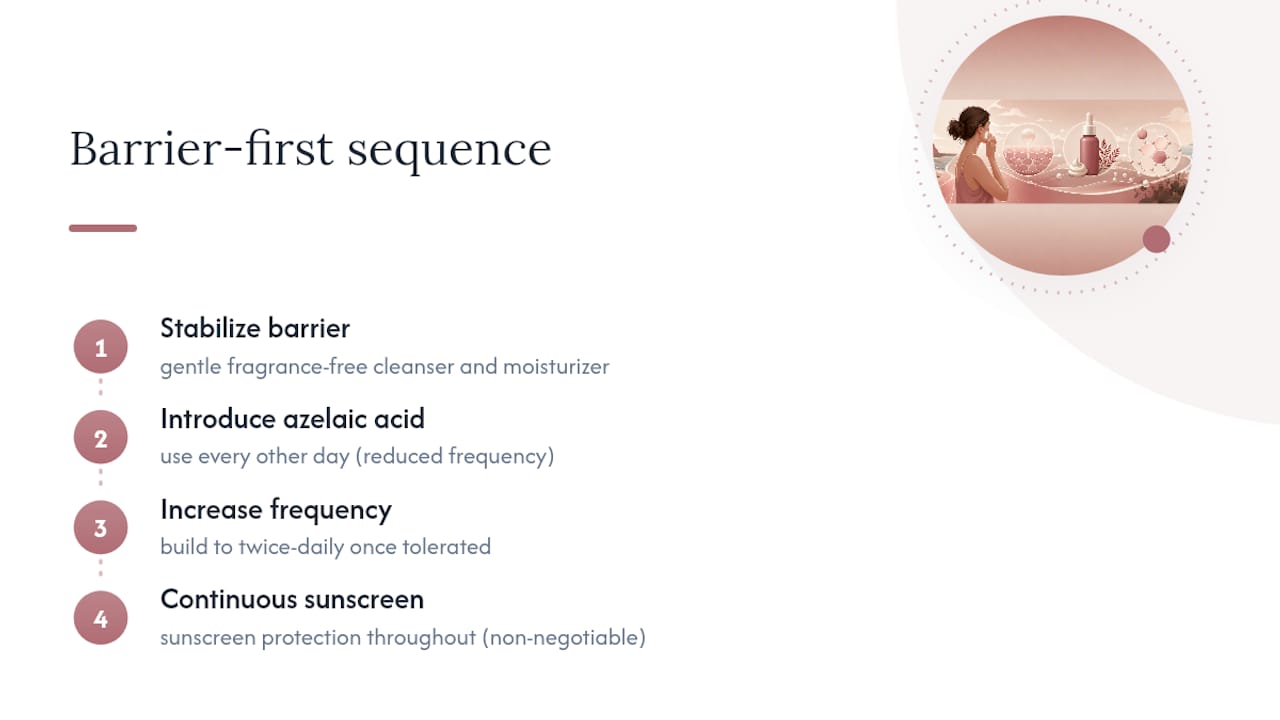
An experienced dermal clinician approaches azelaic acid as one part of a bigger plan, not a standalone fix. The Barrier-First Clinic Approach starts by preparing and repairing the skin barrier before introducing an active ingredient, since rosacea-prone skin that’s already compromised will react to almost anything applied to it.
The practical sequence looks like this: stabilize the barrier with gentle, fragrance-free cleansers and moisturizers first, introduce azelaic acid at a reduced frequency (every other day rather than daily), then build up to the standard twice-daily regimen only once the skin shows it can tolerate the active without excessive stinging. Sunscreen is non-negotiable throughout, since rosacea skin is chronically photosensitive.
For patients whose inflammatory lesions respond slowly, or whose skin needs extra support alongside topical therapy, in-clinic adjuncts like a structured red light therapy plan can complement the at-home routine by calming inflammation without adding another irritant to the skin. None of this replaces a dermatologist’s input for moderate to severe disease. It’s a practical bridge for people managing mild to moderate rosacea who want a structured, low-irritation way to introduce an evidence-backed active.
Who Should Be Cautious With Azelaic Acid
Azelaic acid is generally well tolerated, but it isn’t automatically the right choice for every rosacea patient. Anyone with a known hypersensitivity to azelaic acid or to any inactive ingredient in a specific formulation should avoid that product and ask a pharmacist or clinician about alternatives.
People with significantly compromised skin barriers, active eczema flares in the treatment area, or open wounds or broken skin should hold off on starting azelaic acid until the skin has settled, since applying an active acid to already-inflamed or broken skin tends to amplify irritation rather than help.
Precaution also applies to combination use. Layering azelaic acid with other actives that carry their own irritation potential, strong retinoids, high-percentage exfoliating acids, or benzoyl peroxide, without spacing them out or easing in slowly raises the odds of a reactive flare. If your routine already includes other active ingredients, introduce azelaic acid on its own for the first few weeks before layering anything else back in.
Avoid applying azelaic acid near the eyes, on broken or sunburned skin, or immediately after other resurfacing procedures unless a clinician has specifically cleared it. If accidental contact with eyes occurs, rinse thoroughly with water. None of this makes azelaic acid a high-risk ingredient. It simply means the usual common-sense precautions that apply to most topical actives apply here too.
Mixing Azelaic Acid With Other Rosacea Treatments
Azelaic acid tends to play well with other rosacea-focused treatments, which is part of why it shows up so often in combination regimens rather than as a lone therapy. Its mechanism, calming inflammation and normalizing keratinization, doesn’t compete directly with how oral antibiotics or other topicals work, which is one reason clinicians pair it with oral doxycycline for moderate disease rather than choosing one or the other.
Where caution is warranted is in combining azelaic acid with other topical actives that carry their own irritation risk. Stacking it with retinoids, salicylic acid, or benzoyl peroxide on the same day can compound stinging and dryness well beyond what either ingredient would cause alone. If a dermatologist has you on a multi-step topical plan, applying azelaic acid in the morning and a stronger active at night, rather than layering both at once, is a common way to reduce that overlap.
Metronidazole and azelaic acid are sometimes discussed as competing options rather than complementary ones, since both target inflammatory rosacea lesions through different mechanisms. Switching between them, or trialing one after the other fails to deliver results, is more common in practice than combining both simultaneously. There’s no strong evidence supporting azelaic acid plus metronidazole as a combined regimen outperforming either used alone.
If you’re on oral isotretinoin or other systemic acne or rosacea medications, mention that to whoever prescribes or recommends azelaic acid, since skin already sensitized by systemic retinoids may need a slower introduction to any additional topical active.
Special Situations: Pregnancy, Breastfeeding, and Older Skin
Topical azelaic acid has a reassuring profile for use during pregnancy compared with many other active ingredients used for skin conditions, largely because minimal systemic absorption occurs through the skin. That said, anyone who is pregnant or breastfeeding should still run any rosacea treatment plan, azelaic acid included, past their doctor or obstetrician before starting, since individual circumstances vary and a clinician needs the full picture of what else is being used.
For breastfeeding, the same principle applies: topical application to facial skin carries a low likelihood of meaningful transfer, but confirming with a healthcare provider before starting is the responsible step rather than assuming it’s automatically fine.
Older adults generally tolerate azelaic acid well, and age itself isn’t a barrier to use. What does matter more with older skin is that it’s often thinner and slower to repair its barrier, which can mean a longer adjustment period before twice-daily application feels comfortable. Starting at reduced frequency, as outlined in the application guidance earlier in this article, is a sensible approach for older patients just as it is for anyone with a more reactive barrier.
No population needs an entirely different product. What changes across these groups is the pace of introduction and the importance of looping in a clinician before starting, not the ingredient itself.
What to Do If Your Skin Reacts Badly
A small percentage of people find that even a slow, careful introduction to azelaic acid doesn’t settle into comfortable tolerance. That doesn’t necessarily mean the ingredient is off the table permanently, but it does mean the current approach needs to change.
First step: reduce frequency further, down to two or three times a week, and give the skin two full weeks at that lower frequency before deciding whether to continue. Many patients tolerate azelaic acid after an initial adjustment period, and temporary dose reduction or a short break can often restore comfortable use without abandoning the treatment altogether, according to clinical observation from the Barrier-First Clinic Approach.
If irritation persists despite a reduced schedule, a short treatment break of three to five days, followed by reintroduction at the lowest frequency, is a reasonable next step. Pair that break with a simple, fragrance-free moisturizing routine to let the barrier recover fully before trying again.
True allergic reactions look different from ordinary irritation. Hives, significant swelling, or a rash that spreads well beyond the area where the product was applied point toward an allergic response rather than routine stinging, and that calls for stopping the product immediately and getting medical review rather than trying to push through it.
If two genuine attempts at reintroduction still result in the same reactive pattern, it’s reasonable to conclude that particular formulation isn’t a fit for your skin. That’s the point to discuss a different vehicle (switching from gel to cream, or vice versa) or a different topical altogether with a dermatologist.
Staying on Track: Long-Term Use and Maintenance
Rosacea doesn’t resolve permanently with a single course of treatment, which means the question of long-term azelaic acid use comes up for almost everyone who responds well to it initially. The good news is that azelaic acid’s safety profile doesn’t raise the kind of long-term concerns associated with some other topical actives, like the thinning risk sometimes discussed with prolonged topical steroid use.
Many patients who see improvement in the first 12 to 15 weeks continue on a maintenance schedule afterward, often at a slightly reduced frequency, once daily rather than twice, to sustain results without over-treating settled skin. That’s a decision worth making with a clinician rather than guessing, since the right maintenance frequency depends on how your individual skin responded during the active treatment phase.
Watch for signs that maintenance dosing needs adjusting: gradual return of papules and pustules suggests you may need to step back up to twice-daily use, while ongoing dryness or sensitivity suggests dropping frequency further. Rosacea is also a condition with known flare triggers, sun exposure, heat, alcohol, and certain foods among them, and no topical treatment, azelaic acid included, cancels out the need to manage those triggers alongside it. Long-term success tends to come from combining consistent topical use with trigger awareness, not from the product working in isolation.
A Clinician’s View on Living With Rosacea Long-Term
Rosacea is a chronic condition, and that single fact reframes everything else in this article. Azelaic acid doesn’t cure rosacea. It controls flares and reduces the visible burden of papules and pustules for as long as you use it consistently, which is a genuinely useful outcome, but a different promise than the word “treatment” sometimes implies to people newly diagnosed.
What I’ve come to see as the real determinant of success isn’t the product concentration or even the formulation. It’s adherence, and adherence is almost always a tolerability problem in disguise. People stop using azelaic acid not because it fails to work, but because early stinging discourages them before the 12 to 15 week window has had a chance to prove itself.
The honest conversation to have with a clinician isn’t just “does this work.” It’s “what’s the trade-off between efficacy and how my skin will feel getting there,” and that conversation should happen before frustration sets in, not after.
— chevonne
Where Fundamentalskin Fits Alongside Your Azelaic Acid Routine
Topical azelaic acid remains the right first-line, at-home foundation for managing papulopustular rosacea, and nothing here changes that. What clinic-based care adds is support for the parts topical therapy alone can’t fully address: barrier repair, inflammation that needs a hands-on approach, and the texture and tone changes rosacea leaves behind over time.

Fundamentalskin’s Biomimetic Peel + LED Therapy is built around organic, Australia-sourced ingredients and works as a barrier-supporting adjunct alongside your azelaic acid routine rather than a replacement for it, calming inflammation while supporting the skin’s own repair process. For ongoing redness and inflammation between peel sessions, a single red light therapy session offers a no-downtime option that complements at-home treatment without adding another irritant to your skin. And if your rosacea has left behind texture or tone concerns that topical therapy alone doesn’t touch, the full range of facial treatments at Fundamentalskin, led by Dermal Clinician Chevonne, gives you a clinically guided way to address them. Book a consultation to talk through where in-clinic support makes sense alongside your current routine.
Sources
This article is general information, not a substitute for advice from a qualified doctor. Consult a qualified healthcare professional about your own circumstances before acting on anything here.
FAQ
Is azelaic acid good for people with rosacea?
Yes.
How quickly does azelaic acid work for rosacea?
Improvement is gradual and builds over 12 to 15 weeks of consistent twice-daily use, based on the trial timeline reported in the JAMA Dermatology head-to-head study; most clinicians recommend reassessing around the 12-week mark.
What do people use for rosacea besides azelaic acid?
Metronidazole and ivermectin are the other commonly used topical options, alongside oral doxycycline for moderate cases and laser or light treatments for persistent redness and visible vessels that topicals don’t fully address; in-clinic support like red light therapy is sometimes used as a complementary adjunct rather than a substitute.
Can I use azelaic acid long-term for rosacea?
Yes, many patients continue on a maintenance schedule, often once daily instead of twice, once initial improvement is achieved, since azelaic acid doesn’t carry the long-term tissue concerns associated with some other topical treatments.
Recommended
Comments