.png)
Clinician Red Light Therapy Frequency for Australia: 3–5/wk

Most evidence-based protocols commonly recommend several sessions per week, with each session lasting 10 to 20 minutes per targeted area, sustained over the first several weeks of treatment. From there, the right red light therapy frequency depends on your goal and your device’s power output. Skin rejuvenation, muscle recovery, and chronic pain each follow a different rhythm, and every protocol needs weeks of consistency before results show up.
TL;DR:
Most protocols recommend starting with 3 to 5 sessions weekly during the initial 4 to 12 weeks, then reducing to 2 to 3 sessions for maintenance.
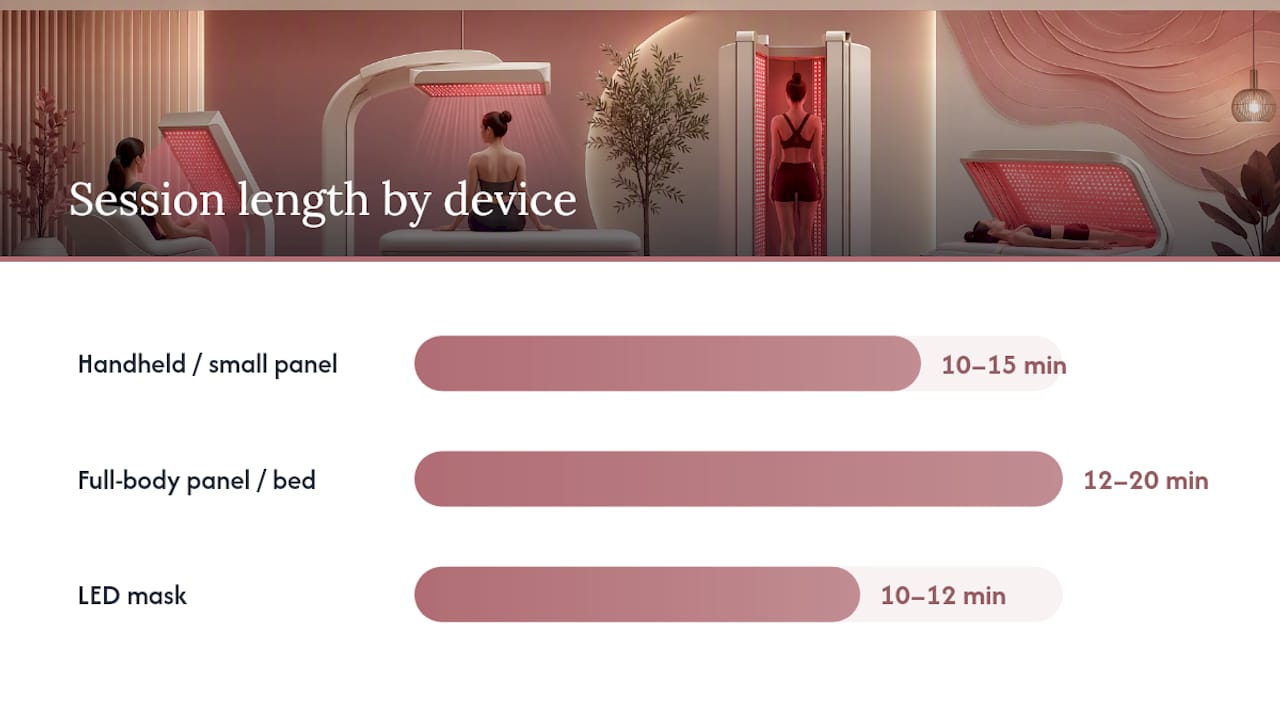
Actual session length varies by device type, typically 10 to 15 minutes for handhelds, 12 to 20 minutes for full-body panels, and 10 to 12 minutes for LED masks.
Benefits follow a dose-response curve, meaning overdoing sessions can cause skin irritation, redness, or worsening symptoms, requiring adjustment.
Device output parameters, especially irradiance and fluence, differ widely; favor devices that publish their specific metrics for effective dosing.
Consistency and patience are crucial, as visible skin or tissue changes usually require 6 to 12 weeks of sustained therapy.
Table of Contents
Red Light Therapy Frequency Guidelines: Setting a Routine That Works
Consistency beats intensity with photobiomodulation, the clinical term for red and near-infrared light treatment. A single session does very little on its own. The Cleveland Clinic notes that red light therapy requires ongoing, consistent use over weeks or months, with maintenance sessions built in once you reach your goal. Your skin cells and muscle tissue respond to cumulative dosing, not a one-off hit of light.
This is where the biphasic dose-response comes in, and it’s the single most misunderstood part of red light therapy. More light does not mean more benefit. Research on photobiomodulation shows that effects follow a curve: benefits rise with dose up to a point, then plateau, and can actually reverse if you overdo it. That’s why a device blasting maximum irradiance for 40 minutes daily can underperform a moderate 10-minute session done consistently.
Session length depends heavily on device type:
Handheld or small panels: 10 to 15 minutes per targeted area, since output is concentrated on a smaller surface.
Full-body panels or beds: often 12 to 20 minutes per session, covering multiple areas at once.
LED masks: typically 10 to 12 minutes, given their close proximity to skin.
Statistic Callout: Trials reviewed in the photobiomodulation dosing literature commonly use irradiance around 20 to 60 mW/cm² and fluence between 4 and 18 J/cm², with sessions of roughly 10 to 12 minutes delivered two to five times weekly.
A practical build phase often involves multiple sessions a week initially, tapering to fewer sessions weekly once you see visible change. For acute flare-ups, such as a pain episode or breakout, some clinicians favor short daily sessions for a period, then a pullback to an every-other-day rhythm.
What’s the Ideal Frequency for Your Specific Goal?
Frequency isn’t one-size-fits-all. Your goal changes the math.
Skin rejuvenation: Start with 3 to 5 sessions weekly for 4 to 12 weeks. A review of clinical dosing found measurable improvements in collagen production and elasticity with roughly 10 to 12 minutes a day, twice-weekly, though no single standardized protocol exists across studies. After the build phase, most people taper to 2 to 3 sessions a week for upkeep.
Acne and inflammatory skin: Monitor closely. Start at 3 sessions weekly and adjust based on how your skin responds, since inflamed skin can react differently than a normal complexion.
Hair growth: This is a long game. Trials generally use consistent sessions several times weekly for months before density changes appear, so treat it as a sustained commitment rather than a quick fix.
Muscle recovery: Timing matters more than a fixed weekly count here. Applying red light immediately after training, or within a short window afterward, tends to align better with soreness reduction than a rigid weekly quota, as outlined in clinician guidance on using red light for delayed-onset soreness.
Chronic pain: An intensive phase, often daily or near-daily during a flare, followed by tapering to 2 to 3 sessions weekly once symptoms settle.
Sleep and general wellness: Evening sessions, roughly an hour before bed, done 3 to 4 times weekly, tend to fit best into a wellness routine.
Pro Tip: Pick the schedule you can actually sustain for 8 weeks straight. A perfect protocol you abandon after 10 days beats nothing, but a slightly less aggressive one you stick with beats both.
How Do You Know If You’re Overdoing It?
Overexposure shows up as skin irritation, not just a lack of results. Healthline notes that increased inflammation, redness, stinging, or worsening symptoms are signs you’ve gone too far, and the fix is simple: reduce session time, cut back frequency, or increase your distance from the panel.
Redness that lingers past an hour after a session, rather than fading quickly.
New stinging or tightness during or after treatment.
Symptoms getting worse instead of better after two or three weeks.
Increased sensitivity to sunlight or other light exposure.
Eye protection matters regardless of frequency. Never look directly into a panel, and check with a clinician first if you’re on photosensitizing medication, since some antibiotics and acne treatments amplify light sensitivity. The American Academy of Dermatology frames red light therapy as a complementary treatment, not a stand-alone cure, and recommends consulting a professional before starting, particularly with significant skin conditions. Data on pediatric and pregnancy use remains limited, so both call for medical advice before starting any home protocol.
Why Device Specs Change Your Ideal Frequency
Two devices with the same “red light” label can deliver wildly different doses. Wavelength decides how deep the light travels. Red light around 630 to 680 nm works mostly at the skin’s surface, while near-infrared light at 800 to 850+ nm reaches deeper into tissue for muscle and joint concerns, a distinction covered in more detail in how LED light therapy works on the skin.
Irradiance (measured in mW/cm²) tells you how much light energy hits your skin per second.
Fluence (J/cm²) is the total dose delivered over a session, the figure most tied to actual results.
Distance matters enormously. Move six inches farther from a panel and your effective dose can drop by half.
Higher-powered panels need shorter sessions to hit the same fluence as a weaker device running longer.
Continuous wave delivery has stronger supporting evidence for skin and recovery goals than pulsed modes, which remain unproven as superior for general use.
A consensus review on photobiomodulation parameters urges manufacturers and users alike to track wavelength, irradiance, fluence, distance, and session frequency together, since one number alone tells you very little. Because output varies so much between brands, a product guide recommends favoring devices that publish their irradiance and fluence figures, rather than vague marketing claims.
A Clinician-Backed Phased Protocol You Can Actually Follow
A build-then-maintain structure works for most goals. Weeks 1 through 12 run at the higher end, 3 to 5 sessions weekly, to establish a biological response. After that, tapering to 2 to 3 sessions weekly maintains results without overdoing exposure.
Keep a consistent distance from your device, matching the manufacturer’s stated range.
Time sessions the same way each visit, morning or evening, so your routine stays predictable.
Track photos and any skin reactions every 2 to 4 weeks to spot changes early.
Flag any worsening symptoms to a clinician before increasing frequency further.
Pro Tip: Photograph your skin under the same lighting and angle every two weeks. Memory is unreliable, but a side-by-side photo isn’t, and it’s the fastest way to know if your current schedule is actually working.
For readers managing pigmentation or rosacea alongside red light use, a clinician-crafted rosacea protocol shows how build-to-maintenance scheduling plays out in practice, and pigmentation-specific guidance covers contraindications worth knowing before combining treatments.
A Clinician’s Note on Patience and Consistency
Real skin change from red light therapy usually takes 6 to 12 weeks, not days. Choose a schedule you can sustain, log your sessions and reactions, and let the timeline play out before judging results.
— chevonne
Get Clinician-Supervised Red Light Sessions Without the Guesswork
Figuring out the right red light therapy frequency on a home device is one thing. Getting it dosed correctly, on a schedule built around your actual skin and goals, is another. Fundamentalskin offers clinician-led sessions where cadence, session length, and device output are calibrated to you rather than left to a generic manual.

The full-body Red Light Therapy Pod delivers whole-body dosing in a single booked session, while the Biomimetic Peel + LED Therapy combination pairs LED treatment with a targeted peel for readers focused on pigmentation, redness, or texture. Both are led by a Dermal Clinician with 15 years of experience, so your frequency and session timing get adjusted based on how your skin actually responds, not a one-size-fits-all chart. If you’re ready to stop self-dosing and start a supervised routine, book a session through the Red Light Therapy Pod page.
This article is general information, not a substitute for advice from a qualified doctor. Consult a qualified healthcare professional about your own circumstances before acting on anything here.
Sources
FAQ
What Is the Best Frequency for Red Light Therapy?
For most goals, 3 to 5 sessions per week during an initial build phase works best, tapering to 2 to 3 sessions weekly for maintenance. The right cadence depends on your device’s power output and your specific goal, whether that’s skin, muscle recovery, or pain management.
How Frequently Should I Do Red Light Therapy for Skin Results?
Skin rejuvenation protocols commonly use sessions of about 10 to 12 minutes, twice weekly, for 4 to 12 weeks before results become visible, according to clinical dosing reviews. After that window, most people shift to 2 to 3 sessions weekly to hold the improvement.
Why Don’t Doctors Recommend Red Light Therapy as a Stand-Alone Treatment?
Dermatology guidance treats red light therapy as a complementary treatment rather than a cure, and the AAD recommends professional consultation before starting, especially for people on photosensitizing medication or with significant skin conditions. It works best alongside, not instead of, other dermatologist-guided care.
Can You Do Too Much Red Light Therapy?
Yes. The biphasic dose-response means benefits plateau and can reverse with excessive exposure, and Healthline notes that increased inflammation, redness, or stinging signal overexposure. If you notice these signs, reduce session time or frequency, or increase your distance from the device.
How Much Does a Red Light Therapy Session Cost at Fundamentalskin?
A Single Session in the Red Light Therapy Pod costs $69. Combined options like the Biomimetic Peel + LED Therapy are priced separately on the clinic’s site.
Recommended
Comments