.png)
Why Formulation Matters for Vitamin C and Pigmentation

Vitamin C can genuinely fade many sun- and inflammation-related dark spots, but it works gradually, not overnight. The most reliable results come from a biologically active form like L-ascorbic acid or a stable derivative in a well-formulated, well-packaged product, used daily alongside sunscreen. Most people who stick with it start noticing visible change after about 8 to 12 weeks, not days.
TL;DR:
Vitamin C mainly reduces epidermal pigmentation, such as post-inflammatory hyperpigmentation and sun spots, but deeper melasma often requires additional treatments.
Consistent daily use of a stable, 10-20% L-ascorbic acid serum paired with sunscreen typically shows visible fading after 8 to 12 weeks.
Packaging with an airless pump or opaque, water-free formulas helps maintain vitamin C stability and efficacy over time.
Combining vitamin C with stabilizers like vitamin E and ferulic acid enhances antioxidant protection and prevents oxidation, improving results.
For stubborn or deep pigment, professional treatments like peels, IPL, or skin needling may be necessary to accelerate fading beyond topical routines.
Table of Contents
Which Types of Pigmentation Actually Respond to Vitamin C?
Not all dark spots are built the same, and that matters enormously when you’re deciding whether vitamin C for pigmentation is even the right tool. Post-inflammatory hyperpigmentation (PIH) shows up after acne, a cut, a bug bite, or any skin trauma, and it sits mostly in the epidermis, the skin’s upper layer. Solar lentigines (commonly called age spots or sun spots) are flat, well-defined patches caused by cumulative UV exposure, also largely epidermal. Melasma, on the other hand, tends to reach deeper into the dermis and is driven by hormonal triggers as much as sun exposure, which is why it behaves so differently.
Depth is the deciding factor. Vitamin C works primarily where melanin is actively being produced in the upper skin layers, so epidermal pigment (most PIH and many sun spots) tends to respond well to consistent topical use. Melasma and deeper dermal pigment often need more than a serum. They frequently require a combined approach, sometimes including professional treatment, to see meaningful fading.
Before you commit to a vitamin C serum for hyperpigmentation as your sole strategy, run through this quick self-check:
Did the spot appear after a breakout, injury, or irritation? PIH is likely, and topical vitamin C is a strong first move.
Has the spot been present for years with no clear trigger, and does it darken further in summer? Likely sun-driven, and vitamin C plus rigorous sun protection helps.
Does the pigment appear as larger, symmetrical patches on the cheeks, forehead, or upper lip, often worsening with hormonal shifts? This points to melasma, where topical vitamin C alone is usually not enough.
Is the patch very dark, longstanding, or resistant to at-home care? That’s a signal to get a professional opinion rather than guessing.
How Vitamin C Reduces Pigmentation at the Cellular Level
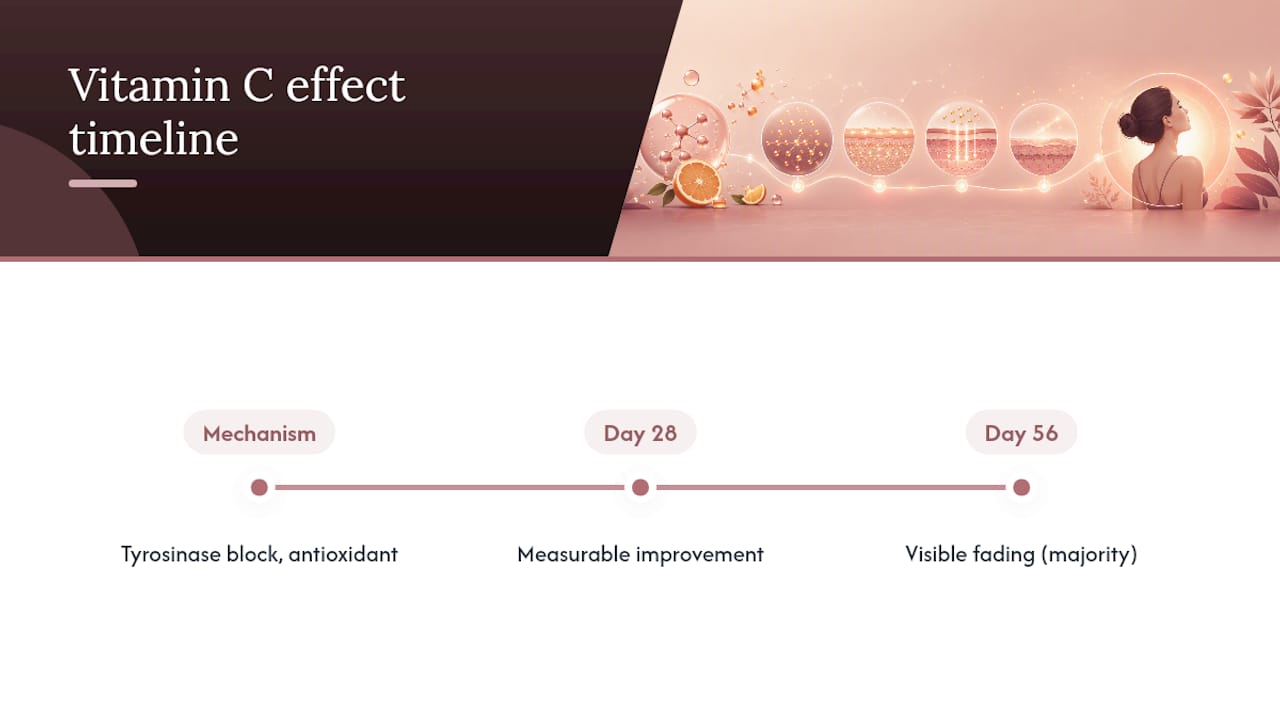
Vitamin C interrupts pigment production before it ever reaches the skin’s surface. Its primary mechanism is inhibiting tyrosinase, the enzyme that kicks off melanin synthesis, partly by chelating the copper ions tyrosinase needs to function. Less active tyrosinase means less new pigment being made, which is why consistency matters more than intensity when you’re using it.
Visible fading is commonly noticed after 8 to 12 weeks of consistent, once-daily application, according to a systematic review of vitamin C’s effect on melanin pigmentation.
Beyond blocking new pigment, vitamin C works as an antioxidant, neutralizing free radicals generated by UV exposure that would otherwise trigger more melanocyte activity. That antioxidant role also gives it a photoprotective function, and it becomes considerably more effective when paired with vitamin E and ferulic acid, a combination known to boost stability and reduce oxidative stress on skin more than any single antioxidant alone.
The clinical evidence backs this up with real numbers. In one study using a stable 10% anhydrous L-ascorbic acid formulation, the majority of participants showed visibly lighter or less pigmented spots by day 56, with measurable improvement already tracked at day 28. That two-stage timeline, early softening followed by more obvious fading, matches what dermal clinicians see in practice.
How Do You Choose the Right Vitamin C Serum?
Not every bottle labeled “vitamin C” delivers the same result, and the differences come down to chemistry, concentration, and packaging.
L-ascorbic acid is the biologically active form with the strongest research backing for pigmentation, but it’s notoriously unstable. Exposed to light, heat, or air, it oxidizes and turns a dull yellow or brown, at which point it’s doing far less for your skin. Derivatives like ascorbyl glucoside, magnesium ascorbyl phosphate, and tetra-isopalmitoyl ascorbic acid are gentler and more stable, though they typically need to convert to active ascorbic acid once absorbed, which can mean a slightly slower or milder effect.
Concentration matters, but more isn’t automatically better. A commonly cited effective range sits between 10% and 20%. Formulas above roughly 20% raise irritation risk without a proportional gain in pigment-fading power, especially on sensitive or already-compromised skin.
Packaging is where a lot of otherwise good products fail before they even reach your bathroom shelf. Look for:
An airless pump or opaque bottle that limits light and air exposure.
Products labeled anhydrous (water-free), since water accelerates oxidation of L-ascorbic acid.
Formulas that list vitamin E and ferulic acid alongside vitamin C, which act as stabilizers and antioxidant boosters.
A color check: a fresh, active serum should be clear to pale yellow. Anything turning amber or brown has likely degraded.
Pro Tip: Buy vitamin C serum in smaller bottles you’ll finish within two to three months. A large bottle that oxidizes halfway through is money and results lost, no matter how good the formula was on day one.
If you want a deeper breakdown of what “stability” actually means on an ingredient label, this guide to choosing sunscreen for pigmented skin covers the same packaging principles that apply across your whole antioxidant routine.
How Should You Use Vitamin C for Dark Spots Every Day?
The order and timing of application changes how much benefit you actually get from vitamin C for dark spots, and it’s simpler than most routines make it sound.
Cleanse with a gentle, non-stripping cleanser to remove oil and debris without disrupting the skin barrier.
Apply vitamin C serum to dry skin, morning is ideal since this is when its antioxidant, photoprotective role matters most.
Layer moisturizer on top to lock in hydration and buffer any mild tingling from the active.
Finish with broad-spectrum sunscreen, SPF 30 or higher, applied generously. Skipping this step undoes much of the work vitamin C is doing, since UV exposure directly re-stimulates the pigment pathways it’s trying to calm.
If you’re also using retinoids or exfoliating acids, stagger them rather than layering everything at once. A common, well-tolerated approach is vitamin C in the morning and retinoid or acid at night, or alternating nights between actives if your skin runs sensitive. Introduce vitamin C gradually, every other day for the first one to two weeks, before moving to daily use.
Always patch test a new serum on the inside of your forearm for 48 hours before applying it to your face. Watch for persistent redness, burning, or breakouts, mild, brief tingling on application is normal, but anything that lingers or worsens is a sign to dilute usage or switch formulations.

Pro Tip: If your skin stings noticeably every time you apply vitamin C, try applying moisturizer first, then the serum on top. It slows absorption slightly and often eliminates the sting without reducing results.
For a more detailed walk-through of building out a full routine around pigment-prone skin, see this guide on adjusting skincare for pigmentation-prone skin.
How Long Does It Take to See Results?
Set your expectations around 8 to 12 weeks, not eight to twelve days. That window is consistent with clinical findings, including the day-56 measurable improvement seen in a stable 10% L-ascorbic acid trial, where the majority of participants had visibly lighter or less pigmented spots by that point.
Deeper dermal pigment and melasma generally take longer, and often need adjunctive treatment rather than topical care alone to reach a similar result. A review on effective combination strategies notes that outcomes improve substantially when vitamin C is paired with rigorous photoprotection and, where appropriate, professional procedures. Your results also depend heavily on ongoing UV exposure, how consistently you apply the product, the formulation’s actual potency, and your skin’s natural phototype, all of which can speed up or stall progress independent of the product itself.
What Else Can You Combine With Vitamin C for Better Results?
Vitamin C rarely works best alone. Pairing it with the right ingredients, or the right professional step, often makes the difference between slow, partial fading and a genuinely clear result.
Vitamin E and ferulic acid stabilize vitamin C and amplify its antioxidant and photoprotective effects.
Niacinamide helps regulate melanin transfer and calm inflammation, making it a good companion for reactive or acne-prone skin.
Tranexamic acid is increasingly used alongside vitamin C for stubborn or hormonally driven pigment, including melasma.
Gentle exfoliation (mild AHAs or enzyme exfoliants, used sparingly) helps surface pigment shed faster, but avoid combining aggressive exfoliation with vitamin C on the same night.
For pigment that isn’t shifting with home care, in-clinic procedures accelerate the process considerably. Chemical peels, IPL, microneedling, and clinician-led biomimetic peels work by either enhancing product penetration or targeting deeper pigment directly, something a serum alone cannot reach. If you’ve used a consistent topical routine for three months with minimal change, or your pigmentation is deep, widespread, or diagnosed as melasma, that’s the point to escalate from topical-only care to a pigmentation peel or similar clinical option.
Is Vitamin C Safe for Sensitive or Reactive Skin?
Most people tolerate vitamin C well, but mild stinging, tingling, or transient redness on first use is common, especially with L-ascorbic acid at higher concentrations. If irritation persists past the first few applications, drop to a lower concentration, reduce frequency to every other day, or switch to a gentler derivative.
A few compatibility rules keep things simple:
Sunscreen is non-negotiable when using vitamin C. Skipping it works against the ingredient’s whole purpose.
Stagger vitamin C with retinoids or exfoliating acids rather than layering them in the same application.
Stop use and check with a dermal clinician if you notice persistent burning, swelling, blistering, or pigmentation that appears to be getting darker rather than fading.
Package choice for choosing sunscreen and other formulation factors is covered in more detail here, which is worth a look if you’re still narrowing down your product shortlist.
The Bottom Line on Vitamin C and Pigmentation
Vitamin C for pigmentation works, but only within its limits: it’s a strong tool for sun- and inflammation-driven spots, less so for deep or hormonal pigment on its own. Three things matter most: pick a stable formulation, use it daily with sunscreen, and give it the full 8 to 12 weeks before judging results. Patch test first, choose a sensible concentration, and track progress with monthly photos in the same lighting.
What Chevonne Sees in the Clinic
Three rules hold up again and again in practice: consistency beats intensity, sunscreen isn’t optional, and depth of pigment decides the timeline. Clients with epidermal spots pairing a stable topical with periodic peel-assisted treatment typically see measurable change within two to three treatment cycles, roughly the same 8 to 12 week window the research points to. Melasma cases almost always need that combined approach rather than topical care alone.
— chevonne
Ready for Faster Results? What Fundamentalskin Offers Beyond the Serum
If you’ve given a solid vitamin C routine several months and the pigment still isn’t shifting, professional in-clinic treatments may be the next step to consider. Where a serum works gradually from the surface down, in-clinic options go straight to the source of stubborn or deeper pigment.

The Biomimetic Peel + LED Therapy uses organic, Australia-sourced ingredients to accelerate pigment clearing without downtime, a good next step if your skin has plateaued on topical care alone. For pigment sitting deeper in the skin, IPL Photo Rejuvenation and skin needling target melanin at a level no serum can reach. And if you’re not sure which category your pigmentation falls into, a customized facial consultation with Chevonne, a dermal clinician with 15 years of experience, is the fastest way to find out. Book a consultation and get a plan built around your actual skin, not a guess.
This article is general information, not a substitute for advice from a qualified doctor. Consult a qualified healthcare professional about your own circumstances before acting on anything here.
Sources
FAQ
Does Vitamin C Get Rid of Pigmentation?
Vitamin C can meaningfully fade many sun- and inflammation-related dark spots, though it rarely erases pigmentation completely, especially deeper or hormonal pigment like melasma. It works best as a consistent, long-term part of a routine that always includes sunscreen.
How Long Does It Take for Vitamin C to Fade Pigmentation?
Most people see visible fading after 8 to 12 weeks of consistent daily use. Deeper or hormonally driven pigment can take longer and often needs additional treatment beyond a topical serum alone.
What Vitamin C Is Best for Hyperpigmentation?
A stable, well-formulated L-ascorbic acid serum in the 10% to 20% range, packaged in an airless or opaque container, tends to deliver the most reliable results for hyperpigmentation. Derivatives like magnesium ascorbyl phosphate are gentler alternatives for sensitive skin, though generally milder in effect.
What Is the Fastest Way to Get Rid of Pigmentation?
For faster results than topical care alone, professional treatments like the Biomimetic Peel + LED Therapy, IPL, or skin needling target pigment more directly and work well combined with a daily vitamin C and sunscreen routine at home. A dermal clinician consultation can confirm which combination fits your specific pigmentation type.
Recommended
Comments