.png)
Avoid the Abdomen: Clinician Rules for Red Light Therapy in Pregnancy


With OB approval and a few strict precautions, targeted red light therapy on the face, neck, or limbs is generally considered low risk during pregnancy. The precaution that matters most: keep light devices off the abdomen and pelvis, and defer first-trimester use unless your provider tells you otherwise. If you’re unsure about your specific situation, pause treatment and call your obstetric provider before your next session.
TL;DR:
Red light therapy should be avoided over the abdomen and pelvis at all pregnancy stages and deferred during the first trimester unless cleared by your OB.
Sessions should be limited to short durations, typically 5 to 20 minutes, with a maximum of two to three times weekly, using red-only wavelengths to reduce heat build-up.
Small studies indicate no fetal harm from targeted red light use in limited cases, but large-scale safety data specific to pregnancy remains lacking.
Proper eye protection and session logging are essential, and treatment zones must be carefully selected under clinician supervision for safety.
Always consult your healthcare provider before starting or continuing red light therapy during pregnancy to tailor guidance based on individual circumstances.
Table of Contents
Quick Takeaways: Red Light Therapy Safety Checklist for Pregnancy
What Does the Research Actually Show About Red Light and Pregnancy?
How Clinicians Manage Red Light Therapy Differently Than Home Devices
An Editorial Take on Playing It Safe With Red Light and Pregnancy
Consider Clinician-Supervised Red Light Therapy at Fundamentalskin
Quick Takeaways: Red Light Therapy Safety Checklist for Pregnancy
You want a fast answer before you dig into the research, so here’s the practical version. These guardrails reflect the cautious approach that most clinician-reviewed sources and obstetric guidance currently recommend.
Avoid red light therapy during the first trimester unless your OB specifically clears it.
Get sign-off from your obstetric provider before starting any session later in pregnancy.
Never place a device directly over your abdomen, uterus, or pelvic area, at any stage.
Keep sessions short, typically a few minutes per treated area, a few times per week, following your healthcare provider’s advice.
Wear proper eye protection every time, even with handheld or panel devices.
Stop immediately and call your provider if you notice unusual symptoms like dizziness, cramping, or visual changes.
These rules exist because pregnancy changes the calculation on almost every skincare and wellness treatment, and red light therapy is no exception. The next sections walk through why.
How Does Red Light Therapy Actually Work?
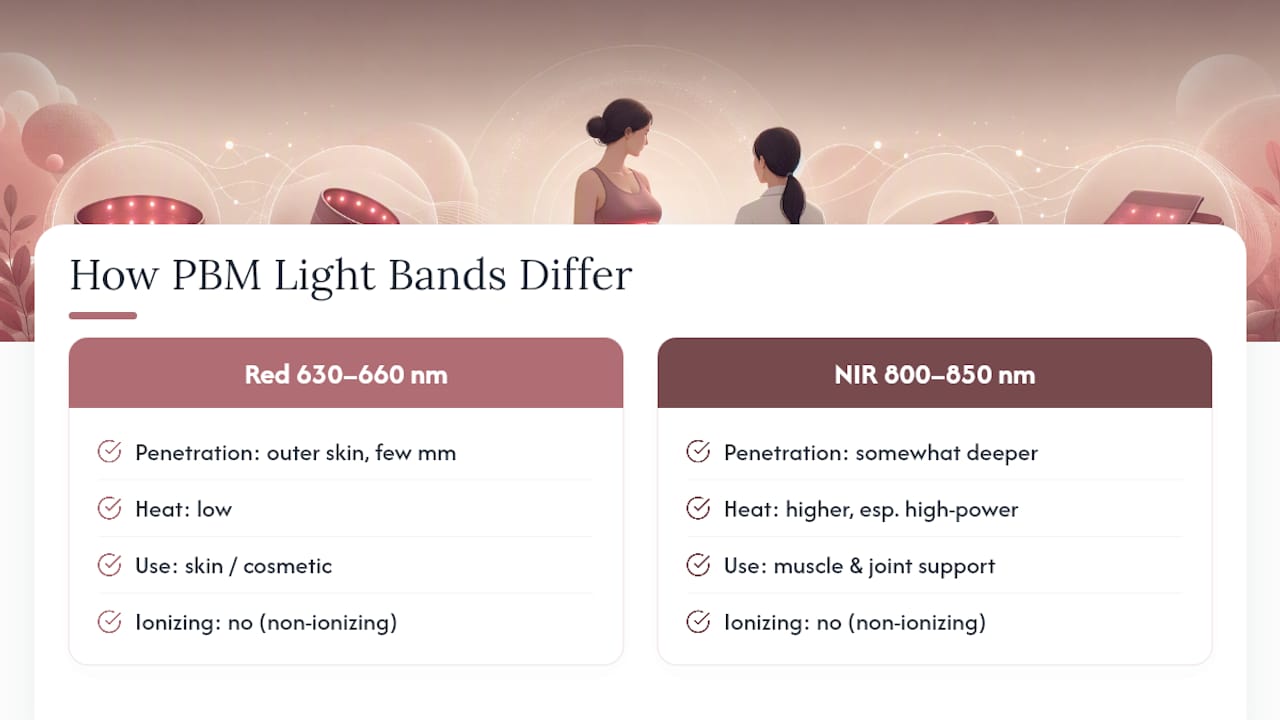
Red light therapy, also called photobiomodulation (PBM), uses specific wavelengths of light to stimulate activity inside skin cell mitochondria. The theory is that this cellular stimulation supports collagen production, reduces inflammation, and speeds tissue repair. Most devices operate in the red band around 630 to 660 nanometers or the near-infrared band around 800 to 850 nanometers, and each band behaves differently once it hits your skin.
Red wavelengths penetrate only the outer layers of skin, generally a few millimeters at most. Near-infrared light travels somewhat deeper, which is why it’s often marketed for muscle and joint support. Neither wavelength ionizes tissue or damages DNA the way ultraviolet light or X-rays can, and that non-ionizing profile is part of why dermatology bodies consider the technology fundamentally different from radiation exposure you’d want to avoid in pregnancy. The American Academy of Dermatology notes that red light therapy is generally considered safe for skin use, though it stops short of issuing pregnancy-specific clearance, largely because that data simply doesn’t exist yet at scale.
Here’s where it gets more nuanced: near-infrared devices, especially higher-powered ones, generate more heat than red-only panels. Photobiomodulation research on tissue penetration confirms red and near-infrared wavelengths are non-ionizing and penetrate only a few millimeters, which makes it physically implausible for light alone to reach a fetus. But heat is a separate variable entirely. Elevated core body temperature is something obstetric providers watch closely throughout pregnancy, so a device that runs warm, or a session that runs long, introduces a risk pathway that has nothing to do with the light itself. That distinction, light versus heat, is the one most home-use marketing glosses over.
What Does the Research Actually Show About Red Light and Pregnancy?
The honest answer: the evidence is encouraging but thin, and almost none of it comes from large human trials during pregnancy. That gap isn’t unique to red light therapy. Pregnant people are routinely excluded from device and drug trials for ethical and liability reasons, which means most safety data on new technologies arrives years after non-pregnant populations have already been studied.
One of the more interesting pregnancy-specific findings comes from a 2022 study on preeclampsia. Researchers found that red light mitigated deterioration of the placental extracellular matrix in a late-onset preeclampsia model and improved trophoblast behavior. This finding is a genuinely promising signal about how red light might interact with placental tissue at a cellular level. It is not, however, a human safety trial, and it doesn’t tell us what happens when a healthy pregnant person uses a consumer LED panel twice a week for six months. Treat it as a mechanistic clue, not a green light.
Small clinical trials do exist outside the cellular-research space. A review aggregating pregnancy-related photobiomodulation studies points to trials like wrist-laser treatment for pregnancy-related carpal tunnel syndrome, where researchers reported symptom improvement without documented fetal harm. Separate reporting on these small trials confirms the same pattern: symptom relief without observed fetal complications in limited clinical settings. The catch is right there in the phrase “small trials.” Sample sizes in this space typically run into the dozens, not the thousands, and few have been designed as randomized controlled trials with pregnancy as the primary safety endpoint.
A few things worth holding onto from the current evidence base:
Placental and cellular research suggests red light interacts constructively with certain tissue processes, at least in modeled conditions.
Small human trials on pregnancy-adjacent uses (like carpal tunnel) report no documented fetal harm, but sample sizes are limited.
Systematic reviews consistently flag the same problem: not enough large-scale, pregnancy-specific data exists to issue a blanket safety statement.
Manufacturer disclaimers about pregnancy often reflect liability caution rather than documented evidence of harm, according to consumer-safety analyses of red light therapy during pregnancy and postpartum.
No documented harm in limited studies is not the same statement as “proven safe.” That distinction is where a lot of online advice quietly goes wrong. A handful of small trials showing no adverse events tells you those specific protocols, at those specific doses, in those specific populations, didn’t cause visible problems. It doesn’t tell you that every device, every wavelength, and every session length carries the same profile. That’s precisely why the guidance throughout this article leans conservative rather than permissive.
Is Red Light Therapy Safe in Each Trimester?
Safety isn’t a single yes-or-no question in pregnancy. It shifts depending on how far along you are and which part of your body is under the light.
First trimester: the most cautious window
Organ formation happens during the first trimester, and this is the stage where most clinicians and consumer health guidance recommend the most restraint. Clinician-reviewed guidance generally recommends deferring red light therapy in the first trimester unless a provider has specifically evaluated your case and cleared it. If you were using red light therapy before conceiving, this is the point to pause and ask your OB rather than assume continuity is fine.
Second and third trimester: proceed only with clearance
Once you’re past the first trimester and have OB approval, the guidance narrows to zone-specific caution rather than a blanket restriction. The abdomen and pelvis stay off-limits throughout pregnancy, full stop, regardless of trimester. The reasoning is straightforward: this is the region closest to the uterus, and there’s no clinical upside to testing thermal or light exposure there when safer zones exist.
Face, neck, shoulders, and limbs are typically viewed as the lower-risk zones, assuming your provider has signed off. These areas let you address common pregnancy skin concerns, redness, dullness, minor breakouts, without exposing the abdominal region at all.
Late pregnancy adds one more practical wrinkle: positioning. Lying flat on your back for extended periods becomes uncomfortable and, in some cases, medically inadvisable as the uterus grows, since it can compress major blood vessels. If your red light session involves lying down, keep it brief, or ask about a reclined or side-lying setup instead.
Pro Tip: Bring your device’s spec sheet, not just the marketing page, to your OB appointment. Wavelength and power output matter far more to a clinician’s assessment than brand reputation.
What Benefits Do People Actually Seek During Pregnancy?
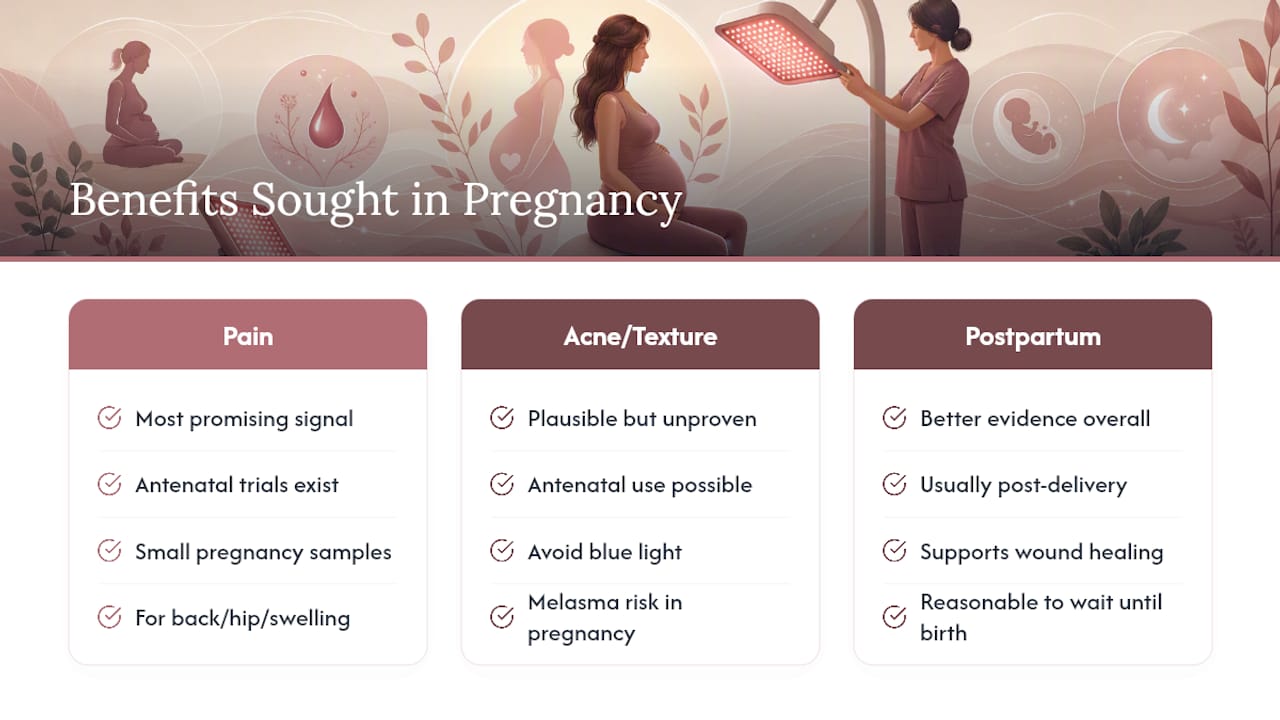
Most pregnant people considering red light therapy are chasing one of three things: pain relief, clearer skin, or an even skin tone. The evidence strength varies quite a bit across those three goals.
Pain and inflammation show the most promising signal. Outside of pregnancy, photobiomodulation has a reasonably solid track record for joint and muscle discomfort, and the small pregnancy-specific trials on conditions like carpal tunnel syndrome echo that pattern. If back pain, hip discomfort, or swelling is your main motivation, this is the benefit category with the most supporting research behind it, even though pregnancy-specific sample sizes remain small.
Acne and general skin texture sit in plausible-but-unproven territory. Red and near-infrared wavelengths are commonly used for acne and texture concerns in non-pregnant patients, and there’s no mechanistic reason to think pregnancy changes how those wavelengths interact with skin. The bigger caution here is about which light mode you use, not whether red light works. Blue light, often paired with red light in combination devices for acne, should be avoided during pregnancy because of its association with melasma, the pregnancy mask that already affects many expectant mothers due to hormonal shifts. If your device has a blue setting, skip it until postpartum, and read up on how to manage melasma after pregnancy if it’s already a concern.
Postpartum wound healing is a different story with better evidence behind it. Once you’ve delivered, red light therapy’s role in supporting tissue repair, whether for a C-section incision or general postpartum recovery, has more research support than antenatal use does, simply because postpartum patients aren’t subject to the same trial exclusions. If you’re weighing whether to wait until after birth to start treatment, that’s a reasonable, evidence-supported choice, and it pairs well with broader postpartum self-care planning.
What Are the Risks and Warning Signs to Watch For?
Red light therapy carries a relatively short list of known risks, but pregnancy raises the stakes on each one.
Skin irritation or burns can happen with excessive session length or devices running hotter than labeled, particularly near-infrared panels.
Eye damage is a real risk without proper goggles; retinal tissue is sensitive to concentrated light even at wavelengths considered safe for skin.
Cumulative thermal load from repeated near-infrared sessions deserves more attention in pregnancy than it would otherwise, given how closely core temperature is monitored throughout gestation.
Device inconsistency is an underappreciated risk category. Consumer LED panels vary widely in actual output versus labeled output, which is part of why the AAD stresses checking device labeling and safety claims before use.
Stop treatment immediately and contact your provider if you experience spotting, cramping, dizziness, sudden visual changes, fever, or a noticeable change in fetal movement. None of these symptoms are expected side effects of red light therapy, but any of them warrants a call regardless of what’s causing them.
How Do You Use Red Light Therapy Safely During Pregnancy?
If your OB has cleared you for treatment, the protocol below reflects the conservative parameters most clinician-reviewed sources converge on.
Keep sessions short. Aim for 5 to 20 minutes per treated area, and don’t stack multiple zones into one marathon session.
Limit frequency to 2 to 3 sessions per week. More frequent use hasn’t been shown to add benefit and increases cumulative exposure without added upside.
Choose red-only or low near-infrared modes. Skip blue light entirely, and avoid high-intensity infrared settings that generate noticeable heat.
Confirm the device has a built-in timer and intensity control. Guessing at exposure time increases your risk of overdoing it.
Wear certified eye protection every session, even for quick five-minute treatments on the face.
Log each session: device model, wavelength, duration, and any skin reaction. Bring this log to your next OB visit.
A device like a home LED panel can help you track consistency, but the documentation matters more than the gadget. If you’re curious how the underlying technology works before committing to a routine, this explainer on LED light therapy breaks down the mechanism in plain terms.
Pro Tip: Photograph your treatment area before starting a new red light routine. Pregnancy skin changes fast, and a baseline photo helps you and your provider tell the difference between a treatment reaction and an unrelated hormonal shift.
What Should You Bring to Your OB Appointment?
Walking into your prenatal visit prepared turns a vague “is this okay?” conversation into a focused, five-minute decision. Bring the following:
The device’s model name, manufacturer, and listed wavelength range.
Power output specifications, if listed on the packaging or manufacturer site.
Any manufacturer pregnancy disclaimers, so your provider knows what the label actually says versus what the research says.
Your personal medical history flags: preeclampsia risk, placental concerns, or prior pregnancy loss, since these may shift the calculation.
Ask your provider directly: Is this safe given my specific pregnancy? What session length and frequency would you recommend? Should I check in again at a later stage, particularly heading into the third trimester? A provider who knows your full history can tailor an answer that generic online guidance simply can’t.
How Clinicians Manage Red Light Therapy Differently Than Home Devices
Supervised, clinic-based red light therapy operates on a different risk profile than an at-home panel purchased online. A clinician can calibrate wavelength and dose to your specific skin concern, confirm device output against manufacturer specifications, and adjust treatment zones based on your trimester and medical history in real time. That kind of oversight is difficult to replicate with a consumer device and a search engine.
Treatments involving LED and red light are best administered under the supervision of a dermal clinician who screens client history before recommending a protocol, with pregnancy status considered as part of the intake conversation. Zone selection, session length, and follow-up spacing are documented for each visit, which gives both the client and her obstetric provider a clear record if questions come up between now and delivery. That documentation habit, explained further in this clinician-supervised dosing overview, is the same practice recommended throughout this guide for home use.
For pregnant clients specifically, that means avoiding blue light modes, keeping treatment zones away from the abdomen, and adjusting session frequency based on individual provider recommendations, rather than defaulting to a one-size-fits-all protocol.
An Editorial Take on Playing It Safe With Red Light and Pregnancy
The conventional advice on this topic tends to swing to one of two unhelpful extremes: either “it’s just light, it’s obviously fine,” or “avoid anything electronic while pregnant.” Neither position holds up once you actually read the research. The placental and cellular evidence is genuinely interesting, not dismissible, but it’s early-stage and mechanistic, not a green light for unsupervised daily use.
What gets underestimated most is the heat variable. People fixate on wavelength safety and forget that near-infrared devices can run warm enough to matter in a population where core temperature is actively monitored. That’s a bigger practical risk than the light itself.
My honest read: this is a category where clinic supervision earns its keep. A provider who can verify actual device output, document your sessions, and coordinate with your OB removes most of the guesswork that makes home use risky, not because the light is dangerous, but because consumer devices and self-directed protocols leave too many variables unchecked. If you’re pregnant and curious about red light therapy, start that conversation with a clinician before you start the sessions.
— chevonne
Consider Clinician-Supervised Red Light Therapy at Fundamentalskin
Clinician-supervised sessions offer oversight that home devices can’t: screening pregnancy status, calibrating dose and wavelength to specific skin concerns, and documenting every session for client records or OB review.

If pain relief, skin tone, or postpartum recovery is on your mind, the LED Light Facial offers a supervised entry point, while the red light therapy pod provides a dedicated single session for targeted treatment under clinical guidance. For clients wanting to combine treatments, the Biomimetic Peel + LED Therapy pairs organic, Australia-sourced ingredients with light-based support. Every consultation starts with a screening conversation about your pregnancy status and history, so your protocol gets built around your actual circumstances rather than a generic routine. Book a consultation to walk through your options and get a session plan your OB can review.
This article is general information, not a substitute for advice from a qualified doctor. Consult a qualified healthcare professional about your own circumstances before acting on anything here.
Sources
FAQ
Is Red Light Therapy Safe During Pregnancy?
With OB approval and conservative parameters, red light therapy on the face, neck, or limbs is generally considered low risk. Direct abdominal exposure should be avoided throughout pregnancy, and many clinicians recommend deferring treatment during the first trimester unless specifically cleared.
Can I Use Red Light Therapy on My Pregnant Belly?
No. Clinician-reviewed guidance consistently recommends against placing red light devices directly over the abdomen or pelvis at any stage of pregnancy, since this area sits closest to the uterus and offers no clinical benefit over treating other zones.
Can I Use Infrared Therapy While Pregnant?
Near-infrared light penetrates slightly deeper than red light and can generate more heat, which matters because elevated core temperature is a factor obstetric providers monitor closely. Lower-intensity, red-only modes are generally preferred over high-heat infrared settings during pregnancy, and any infrared use should be cleared by your provider first.
Why Do Some People Say They Look Better While Pregnant?
The “pregnancy glow” often comes from increased blood volume and hormonal shifts that boost circulation and oil production, giving skin a flushed, dewy appearance rather than any specific treatment. It’s a temporary physiological effect, not something red light therapy causes or is required to achieve.
Does Fundamentalskin Offer Red Light Therapy for Pregnant Clients?
Fundamentalskin offers clinician-supervised LED and red light sessions, including a dedicated red light therapy pod session, with pregnancy status screened as part of every client intake. Current pricing for individual sessions is listed on the facial treatments page.
Recommended
Comments