.png)
Clinician Led Chemical Peel Costs in Australia $60–$3,950: What’s Included

A light peel in Australia typically costs $60 to $200, a medium peel runs $200 to $400, and medical or deep peels start around $400 and can climb into surgical price territory when a specialist and hospital setting are involved. Prices shift with practitioner qualifications, location, and treatment area, so the number on a price list is a starting point, not a quote. Before booking anything, get a consultation and patch test with a qualified clinician who can assess your skin and give you an accurate figure.
TL;DR:
Prices for chemical peels vary widely in Australia, ranging from $60 to $500 depending on depth, acid strength, and practitioner qualifications.
Superficial peels typically cost $60 to $200 with minimal downtime, while medium peels cost $200 to $400 for pigmentation and texture improvements.
Practitioner training, location, and treatment scope significantly influence the price, with higher costs in metropolitan clinics and for treatments in a medical setting.
Multi-session packages can save 10 to 20 percent but only if the number of treatments aligns with your skin needs and the clinic’s full all-in pricing is understood.
Table of Contents
How Much Does a Chemical Peel Cost in Australia?
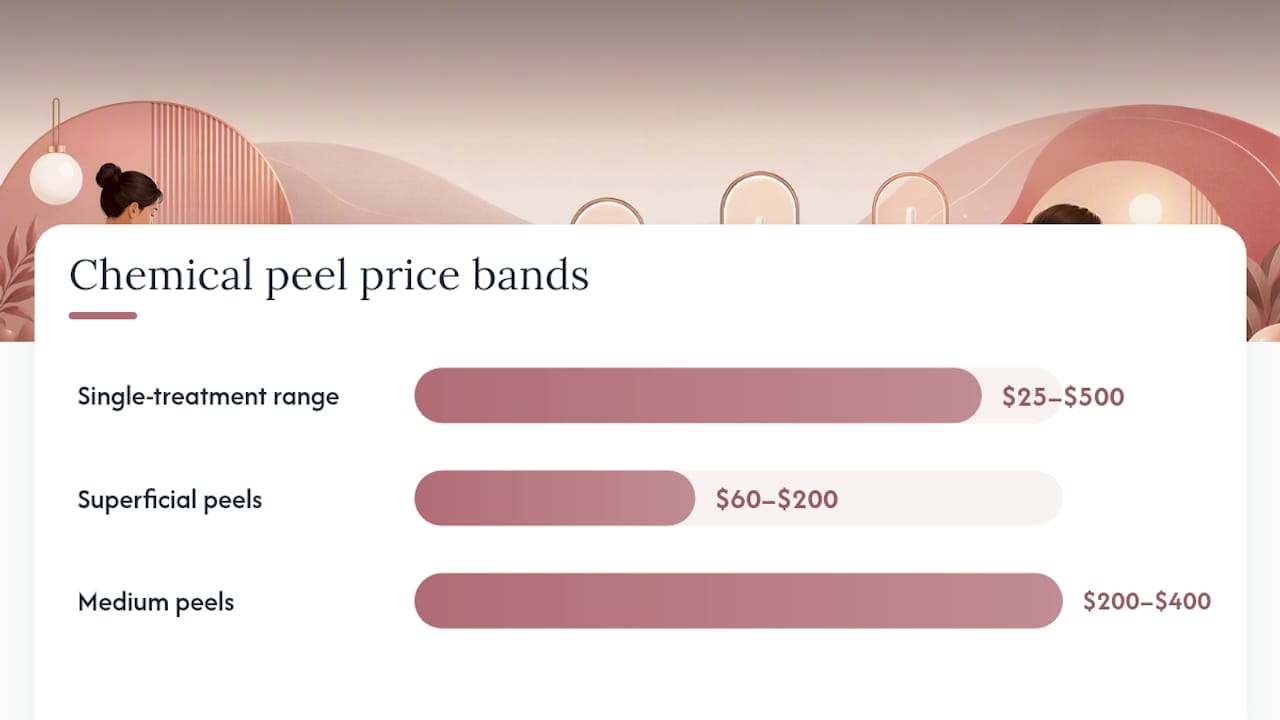
Chemical peel prices in Australia span an unusually wide range, and understanding why helps you read a quote correctly instead of guessing whether it’s fair. Single treatments run anywhere from about $25 to $500, with most clinic peels landing between $100 and $400. That spread reflects three things: the acid used, how deep it penetrates, and who’s performing the treatment.
At the lower end, superficial peels often sit in the $60 to $200 bracket. These are the lunchtime treatments: mild glycolic or lactic acid formulas that brighten and smooth without meaningful downtime. Think of them as a tune-up rather than a fix. If you’re curious about how these fit into a busy schedule, a clinician lunchtime peel is designed exactly around that constraint.
Medium-depth peels, which target pigmentation and rougher texture, generally cost $200 to $400. These use stronger acids like TCA at moderate concentrations and require more clinical judgment to apply safely, which is part of why the price jumps.
Medical or deep peels start around $400 and can run much higher once you add medical setting fees. One Sydney example shows total costs reaching almost $3,950 when surgical, theater, and anesthetist fees enter the picture, typically for the deepest phenol-based treatments performed in a hospital or specialist setting.
Rough price bands to keep in mind:
Light/superficial peels: $60 to $200, minimal downtime, good for mild dullness and fine lines
Medium peels: $200 to $400, address pigmentation and moderate texture concerns
Medical/deep peels: $400 and up, sometimes into the thousands with hospital fees, for significant scarring or deep sun damage
What Drives the Price of a Chemical Peel Up or Down?
Two clinics offering “the same” peel can charge wildly different amounts, and the gap usually comes down to a handful of variables you can actually ask about.
Practitioner qualifications matter more than almost anything else. A dermal clinician or nurse typically charges less than a cosmetic doctor or dermatologist, but that doesn’t automatically mean lower quality. It means a different scope of practice and a different type of treatment on offer. Dr. Sheridan notes that cost is closely tied to peel type, area treated, and the practitioner’s training, which is worth remembering when a price feels oddly low.
Location plays a role too. Clinics in inner city Sydney or Melbourne carry higher rent and staffing costs than regional practices, and that overhead shows up in the price list. Treatment area size matters as well. A full-face peel costs more than a spot treatment on the cheeks or forehead.
What’s bundled into the price also changes the comparison:
Whether the fee includes a consultation and patch test, or charges those separately
Whether post-care products (sunscreen, healing balm) are included or sold on top
Whether follow-up visits for monitoring are part of the package or billed individually
Whether membership or loyalty pricing brings the effective cost down over time
Pro Tip: Ask every clinic for the “all-in” price, not just the headline session fee. A $150 peel that charges $40 extra for aftercare products is not actually cheaper than a $180 peel that includes them.
Which Peel Depth Matches Your Skin Concern and Budget?
Matching the right depth to your skin concern saves you money and disappointment, because paying for a deep peel when a superficial one would do is money wasted, and the reverse leaves you undertreated.
Superficial peels use mild acids like glycolic, lactic, or salicylic acid at low concentrations. Sessions usually take 30 to 45 minutes with little to no visible downtime, just mild redness for a few hours. These work well for dullness, mild congestion, and early fine lines, and they’re the most affordable option, generally $60 to $200 per session.
Medium peels step up to stronger TCA concentrations or combination formulas. Expect visible flaking for three to seven days and a more noticeable result, particularly for pigmentation and uneven texture. These sit in the $200 to $400 range and are the most common recommendation for genuine improvement in sun damage and melasma.
Deep or medical peels, often phenol-based, penetrate significantly further and are usually performed by a doctor or dermatologist, sometimes in a hospital or day surgery setting with sedation. Downtime can run one to two weeks with significant redness and peeling. These address deep scarring, severe sun damage, and pronounced wrinkling, and they carry the highest costs, from $400 well into four figures once medical fees apply.
Skin concern should drive the decision, not price alone. A superficial peel won’t touch deep acne scarring, and a deep peel is overkill for occasional dullness.
Do Multi-Session Packages Actually Save You Money?
Packages usually do save money, but only if you genuinely need the number of sessions included. Clinics commonly package peels in sets of three or four treatments, particularly for pigmentation and acne scarring, since one session rarely resolves either concern.
A three or four session package typically discounts the per-session price by 10 to 20% compared to booking singly
Packages make sense when a clinician has recommended a course of treatment for pigmentation or texture, not for a one-off event like a wedding
Always check the expiry window on package sessions, whether missed appointments roll over, and whether the package is transferable if your circumstances change
If a clinic pushes a package before assessing your skin, treat that as a flag rather than a deal.
At-Home Peels vs. Clinic Treatments: What’s the Real Trade-Off?
At-home peel products are genuinely cheap, commonly under $70 in Australia, but cheap and equivalent are not the same thing. Home formulas use lower acid concentrations by regulation, which limits both the risk and the results.
At-home AHA/BHA products work well for ongoing maintenance between clinic visits, keeping skin smooth and refreshed
In-clinic treatments allow higher concentrations, professional supervision, and a protocol tailored to your exact skin, which makes them the better choice for pigmentation, scarring, and any deeper correction
Skin of color needs particular care with peel strength and technique, since the wrong acid or concentration risks post-inflammatory pigmentation
Never attempt a stronger-than-labeled peel at home. Unsupervised deep exfoliation on compromised skin can cause burns, scarring, and pigment changes that cost far more to fix than the original treatment would have
What Follow-Up Costs Should You Budget For?
The session price is rarely the total price. Downtime itself carries a cost if you need to plan time away from client-facing work, especially with medium or deep peels where visible flaking lasts several days.
Light peels: little to no functional downtime, negligible planning cost
Medium peels: three to seven days of flaking, worth planning around social or work commitments
Deep peels: one to two weeks of visible recovery, sometimes requiring a follow-up visit to monitor healing
Post-care products add up too. A proper SPF and a soothing serum can run $40 to $100 depending on the brand, and skipping sunscreen after a peel risks undoing the results entirely. Many clinics also recommend pairing a peel with LED therapy or a skin needling session for compounding results, which raises the total spend but often improves the outcome.
How Do You Know a Clinician Is Actually Qualified?
A low price with no patch test and vague training claims is the clearest warning sign in this industry. Credentials tell you what someone is trained and legally permitted to do, and that directly affects both safety and cost.
Ask what qualification the practitioner holds. A dermal clinician, registered nurse, or cosmetic doctor each has a different scope, and stronger peels should only be performed by someone qualified for that depth.
Ask what happens if you have a reaction. A clinic with a clear complication protocol and follow-up plan is one that takes safety seriously.
Ask for a written quote covering the full treatment, not just the headline number.
If you have darker skin, ask directly about the clinician’s experience treating skin of color, since pigmentation response varies significantly by acid type and technique.
Pro Tip: If a price feels too low relative to everything above, it usually is. A patch test and a proper consultation should never be skipped to save $20.
What Should You Bring to a Consultation?
A clear written quote protects you from surprise costs later. Ask the clinic to list the consultation fee, patch test, the treatment itself, recommended post-care products, and how many follow-up visits are included. That single document lets you compare clinics on the same basis instead of guessing what’s bundled in.
Confirm the total price for a full course, not just one session, if multiple treatments are likely
Divide package prices by the number of sessions to get your real per-session cost
Build in a buffer for extra products or an additional session if your skin needs more correction than expected
Bring a list of current skincare products and any recent treatments so the clinician can assess compatibility
Does Medicare or Private Health Insurance Cover Chemical Peels?
Medicare does not cover chemical peels in Australia, because the Medicare Benefits Schedule only funds treatments classified as medically necessary, and cosmetic skin peels fall outside that definition regardless of provider. This applies whether the peel is performed by a dermal clinician, a nurse, or a cosmetic doctor.
Private health insurance is similarly limited. Most extras policies exclude cosmetic procedures entirely, and even policies with an “ancillary” or “natural therapies” allowance rarely extend to chemical peels specifically. The exception is genuinely rare: if a peel is prescribed as part of treating a diagnosed medical skin condition, such as severe cystic acne scarring under specialist care, some funds may consider partial reimbursement on a case-by-case basis. That requires a referral and supporting documentation from a specialist, and it’s the exception rather than anything you should plan around.
Practically, this means the full cost of a chemical peel, whether it’s a $60 lunchtime treatment or a $400 medical-grade peel, comes out of pocket. Some clinics offer payment plans or buy-now-pay-later options through third-party providers, which can help spread the cost of a multi-session package without requiring the full amount upfront. It’s worth asking whether a clinic offers this before committing to a course of treatment, particularly if you’re budgeting for four sessions rather than one.
Do Prices Differ Between Sydney, Melbourne, and Regional Australia?
Yes, and the gap can be meaningful enough to factor into your decision, especially if you’re near a state border or willing to travel for treatment. Clinics in central Sydney and Melbourne generally sit at the higher end of the national price bands due to commercial rent and higher practitioner wages in metro areas. A superficial peel that costs $80 in a regional town might be priced closer to $150 in an inner-city Sydney clinic offering an identical treatment.
Coastal and border regions, including areas like the Gold Coast and Tweed Heads, often sit in a middle ground: lower overheads than a capital city center, but still competitive access to well-trained clinicians. This is one reason many Queensland and northern New South Wales residents find strong value without needing to travel into a capital city for quality treatment.
Regional and rural clinics can offer genuinely lower prices, but the trade-off is sometimes fewer options for advanced medical-grade or deep peels, which are more commonly concentrated around major hospitals and specialist dermatology practices in metro areas. If you need a deep phenol peel specifically, you may have fewer local choices outside a capital city, and that scarcity can push prices up rather than down despite the lower general cost of living. The smart move is comparing quotes from at least two providers in your region before assuming the local price reflects the national range.
Is a Chemical Peel Cheaper Than Other Skin Treatments?
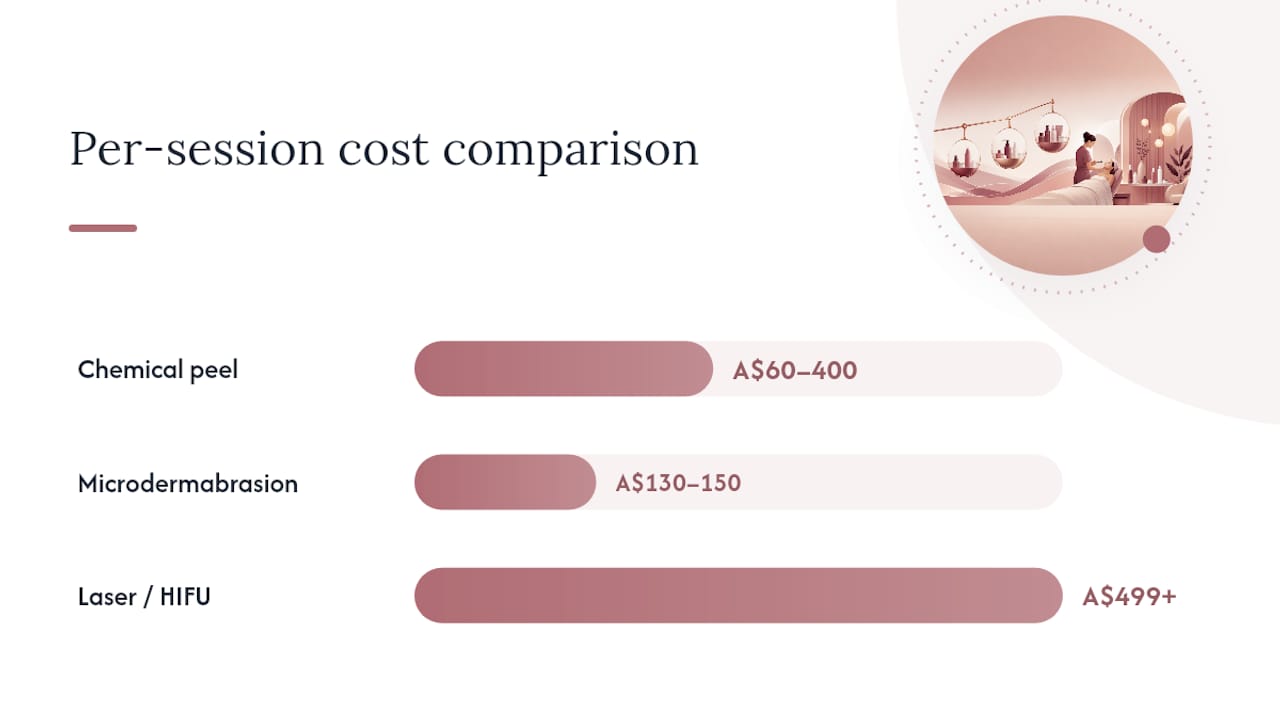
Chemical peels sit in the middle of the cost spectrum compared to other common skin treatments in Australia, which is part of why they remain so popular. A single peel session at $60 to $400 is generally less expensive than laser resurfacing or HIFU treatments, which often start at $499 per session and target deeper structural skin concerns like laxity rather than surface tone and texture.
Compared to microdermabrasion or hydro dermabrasion, which use physical exfoliation rather than acids, chemical peels and these mechanical options land in a similar price bracket, generally $130 to $150 per session, though they work through different mechanisms and suit slightly different concerns. Peels tend to be more effective for pigmentation specifically, while mechanical exfoliation is often gentler for sensitive or reactive skin.
Skin needling, which stimulates collagen through controlled micro-injury rather than chemical exfoliation, typically costs more per session than a light or medium peel and is often recommended for scarring and deeper texture concerns rather than pigmentation alone. For pure pigmentation correction specifically, a course of medium peels is often more cost-effective than a single high-cost laser session, particularly when a clinician recommends a multi-session pigmentation program rather than a one-off intensive treatment. The right comparison depends entirely on what you’re treating, not just the price tag on each option.
Why Clinic-Led Peels Are Worth the Higher Price Tag
I’ll say the thing most price guides won’t: comparing a $60 lunchtime peel to a $400 clinician-led pigmentation program as if they’re competing for the same budget line misses the point entirely. They’re not interchangeable treatments. One is maintenance. The other is correction.
For genuine pigmentation, melasma, or texture concerns, I recommend investing in a clinician-led program over stacking cheaper single sessions. Our clinician-led pigmentation peels for skin of color typically show noticeable improvement at 8 to 12 weeks, which reflects how skin actually remodels, not how fast a marketing claim wants it to. The Larimedical Biomimetic Peel pairs a targeted peel with LED therapy specifically because pigment correction benefits from that combination.
Book a proper consultation first. A tailored plan built around your actual skin, not a generic price list, is what makes the investment worthwhile.
— chevonne
Get a Clinician-Led Peel Quote With Fundamentalskin
At Fundamentalskin, you get a dermal clinician’s assessment before you ever commit to a peel, not a generic price list guess. Chevonne brings 15 years of clinical experience to every consultation, which means your quote reflects your actual skin, not a one-size-fits-all session fee.

Our Biomimetic Peel + LED Therapy is priced at $249 and includes a clinician-led protocol built around pigmentation, tone, and texture concerns, with the option to add the Larimedical Cocktail for $60 more. If you’re after a broader range of options, our facial treatments page covers everything from Dermaplaning at $129 to Synergie Peels at $129, each with a consultation built in so you know exactly what you’re paying for before you book. This service focuses on organic, Australia-sourced ingredients and non-invasive results without downtime.
Ready to see what a tailored plan actually costs? Book your consultation and get a personalized quote today.
Sources
FAQ
Are Chemical Peels Really Worth It?
For genuine concerns like pigmentation, sun damage, or textural scarring, yes, particularly when performed by a qualified clinician who tailors the peel depth to your skin. For occasional dullness, a lighter, cheaper treatment or a good at-home routine may deliver similar value without the higher cost.
How Much Do Chemical Peels Generally Cost in Australia?
Prices typically range from about $60 to $200 for light peels, $200 to $400 for medium peels, and $400 upward for deep or medical peels. One example of a biomimetic peel with LED therapy is priced at $249 and includes a clinician-led protocol.
How Long Do the Results of a Chemical Peel Last?
Results vary by depth and skin concern, but clinician-led pigmentation programs commonly show visible improvement around 8 to 12 weeks as skin remodels. Maintenance treatments or a consistent at-home routine help extend results between clinic sessions.
What Are the Risks of a Chemical Peel?
Risks include redness, flaking, temporary sensitivity, and, with deeper peels or unsupervised use, scarring or pigment changes. Choosing a qualified clinician and getting a proper patch test significantly reduces these risks compared to unsupervised at-home treatments.
Recommended
Comments