.png)
How to Adjust Skincare for Pigmentation Prone Skin


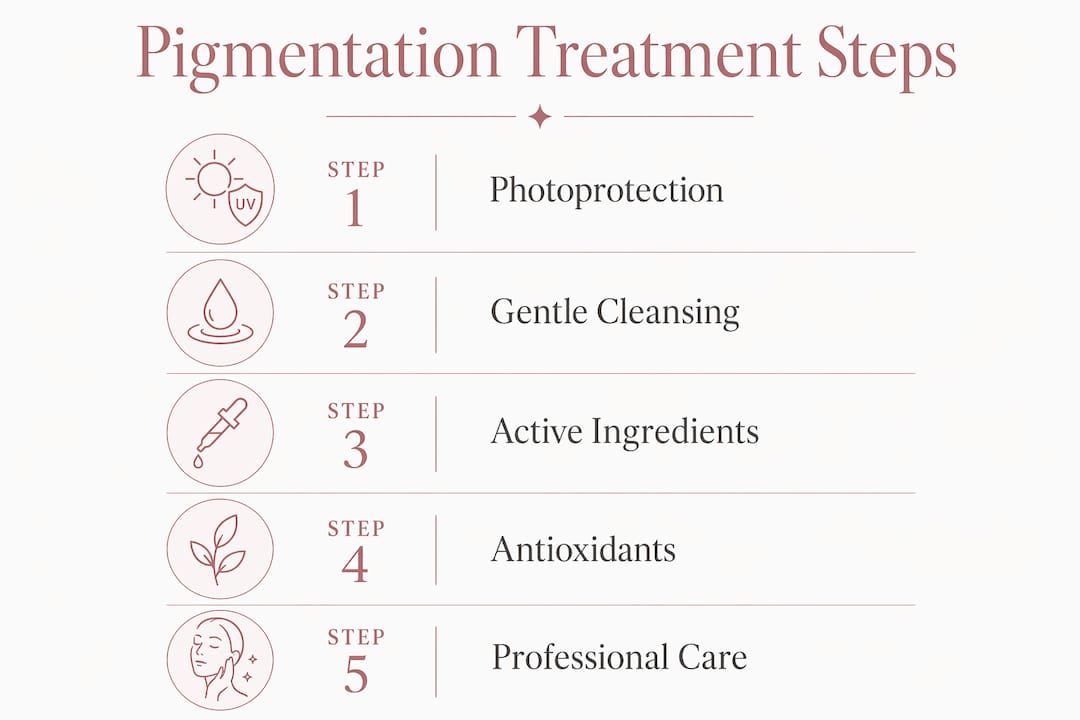
Hyperpigmentation is defined as an overproduction of melanin that creates dark spots, uneven patches, and discoloration on the skin. Adjusting your skincare for pigmentation prone skin requires three non-negotiable pillars: strict photoprotection, carefully introduced topical lightening agents, and professional procedures reserved for stubborn cases. The clinical term for this condition covers disorders like melasma, postinflammatory hyperpigmentation (PIH), and solar lentigines. Each responds to the same foundational approach, even though the triggers differ. Getting this routine right means fewer flares, faster fading, and a genuinely more even complexion.
How to adjust skincare for pigmentation prone skin: start with photoprotection
Strict photoprotection is the first-line management step for any pigmentation disorder, including PIH and melasma. Without it, every topical treatment you apply works against an active trigger. Think of sunscreen not as a cosmetic step but as a therapeutic one. UV exposure, visible light, and high-energy visible (HEV) light all activate melanin production pathways. Skipping or under-applying sunscreen keeps those pathways switched on.
Why standard sunscreen is not always enough
Most broad-spectrum sunscreens block UVB and UVA rays effectively. The gap is visible light. Visible light and HEV can trigger pigmentation flares in melasma and PIH, and conventional sunscreens do not filter them. Iron oxide tinted sunscreens fill that gap. Clinical trials show that iron oxide sunscreen use produces measurable pigmentation improvements as early as 8 weeks, sustained through 12 weeks. That is a meaningful result from a product most people treat as optional.
Practical photoprotection habits that actually work
Getting the right sunscreen is only half the equation. Application habits determine whether it works.
Apply broad-spectrum SPF 50+ every morning, including on overcast days and indoors near windows. UVA rays penetrate glass.
Use a tinted, iron oxide sunscreen if you have melasma or darker skin tones. This covers the visible light gap.
Apply a full quarter-teaspoon to your face. Most people apply less than half the amount needed for labeled SPF protection.
Reapply every two hours when outdoors, or after sweating and swimming.
Pair sunscreen with physical barriers: wide-brim hats, UV-protective clothing, and shade during peak hours (10 a.m. to 4 p.m.).
Pro Tip: Choose a post-procedure or daily sunscreen that contains antioxidants like vitamin C or vitamin E. Antioxidant-enriched sunscreens provide additional inflammation control, which is especially important for pigmentation-prone skin after treatments.
How to safely introduce active ingredients without triggering new dark spots
Layering active ingredients is where most people with pigmentation-prone skin go wrong. The skin’s irritation threshold is lower than average, and irritation directly triggers new melanin production. That means a routine that causes redness or peeling can create the very problem you are trying to fix.
The safest approach follows a clear sequence:
Start with one active at a time. Choose your highest-priority ingredient, whether that is vitamin C, niacinamide, or a retinoid, and use it alone for 2–3 weeks before adding anything else.
Monitor your skin’s response daily. Look for persistent redness, stinging, or flaking. These are signals to slow down, not push through.
Buffer new actives with a moisturizer. Apply your moisturizer first, wait a few minutes, then apply the active on top. This slows absorption and reduces the chance of irritation. Buffering actives with moisturizers supports barrier recovery and prevents the irritation-to-pigmentation cycle.
Never stack retinoids and exfoliating acids in the same routine phase. Using glycolic acid and a retinoid on the same night is a common mistake. Stacking strong exfoliants and retinoids without spacing raises irritation risk significantly.
Pause actives at the first sign of barrier damage. Return to a simple routine of cleanser, moisturizer, and sunscreen until skin settles. Then reintroduce at a lower frequency.
Pro Tip: If you are new to retinoids, start with two nights per week. Increase to every other night only after four weeks of no irritation. Patience here protects your results.
Understanding how pigmentation forms under the skin makes it easier to see why this gradual approach matters. Melanocytes respond to inflammation signals quickly. Keeping irritation low keeps those signals quiet.
What are the best topical ingredients for hyperpigmentation?
Topical depigmenting agents are the backbone of any skincare routine for pigmentation. Evidence supports the use of hydroquinone, niacinamide, azelaic acid, glycolic acid, and tranexamic acid for pigmentation management. Combination therapy consistently outperforms single-ingredient approaches, especially for melasma.
Ingredient | Primary action | Best used for | Key caution |
Hydroquinone | Inhibits melanin synthesis | Melasma, PIH | Limit to 3-month cycles; avoid overuse |
Niacinamide | Blocks melanin transfer to skin cells | All pigmentation types | Well tolerated; safe for daily use |
Azelaic acid | Reduces tyrosinase activity | Rosacea-related PIH, melasma | Mild tingling is normal |
Glycolic acid | Exfoliates and boosts ingredient penetration | Solar lentigines, dull skin | Increase sun sensitivity; always use SPF |
Tranexamic acid | Reduces UV-induced pigmentation signals | Melasma, diffuse pigmentation | Oral and topical forms available |
Vitamin C | Antioxidant; inhibits oxidation of melanin | Brightening, prevention | Unstable in some formulations; store correctly |
Antioxidants like vitamin C and vitamin E work best as supporting agents alongside primary depigmenting ingredients. They reduce oxidative stress that amplifies pigmentation signals. For melasma specifically, combination topical therapies achieve better pigmentation control and longer maintenance than any single ingredient alone.
Maintenance matters as much as the active treatment phase. Ongoing photoprotection and topical lightening agents are required even after significant improvement to prevent relapse. Once your pigmentation improves by 30% or more, you can reduce frequency rather than stop entirely.
Key principles for using topical actives safely:
Use brightening ingredients in the morning (vitamin C, niacinamide) and resurfacing ingredients at night (retinoids, glycolic acid).
Avoid overuse. More product does not mean faster results. It means more irritation.
Rotate or cycle hydroquinone rather than using it indefinitely.
When do professional procedures fit into a pigmentation treatment plan?
Professional procedures are second-line options, not starting points. They work best when topical treatments have been used consistently for at least 8–12 weeks and pigmentation remains stubborn. Skin priming with lightening agents before any procedure improves both safety and results. Topical pre-treatment reduces the risk of postinflammatory hyperpigmentation triggered by the procedure itself.
Procedures that have clinical support for pigmentation-prone skin include:
Chemical peels using glycolic, lactic, or salicylic acid. These accelerate cell turnover and improve penetration of topical agents.
IPL (Intense Pulsed Light) combined with topical tranexamic acid. A 2026 RCT showed that IPL combined with tranexamic acid produced superior melasma outcomes compared to IPL alone over a four-month regimen.
Laser treatments for resistant pigmentation. These carry a higher risk of PIH in darker skin tones and require careful patient selection.
LED therapy to reduce inflammation and support skin recovery post-procedure.
The risk of worsening pigmentation through procedures is real. Skin that is not properly primed, or that is treated too aggressively, can develop new dark spots from the inflammatory response. Working with a qualified Dermal Clinician who understands pigmentation-prone skin is not optional. It is the difference between improvement and a setback. You can review pigmentation treatment options compared to understand which approach suits your skin’s current stage.
Common mistakes that worsen pigmentation and how to fix them
The most common reason pigmentation worsens during treatment is irritation. Pigmentation-prone skin has a lower threshold for irritation-induced melanin production than lighter skin types. Persistent redness or barrier damage prolongs and deepens existing pigmentation.
Watch for these warning signs that your routine needs simplifying:
Stinging or burning that lasts more than a few minutes after applying an active
Visible peeling or flaking outside of a planned exfoliation step
New dark spots appearing in areas where you recently had redness
Skin that feels tight, dry, or reactive after your usual routine
“The skin’s response to irritation is pigmentation. Protecting the barrier is not a passive step. It is an active treatment decision.”
When these signs appear, strip your routine back to a gentle cleanser, a fragrance-free moisturizer, and SPF 50+. Hold all actives for at least one week. Reintroduce them one at a time, starting at the lowest frequency.
Visible light exposure indoors is an underestimated trigger. Sitting near a window for several hours a day delivers enough HEV light to reactivate pigmentation in melasma-prone skin. Wearing a tinted iron oxide sunscreen daily, even at home, addresses this. Consistency and patience are the two qualities that determine long-term results. Pigmentation takes weeks to form and months to fade. Rushing the process always sets it back.
Key takeaways
Effective pigmentation management requires photoprotection as a therapeutic step, gradual introduction of active ingredients, and professional procedures only when topical treatments have been given adequate time.
Point | Details |
Photoprotection is non-negotiable | Use broad-spectrum SPF 50+ with iron oxide daily, indoors and outdoors. |
Introduce actives one at a time | Wait 2–3 weeks between new ingredients to avoid irritation-triggered pigmentation. |
Combination topicals outperform singles | Pair niacinamide, tranexamic acid, or azelaic acid with antioxidants for better results. |
Procedures require skin priming | Prime with topical lightening agents for 8–12 weeks before any professional procedure. |
Maintenance prevents relapse | Continue sunscreen and reduced-frequency topicals after improvement to hold results. |
What 15 years of treating pigmentation has taught me
After working with pigmentation-prone skin for 15 years, the pattern I see most often is this: people do too much, too fast, and then wonder why their skin looks worse. They layer vitamin C, a retinoid, and a glycolic acid toner in the same week and end up with a reactive, inflamed barrier that produces more pigmentation than they started with.
The counterintuitive truth is that less is more, especially at the beginning. A simple routine done consistently beats a complex one done inconsistently. Photoprotection is not the boring part of the plan. It is the most therapeutic thing you can do every single day. I have seen clients achieve significant fading from sunscreen alone, simply because they finally applied enough of it and stopped skipping reapplication.
Realistic timelines matter too. Melasma and PIH do not fade in two weeks. Clients who commit to a proper routine for three to six months see real, lasting change. Those who expect faster results tend to over-treat, irritate their skin, and end up back at the start. Professional procedures can accelerate results, but only when the skin is primed and stable. I would never recommend a peel or IPL to someone whose barrier is compromised. The risk of worsening pigmentation is too high.
My honest advice: be patient with your skin. Build your routine layer by layer. Protect it every single day. And when you are ready to add a professional treatment, work with someone who understands your skin type and its specific triggers. The results are worth the discipline.
— chevonne
Fundamentalskin’s Biomimetic Peel + LED Therapy for pigmentation
If your topical routine is solid and you are ready to take the next step, Fundamentalskin offers the Biomimetic Peel + LED Therapy as a professional treatment designed to complement your existing skincare and photoprotection routine.

This treatment pairs a biomimetic peel with LED light therapy to support skin renewal, reduce pigmentation, and calm post-treatment inflammation, all without downtime. It works best when your skin is already primed with topical depigmenting agents and protected daily with SPF 50+. Chevonne, Fundamentalskin’s lead Dermal Clinician, tailors each session to your skin’s current condition and pigmentation type. You can also explore successful pigmentation treatment results to see what a structured, professional approach achieves over time. Book a consultation to find out whether this treatment fits your plan.
FAQ
What is the most important step for pigmentation-prone skin?
Photoprotection is the single most important step. Broad-spectrum SPF 50+ with iron oxide filters UV and visible light, both of which trigger melanin production.
How long does it take to see results from topical pigmentation treatments?
Most topical treatments require 8–12 weeks of consistent use before visible fading occurs. Melasma and deeper PIH can take three to six months to show significant improvement.
Can I use vitamin C and niacinamide together for dark spots?
Yes. Vitamin C and niacinamide are compatible and work well together. Vitamin C inhibits melanin oxidation while niacinamide blocks melanin transfer to skin cells, making them a complementary pair.
Why does my pigmentation get worse when I use actives?
Irritation from actives triggers new melanin production. If your skin is reacting with redness or peeling, the active is causing more harm than good. Simplify your routine and reintroduce ingredients more slowly.
Do I need professional treatments for pigmentation?
Not always. Many people achieve significant improvement with topical treatments and strict photoprotection alone. Professional procedures like chemical peels or IPL are reserved for stubborn pigmentation that does not respond to topical care after several months.
Recommended
Comments