.png)
What Is Certified Organic Skincare? Your Clear Guide


Certified organic skincare is defined as any skincare product whose ingredients are grown and processed under strict organic standards, verified by an independent certification body such as USDA Organic or COSMOS. Unlike products labeled simply “natural” or “clean,” certified organic beauty products must pass third-party audits covering farming, processing, and packaging before they can display an official seal. This guide explains exactly how that certification works, what it means for your skin, and how to find certified organic skincare products you can trust.
What is certified organic skincare and how is it defined?
Certified organic skincare is a formal product category governed by independent standards, not a marketing claim. To earn the USDA Organic seal, a product must contain at least 95% organic ingredients. Products containing 70–95% organic ingredients may label themselves “Made with Organic Ingredients” but cannot display the seal.
COSMOS Organic, the leading international standard used across Europe and Australia, sets its own thresholds. It requires at least 95% natural origin content and a minimum of 20% total organic content across the finished product. For rinse-off products like cleansers, the minimum organic content drops to 10%. These numbers reflect how much of the formula actually comes from certified organic farming.

The core promise of any certified organic label is ingredient purity backed by documentation. Every batch can be traced from the farm where the plant was grown to the factory where it was processed. That traceability is what separates certified organic beauty products from the broader “natural” category.
What standards and certifications define organic skincare?
Several certification bodies set the rules for organic skincare globally. Each has its own requirements, but all share the same foundation: independent auditing and strict ingredient controls.
The major certification bodies include:
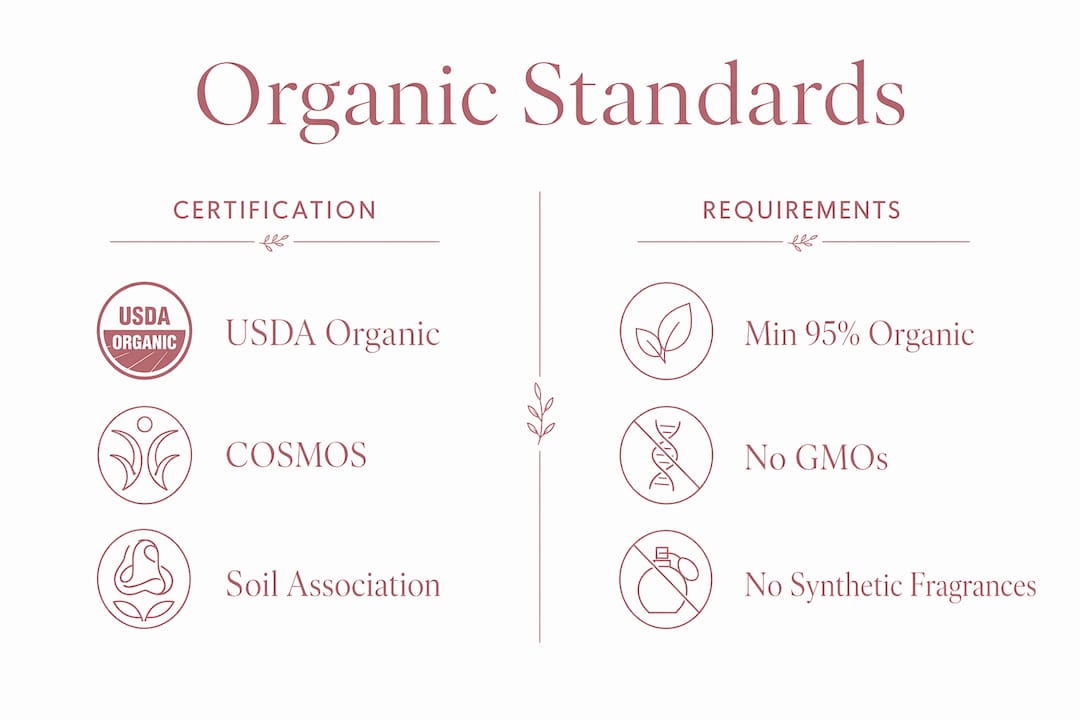
USDA Organic (United States): Governed by the National Organic Program, it covers ingredient sourcing, processing, and labeling.
COSMOS Organic (International): A European standard recognized in Australia, the UK, and beyond, administered by certifiers including ECOCERT and the Soil Association.
Soil Association (United Kingdom): One of the oldest and most rigorous organic certifiers, with standards that often exceed USDA requirements.
ECOCERT (France/International): A widely recognized certifier that audits both ingredients and manufacturing processes.
Certification | Region | Organic Content Requirement | Key Restriction |
USDA Organic | United States | 95% organic ingredients | No GMOs, synthetic pesticides |
COSMOS Organic | International | 95% natural origin, 20% organic | No petrochemicals, parabens |
Soil Association | United Kingdom | Aligns with COSMOS | No synthetic fragrances |
ECOCERT | International | Aligns with COSMOS | Sustainable sourcing required |
Certified organic skincare strictly prohibits GMOs, parabens, phthalates, synthetic fragrances, and artificial colors. These restrictions apply not just to the final formula but to every stage of production. Certification also covers the surrounding environment. If crops are exposed to pesticide-treated fields nearby, certification can be denied. That level of scrutiny goes far beyond what any “natural” label requires.
Pro Tip: When you pick up a product, look for the certification body’s logo directly on the packaging, not just the word “organic” in the product name. The logo means an auditor verified the claim.
How does certified organic skincare differ from natural or conventional products?
The word “natural” on a skincare label means almost nothing from a regulatory standpoint. Natural and clean labels are marketing terms without federal or independent oversight, unlike certified organic, which requires documented third-party audits. A brand can call a product “natural” while it contains synthetic preservatives, petrochemical derivatives, or pesticide residues.
Conventional skincare sits at the opposite end of the spectrum. Certified organic products exclude petrochemicals, synthetic additives, and potentially toxic substances commonly found in conventional formulas. Ingredients in conventional products are sourced from farms with no restriction on pesticide or herbicide use.
Category | Ingredient Sourcing | Third-Party Audit | Synthetic Chemicals Allowed |
Certified Organic | Organically farmed, traceable | Yes, required | No |
Natural | Loosely plant-derived | No | Often yes |
Conventional | No sourcing restriction | No | Yes |
A few common misconceptions are worth addressing directly:
“Chemical-free” is not possible. Water is a chemical. Every ingredient, natural or synthetic, is a chemical compound. The real distinction is whether those chemicals come from synthetic or organic sources.
“Natural” does not mean safe. Poison ivy is natural. Certification matters because it controls which natural ingredients are used and how they are processed.
Organic does not automatically mean cruelty-free. Organic certification guarantees ingredient purity but does not automatically mean ethical practices like cruelty-free. You need to look for separate cruelty-free or vegan certifications alongside the organic seal.
Understanding these differences helps you read labels with confidence rather than relying on packaging design or brand storytelling.
What are the benefits and limitations of certified organic skincare?
Certified organic skincare delivers real, measurable benefits, but it also has limits that are worth knowing before you commit to a full routine switch.
Key benefits:
Fewer synthetic residues. Organic ingredients contain fewer residues from pesticides and chemicals, which directly benefits sensitive and reactive skin types. Reducing the synthetic load in your daily routine can calm redness, reduce irritation, and support your skin barrier.
Better for sensitive skin. Organic skincare for sensitive skin is one of the most well-supported use cases. Without synthetic fragrances, artificial colors, or petrochemicals, the formula is less likely to trigger a reaction.
Environmental impact. Organic farming prohibits synthetic pesticides and fertilizers, which protects soil health, waterways, and biodiversity. Choosing certified products supports that entire ecosystem.
Ingredient transparency. Certification requires full traceability. You know where each ingredient came from and how it was processed.
Limitations to understand:
Certified organic does not mean 100% organic. A product bearing the COSMOS seal may still contain up to 5% non-organic content where certified alternatives are not available.
Preservatives are still present. Preservatives are necessary for safety in water-containing skincare. Certified organic products use preservatives derived from natural sources, such as radish root ferment or rosemary extract, rather than synthetic parabens. This is a practical safety requirement, not a compromise.
Shelf life can be shorter. Without synthetic stabilizers, some certified organic formulas have a shorter shelf life or require refrigeration.
Pro Tip: If you have reactive skin, start with a certified organic moisturizer or serum before switching your entire routine. One product at a time lets you track how your skin responds. You can read more about making that switch safely in this guide on switching to an organic routine.
How can you identify and verify certified organic skincare products?
Reading a skincare label accurately is a skill. Most people scan for the word “organic” and stop there. That approach leaves you vulnerable to misleading marketing.
Step-by-step label verification:
Look for a recognized certification logo. The USDA Organic seal, COSMOS logo, Soil Association symbol, or ECOCERT mark must appear on the packaging. A logo means an auditor verified the claim. A word does not.
Read the full product name carefully. “Organic Rose Face Cream” is not the same as a product certified by COSMOS or USDA. The word in the name is a marketing choice, not a certification.
Check the ingredient list. Certified organic ingredients are often marked with an asterisk (*) and a footnote stating “from certified organic farming.” Count how many of the top ingredients carry that mark.
Understand label tiers. Under USDA rules, “Organic” on the main label means 95%+ organic content. “Made with Organic Ingredients” means 70–95%. Neither phrase without a seal carries the same weight.
Verify the certifier directly. ECOCERT, the Soil Association, and COSMOS all maintain public databases of certified brands. If a product claims certification, you can confirm it online in under two minutes.
Consumers should look for specific certification symbols rather than vague marketing words like “natural” or “clean.” Vague terms have no regulatory oversight and no enforcement mechanism. The logo is the only reliable signal.
One detail most people miss: certification can apply at the ingredient level or the product level. An ingredient can be certified organic without the finished product being certified. Product-level certification is the higher standard. It means the entire formula, not just one hero ingredient, meets the required threshold. For a deeper look at how organic ingredients actually behave in formulas, the article on organic ingredient absorption covers the science clearly.
Key Takeaways
Certified organic skincare is defined by independent third-party certification, strict ingredient sourcing standards, and full supply chain traceability, making it fundamentally different from unregulated “natural” or “clean” claims.
Point | Details |
Certification requires auditing | USDA Organic and COSMOS both require independent third-party verification, not self-declaration. |
Organic content thresholds matter | USDA requires 95% organic ingredients for the seal; COSMOS requires 95% natural origin and 20% organic. |
“Natural” is unregulated | Natural and clean labels carry no legal requirement and no independent oversight. |
Preservatives are still used | Certified organic products use natural-source preservatives, which are necessary for safety in water-based formulas. |
Certification does not cover everything | Organic certification does not guarantee cruelty-free or vegan status; look for separate seals for those claims. |
What I’ve learned after 15 years of working with certified organic skincare
The biggest mistake I see clients make is trusting packaging design over certification logos. A beautiful amber glass bottle with botanical illustrations feels organic. It is not a guarantee. I have reviewed ingredient lists on products with “pure nature” in their name that contained synthetic fragrance and petroleum derivatives. The logo is the only thing that matters.
What I find genuinely valuable about certified organic formulas is not the marketing story. It is the exclusion list. The value in organic certification lies in the exclusion of synthetic pesticides, herbicides, and fertilizers rather than the exclusion of all chemicals. That distinction matters clinically. When I work with clients who have sensitive, reactive, or pigmentation-prone skin, reducing the synthetic load in their daily routine consistently produces calmer, more even skin over time.
My honest recommendation is to combine your organic certification check with one other ethical label. Organic plus cruelty-free gives you ingredient purity and ethical sourcing in one product. Organic plus a fair trade certification adds supply chain accountability. No single seal covers everything, but two targeted certifications together come close.
Starting an organic routine does not require replacing everything at once. Begin with the products that sit on your skin longest, your moisturizer and serum, since those have the most contact time and absorption opportunity. Cleansers rinse off and have less impact. Prioritize where the ingredients actually stay.
— chevonne
Certified organic skincare at Fundamentalskin
At Fundamentalskin, every treatment protocol is built around ingredient integrity. Chevonne’s clinical approach combines the gentleness of organic-sourced actives with the precision of professional-grade technology, so your skin gets results without unnecessary synthetic exposure.

The Biomimetic Peel + LED Therapy is a standout treatment for clients dealing with pigmentation, fine lines, and dull texture. It works with your skin’s natural repair processes using clean, clinically tested actives, with no downtime. If you want to understand what professional organic-aligned skincare looks like in practice, this is the place to start. Book your consultation with Chevonne and see what your skin looks like when it’s genuinely well cared for.
FAQ
What is the difference between organic and certified organic skincare?
Organic skincare is a broad term any brand can use without oversight. Certified organic skincare has been independently audited against a recognized standard such as USDA Organic or COSMOS, with documented proof of ingredient sourcing and processing.
Which certifications should I look for on organic skincare?
The most recognized certifications are USDA Organic, COSMOS Organic, Soil Association, and ECOCERT. Each requires third-party auditing and prohibits synthetic pesticides, GMOs, and petrochemicals.
Is certified organic skincare better for sensitive skin?
Certified organic skincare tends to be gentler for sensitive skin because it excludes synthetic fragrances, artificial colors, and petrochemicals, which are common irritants. Fewer synthetic residues in the formula means a lower risk of triggering a reaction.
Does certified organic mean the product is 100% organic?
No. Under USDA rules, a product needs at least 95% organic ingredients to display the seal. The remaining 5% may include non-organic ingredients where certified alternatives are not commercially available. COSMOS has similar thresholds with its own breakdown for natural origin and organic content.
Can a product be labeled natural without being certified organic?
Yes. “Natural” and “clean” are unregulated marketing terms with no legal definition or independent oversight. A product can use those words freely without meeting any certification standard. Only a recognized certification logo confirms that an independent auditor has verified the claim.
Recommended
Comments