.png)
Organic Skincare Explained: What It Really Means


Organic skincare is defined as products formulated predominantly with ingredients grown and processed under certified organic agricultural standards, verified by recognized certification bodies such as USDA Organic and COSMOS Organic. The term “organic” in skincare is not a vague marketing claim. It carries legal weight in most markets, requiring third-party verification that ingredients meet strict growing and processing criteria. That said, organic certification describes how ingredients are sourced, not how well a product performs. Understanding this distinction is the foundation of making smarter choices for your skin.
What is organic skincare explained by certification standards?
Certification is what separates a genuine organic product from one that simply uses the word on its label. The USDA National Organic Program requires at least 95% certified organic ingredients for a product to carry the “organic” label. Water and salt are excluded from this calculation, which means the threshold is genuinely high for the remaining ingredients. This standard is the most recognized in the United States and gives consumers a reliable benchmark.
The label wording matters more than most people realize. A product labeled “made with organic ingredients” indicates roughly 70% organic content, a meaningfully lower threshold than the full “organic” designation. Brands can also use phrases like “contains organic ingredients” for products with even lower percentages. Reading the exact label wording, not just the packaging design, tells you which tier you are actually buying.
Internationally, COSMOS Organic goes further than USDA Organic by addressing not just agricultural inputs but also complete formulation rules and packaging sustainability. USDA Organic focuses on how ingredients are grown; COSMOS Organic evaluates the entire product from farm to formula. If you are shopping for products made in Europe or Australia, COSMOS certification is the seal worth looking for.
Here is a quick breakdown of common certification tiers:
USDA Organic (95%+): Full organic label permitted; highest U.S. standard
Made with Organic Ingredients (70%+): Partial organic content; cannot display the USDA seal on the main panel
Contains Organic Ingredients (under 70%): Organic components listed individually; no seal permitted
COSMOS Organic: European standard covering formulation, processing, and packaging sustainability
Certification | Organic Threshold | Scope |
USDA Organic | 95%+ | Agricultural ingredients |
Made with Organic | 70%+ | Agricultural ingredients |
COSMOS Organic | Varies by category | Full formulation and packaging |
ACO (Australian Certified Organic) | 95%+ | Agricultural ingredients and processing |
Pro Tip: Look for the certification seal directly on the front or back panel of the product, not just in the brand’s marketing copy. A seal means a third party verified the claim.
How does organic skincare work at the formulation level?
Being organic does not exempt a product from the laws of cosmetic chemistry. Organic formulations still require controlled pH, preservation systems, and emulsion stability to be safe and effective on skin. A face cream, whether conventional or organic, needs to prevent microbial growth, maintain texture over its shelf life, and deliver ingredients to the skin at a useful concentration. The organic label changes the origin of the ingredients used to achieve these goals, not the goals themselves.
Natural preservatives like rosemary extract, vitamin E (tocopherol), and certain plant-derived alcohols are common in organic formulas. These work differently from synthetic preservatives like parabens or phenoxyethanol, and they can affect a product’s shelf life and texture. This is one reason two organic moisturizers can feel and perform very differently from each other, even if both carry the same certification seal.
Organic plant ingredients also vary in active compound concentration and stability depending on the growing season, harvest conditions, and processing method. An organically grown rosehip oil from one supplier may contain a different level of vitamin A precursors than one from another. This variability is real, and it means the organic label alone does not guarantee consistent or superior efficacy from batch to batch.
Key formulation factors that determine how an organic product actually performs:
Active concentration: The percentage of a beneficial ingredient in the formula, not just its presence
pH level: Determines whether actives like vitamin C or AHAs can function properly on skin
Emulsion type: Water-in-oil versus oil-in-water affects how the product feels and absorbs
Preservation system: Dictates shelf life and microbial safety without synthetic preservatives
Pro Tip: When evaluating any organic product, check the ingredient list for the active ingredient’s position. Ingredients are listed in descending order of concentration. If your key active appears near the bottom, its concentration is likely too low to produce visible results.
What are the real benefits and limitations of organic skincare?
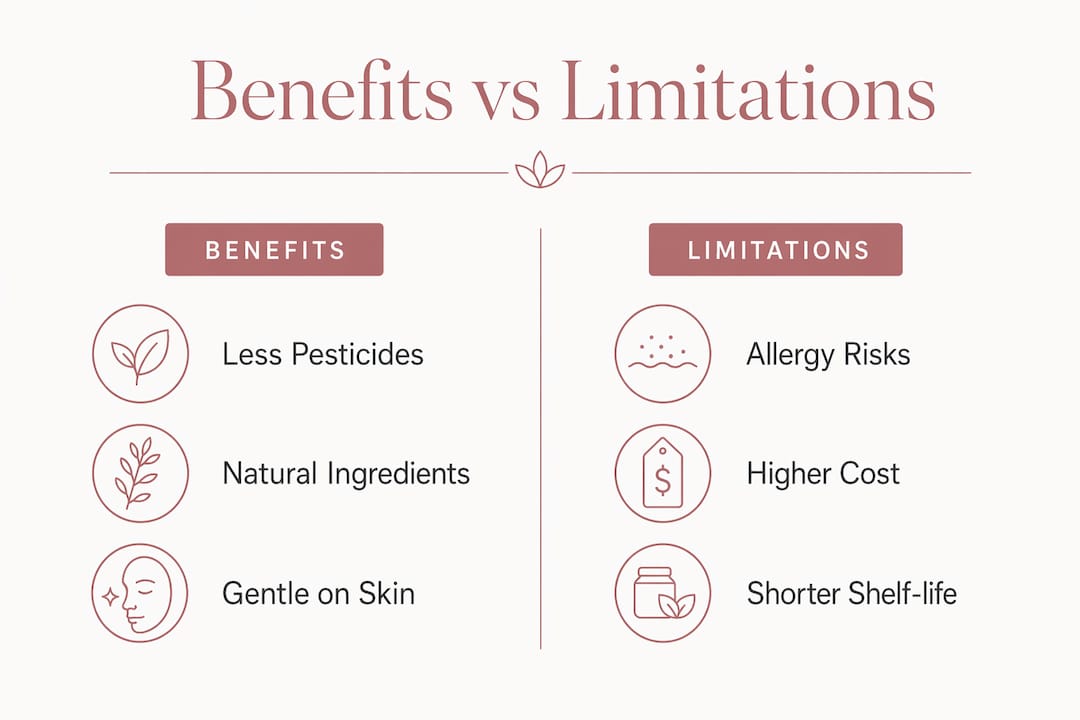
The clearest, most defensible benefit of certified organic skincare is reduced exposure to synthetic pesticide residues. Organic farming eliminates synthetic pesticides and herbicides from the growing process, which lowers the chemical residue load in the final ingredient. For people applying products to their face daily, this reduction in cumulative chemical exposure is a legitimate reason to choose organic. It does not, however, guarantee that your skin will not react to the product.
Some research suggests that organically grown plants may produce higher concentrations of certain bioactive compounds, including antioxidants, as a stress response to growing without synthetic protection. Ingredients like aloe vera and green tea have documented antioxidant and soothing effects, though the organic certification of those ingredients does not automatically amplify those benefits. Formulation quality and ingredient concentration remain the deciding factors.
The environmental case for organic skincare is also real. Organic farming reduces synthetic chemical runoff into soil and waterways, supports biodiversity, and typically involves more sustainable land management practices. Choosing certified organic products, particularly those with COSMOS certification that also addresses packaging, extends your environmental impact beyond your own skin.
“Organic certification adds accountability that unregulated terms like ‘natural’ simply cannot provide. It means a third party has verified the claim, not just the brand.” — Kalahari Rose
Benefit | Evidence Level | Limitation |
Reduced pesticide residues | Strong (farming data) | Does not prevent all skin reactions |
Higher antioxidant content | Moderate (some plant studies) | Depends on formulation and concentration |
Environmental sustainability | Strong (farming practices) | Packaging sustainability varies by brand |
Gentler on sensitive skin | Weak (no clinical consensus) | Natural ingredients can still cause irritation |
How does organic skincare compare to natural and conventional options?
“Natural” and “organic” are not interchangeable, and the difference matters when you are choosing products. “Natural” cosmetic claims are largely unregulated in the United States and Australia. A brand can label a product “natural” without any third-party verification, and the formula can still contain synthetic additives, preservatives, or fragrances. Organic certification, by contrast, restricts the use of synthetic inputs and requires documented traceability. That accountability is the core distinction.
“Clean beauty” sits in a similar gray area. The term has no legal definition and no governing standard. Different retailers define it differently. Sephora’s Clean at Sephora program, for example, excludes certain ingredients but does not require organic certification. A product can be “clean” by one retailer’s definition and contain non-organic ingredients throughout. For consumers who want verified claims, natural skincare ingredients guidance and organic certification are more reliable reference points than marketing categories.
Conventional skincare uses synthetic and naturally derived ingredients without restriction, optimized for stability, texture, and clinical performance. Many conventional products contain well-researched actives like retinol, niacinamide, and hyaluronic acid at clinically tested concentrations. Organic products can include these ingredients if they meet sourcing standards, but the formulation constraints of organic certification sometimes limit the concentration or form of actives available.
Tips for reading labels effectively:
Check the full ingredient list (INCI list), not just the front-of-pack claims
Identify whether the certification seal is present and which body issued it
Look for the position of key actives in the ingredient list
Distinguish between “organic” and “made with organic ingredients” on the label
Research the certifying body if you are unfamiliar with the seal shown
Is organic skincare right for your skin type?
Organic skincare suits many skin types, but the transition requires patience. Switching from conventional to organic products can temporarily disrupt your skin barrier and microbiome, producing short-term reactions like mild breakouts, dryness, or redness. This is not necessarily a sign that the product is wrong for you. It often reflects your skin adjusting to a different preservation system, different lipid profile, or the absence of ingredients it had adapted to.
Here is how to introduce organic skincare safely based on your skin type:
Oily or acne-prone skin: Start with a lightweight organic gel cleanser or serum. Avoid heavy plant oils like coconut or marula initially, as these can block pores for some skin types. Introduce one product at a time.
Dry or mature skin: Organic facial oils and balms rich in omega fatty acids, such as rosehip or sea buckthorn, suit this type well. Introduce a new product every two weeks to monitor tolerance.
Sensitive or reactive skin: Patch test every new product on your inner arm for 48 hours before applying to your face. Fragrance-free organic formulas are the safest starting point. Gradual introduction over two to three weeks reduces the risk of overloading your skin.
Combination skin: Focus on balancing formulas. An organic niacinamide serum or a light botanical moisturizer works well across the T-zone and drier areas without tipping either zone into imbalance.
Aging or pigmented skin: Look for professional-grade organic formulations that combine plant actives with skilled formulation science. Organic vitamin C serums and peptide-rich creams can support collagen and brightness when used consistently.
Pro Tip: Build your organic routine around your skin’s primary concern first, not the most appealing product. If pigmentation is your focus, start with a targeted organic vitamin C or kojic acid formula before adding other steps. A focused routine produces clearer results than a full overhaul at once.
For a step-by-step approach to transitioning safely, the guide on switching to organic skincare covers label reading, product sequencing, and what to expect in the first month.
Key takeaways
Organic skincare is defined by certified ingredient sourcing, not marketing language, and its real value lies in reduced synthetic chemical exposure, environmental accountability, and formulation transparency when paired with quality science.
Point | Details |
Certification defines organic | USDA Organic requires 95%+ certified ingredients; label wording reveals the actual tier. |
Formulation science still applies | Organic products need pH control, preservation, and emulsion stability to be safe and effective. |
Benefits are real but specific | Reduced pesticide residues and environmental impact are the strongest evidence-based advantages. |
“Natural” is not the same as organic | Natural claims are unregulated; organic certification requires third-party verification. |
Skin type guides product choice | Introduce organic products gradually over two to three weeks, one product at a time. |
What I’ve learned after 15 years of working with organic skincare
After more than a decade working with clients across every skin type and concern, the most common misconception I see is this: people assume that “organic” means “gentle” and “conventional” means “harsh.” Neither is reliably true. I have seen clients react to organic essential oils and thrive on well-formulated conventional serums. I have also seen the reverse. The label tells you about ingredient sourcing. It does not tell you how your skin will respond.
What I do believe, based on clinical experience and the evidence, is that certified organic products offer something genuinely valuable: accountability. When a product carries USDA Organic or COSMOS Organic certification, a third party has verified the supply chain. That traceability matters, especially for clients with sensitivities who need to know exactly what is going into their formula.
My practical advice is to treat organic skincare like any other formulation decision. Evaluate it by stability, active concentration, pH appropriateness, and fit for your skin’s current state. For clients dealing with pigmentation, aging skin, or redness, I always recommend pairing a quality organic home routine with clinical skincare treatment that addresses deeper structural concerns. Products alone, organic or not, work best when they complement professional care. Consistency and patience will always outperform the latest label trend.
— chevonne
Ready to take your skin further than products alone?
If you are exploring organic skincare because your skin needs real, lasting change, products are a strong foundation but not the whole picture. At Fundamentalskin, Chevonne combines 15 years of dermal clinician expertise with advanced, non-invasive treatments designed specifically for women dealing with pigmentation, aging skin, redness, and dull texture.

The Biomimetic Peel + LED Therapy works alongside your organic skincare routine to support skin barrier function, stimulate collagen, and address concerns that topical products cannot reach alone. Results are visible, documented, and achieved without downtime. If you are ready to see what your skin is genuinely capable of, explore the full range of professional facial treatments at Fundamentalskin and book a personalized consultation today.
FAQ
What is the difference between organic and natural skincare?
Organic skincare requires third-party certification verifying that at least 95% of ingredients meet certified agricultural standards. Natural skincare claims are unregulated and carry no mandatory verification, meaning a “natural” product can still contain synthetic additives.
Does organic skincare work better than conventional skincare?
Organic certification does not guarantee superior clinical performance. Benefits depend on formulation quality, active ingredient concentration, and how well the product suits your skin type, not the organic label alone.
Can organic skincare cause skin reactions?
Yes. Natural and organic ingredients, including essential oils, plant extracts, and rich botanical oils, can trigger reactions in sensitive skin. Patch testing every new product for 48 hours before full application reduces this risk.
How do I know if an organic skincare product is genuinely certified?
Look for a recognized certification seal on the packaging, such as USDA Organic, COSMOS Organic, or ACO (Australian Certified Organic). The seal confirms third-party verification. Marketing language without a seal is not a substitute.
How long does it take to see results from an organic skincare routine?
Most skin types need four to eight weeks of consistent use before meaningful changes in texture, tone, or hydration become visible. Introducing products gradually over two to three weeks and maintaining daily consistency produces the most reliable outcomes.
Recommended
Comments